
Federally supported Stem Cell Network is developing world-first “curative” stem cell therapies for many diseases

The Ottawa-based Stem Cell Network has used most of $45 million in federal funding to support Canadian researchers who’ve developed “world-first” new technologies and life-saving new therapies, says the head of the network.
 In addition, the funding has helped train the next generations of stem cell scientists and strengthen dozens of pioneering stem cell startup companies, Cate Murray (photo at right), president and CEO of the national not-for-profit Stem Cell Network, said in an interview with Research Money.
The Stem Cell Network community “is the world's driving force and regenerative medicine,” she said. “The field is huge, and it came from Canadians [and their research].”
Regenerative medicine began with Canadians proving the existence of stem cells, and moving through to being at the leading edge of providing therapies and technologies “that will change people's lives, that will change the way care is delivered,” Murray said.
The Stem Cell Network is celebrating its 25th anniversary, including with an impact report that includes an international survey, a bibliometric analysis and a training assessment.
Stem cell therapy uses the body's own stem cells or donor cells to repair, replace or regenerate damaged tissues and organs – aiming to heal injuries or diseases at a cellular level.
Canadian scientists James Till and Ernest McCullough, working at the University of Toronto/Ontario Cancer Institute, discovered stem cells in the early 1960s, Murray noted.
They made their discovery while studying mouse bone marrow, identifying hematopoietic stem cells and defining their ability to self-renew and differentiate, a finding that launched modern stem cell science and regenerative medicine.
Till and McCullough proved these cells could form colonies in the spleen of irradiated mice, demonstrating their unique properties.
University of Calgary scientist Samuel Weiss showed in experiments with mice in 1992 that the central nervous system of mammals contains neural stem cells capable of replicating normal cell types, including neurons.
Weiss’s discovery of the metabotropic glutamate receptor remains a defining moment in establishing neurogenesis research as a pathway to exploring treatments for Parkinson’s, Alzheimer’s, stroke, ALS, and multiple sclerosis through neurological repair.
The promise of stem cell therapy is now becoming a reality, Murray said.
The Stem Cell Network invested $28.4 million of the $45 million in federal funding, provided from April 2022 through to 2025, into 56 research projects and clinical trials, she said.
Industry and other partners contributed an additional $31.8 million to the network’s projects.
The funding supported 550-plus researchers, clinicians and trainees at 22 different research organizations across the country.
The Stem Cell Network used the remaining $16.6 million of federal funding for training, including about 8,000 PhD students and post-docs, and knowledge mobilization work, Murray said. Knowledge mobilization programming covers everything from engaging with high school students to get them to pursue stem cell research, to supporting policy initiatives on things like access, affordability and adoption of regenerative medicine, or fighting misinformation.
So how do taxpayers know they received value from that public funding?
Murray said the Stem Cell Network must first meet all the planning and reporting requirements that it is has through its contracts.
The network also does performance audits or compliance audits where a contracted third party ensures the Stem Cell Network is complying with all the appropriate federal laws and guidelines, not-for-profit laws and regulations.
When it comes to deciding which research to fund, the network uses a peer-review system, including Canadian and international experts, that looks at scientific integrity and project quality and follows projects all the way from the idea to the outcomes, Murray said. These are experts in applicable areas of expertise, such as cardiovascular, bioengineering, clinical research and others.
After being reviewed by peers, proposed projects go to the Stem Cell Network’s Research Management Committee, a group of about a dozen stem cell experts from across the country and some from the U.S. This committee looks at the projects’ strategic fit and potential for commercialization.
The Stem Cell Network has a translational focus, Murray said. “So we want to be able to have our Research Management Committee give us a sense the potential of this research moving forward and translating [into commercial products] and getting into clinics.”
The Research Management Committee also looks at proposed projects from the view of “What's the vision of the network, what's the mandate, what are we trying to do?” she said.
Research projects undergo continual assessment
The Research Management Committee supports the Stem Cell Network in its continual review of funded projects. This includes milestones where principal investigators have to report on their projects and their status, including how the project is proceeding and what early results might be available.
Along with submitting written reports, with some of the bigger projects the principal investigators are asked to present their project research to date to the network’s Research Management Committee, whose members provide scientific feedback including how to strengthen the project.
These continual reviews enable the Stem Cell Network to determine if a project has stalled and isn’t going anywhere, in which case the network can stop funding at the recommendation of the Research Management Committee.
“Or they can also say, on the flip side, this project is doing really well, and if there were any extra resources it could benefit from a top-up. And the [network’s] board should consider that,” Murray said.
All projects also must regularly provide financial updates on what the funding has been used for and what the anticipated spending will be.
Criteria used during the continual review process can include intellectual property generated, journal publications, the next stage of the research, the partners attracted, and other measures.
On top of this due diligence and accountability, the Stem Cell Network does five-year impact assessments of the projects it funds.
These assessments include looking at bibliometrics, an international survey of experts across the country, tracking funded trainees’ career progression, and assessing what the trends are in the research activity – “so you get a sense of return on investment,” Murray said.
“Stem cells technology has really fuelled the field of regenerative medicine, and regenerative medicine is cross-cutting,” she said.
“It has value form chronic disease areas for addressing illness or injury. It’s really a platform,” she added.
Network-supported research’s impact on patients
So what does the Stem Cell Network’s return on investment actually look like in terms of new stem cell technologies and therapies that benefit patients and grow Canada’s stem cell industry? Murray highlighted four examples.
Last week, Vancouver-based Aspect Biosystems and Denmark-headquartered Novo Nordisk entered a new phase of their partnership to develop advanced cellular medicines for diabetes.
About 300,000 Canadians have type 1 diabetes, impacting about one in 21 families, with approximately 12,000 new cases diagnosed annually.
Aspect Biosystems has acquired rights to stem cell-derived islet cell and hypo-immune cell engineering technologies from Novo Nordisk and will lead development, manufacturing and commercialization.
“It was some of our research support that actually provided the foundation for that partnership,” Murray noted. “The research we did with them and supported really catalyzed their story and their growth.”
“When you now look at where Aspect is and what it's going to be, it's going to become potentially a Canadian-based pharma [company]. It’s going to at least become an anchor company,” she added.
“For type 1 diabetes, we will see a functional cure come, one that won't require immunosuppression, which is going to be really important for those kids who have Type 1 diabetes,” Murray predicted.
Another example is Montreal-based ExCellThera, which is developing a small molecule technology called UM171.
Blood cancers, including leukemia, lymphoma and myeloma, affect more than 4 million people worldwide, including 90,000 to 138,000 in Canada. Approximately 1.24 million new cases of blood cancer globally are diagnosed annually, accounting for about six percent of all cancer cases.
However, the challenge with blood cancers for stem cell therapy is that the umbilical cord stem cells used in allogenic stem cell transplants contain very low amounts of stem cells.
 Guy Sauvageau (photo at right), a hematologist at Maisonneuve-Rosemont Hospital, professor of medicine at Universitié de Montréal, and ExCellThera’s scientific founder and CEO, assembled a multi-disciplinary team to address the problem and develop the UM171 cell therapy.
The UM171 molecule enables the expansion of umbilical cord blood, stem and immune cells, Murray said. “It increases the number and the functional quality of the stem cells.”
ExCellThera’s product, branded as Zecelpro (international proprietary name is dorocubicell) has been approved to enter the European market.
“It’s going to be available for adult patients with blood malignancies who are requiring a stem cell transplant, but there's no suitable donor out there,” Murray said.
A Canadian manufacturer, Centre C3i, will manufacture ExCellThera’s product in Montreal.
The Stem Cell Network supported Sauvageau and his team’s research and technology development for close to 25 years, “from the problem through to the patient,” including some early clinical trials that helped compile the data required for European approval, she noted.
“This [therapy] is going to give real-world hope to patients,” Murray said. “So my fingers are crossed that this is going to be a therapy that will get brought into the Canadian market and will get through our regulatory system.”
Long-term investment required for “durable, curative” therapies
The third example is in the area of pediatrics and a condition called bronchial pulmonary dysplasia (BPD). Babies born prematurely commonly have underdeveloped lungs and are at risk of developing BPD.
BPD affects neurological development, including eyesight, organs and cognitive skills, Murray said. “It will be debilitating for that child over the course of their lifetime and for their parents and they will be in the hospital regularly.”
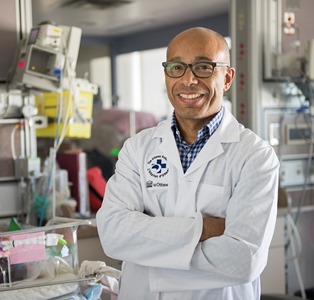 Bernard Thébaud (photo at right), a neonatologist in the Department of Pediatrics at The Ottawa Hospital and the Children’s Hospital of Eastern Ontario, and a professor of pediatrics at the University of Ottawa, saw the impacts of BDP and he was determined to address the condition.
 He and his team developed a stem cell transplant therapy that has now been provided to 10 babies. The first baby who received the therapy is named Emmy and she is now about two years old. (Photo of Emmy and Bernard Thébaud at left. Photo by Sarah Bradley @ iShootEvents).
Emmy and her parents came to the Stem Cell Network’s large conference last  November, Murray said. “So Emmy was there sitting at the table and she says on the microphone to the whole group, ‘Hi, friends.’ And everybody cheered.” (Photo of Emmy and her parents Alicia and Mike at right. Photo by Sarah Bradley @ iShootEvents).
“This little girl is meeting all of her [developmental] milestones because of this stem cell therapy. It gives me goosebumps,” Murray said.
“And then additionally, with this type of therapy, now that little girl's not going to be in and out of hospital. Think of the healthcare savings that come from that,” she added.
“Think about the fact that her parents can choose to have full time jobs while their child is healthy and in daycare and at school and progressing through life, instead of having to be at home and be giving constant care.”
The Stem Cell Network has supported Thébaud’s research and the development of the therapy for many years, she said. “It is a world-first. This has not been done in other countries.”
Thébaud originally used an international supplier for the manufactured stem cells. However, he has worked with the Ottawa Hospital’s Biotherapeutics Manufacturing Centre so that the product now can be made there, without the need for offshore production.
One of the Stem Cell Network’s goals is to build Canada’s stem cell manufacturing capacity and train highly qualified personnel and the next generations of stem cell scientists, Murray said.
The network continues to support Thébaud’s clinical trials. He is also looking at developing a gene therapy approach for people with underdeveloped lungs and patients with diseases like cystic fibrosis.
The fourth example Murray pointed to involves the area of muscular dystrophies, a group of over 150 types of these progressive muscle-weakening conditions, which affect 50,000 Canadians.
 Michael Rudnicki (photo at right), senior scientist, regenerative medicine at the Ottawa Hospital Research Institute, and a professor of medicine and cellular and molecular medicine at the University of Ottawa, started down a research direction that many naysayers contended wouldn’t work.
Rudnicki proved them wrong, and he has developed a small molecule drug for a gene therapy approach to diseases like Duchenne muscular dystrophy.
Rudnicki created a startup, Satellos Bioscience, that has now completed an early phase-one clinical trial and is gearing to start multi-site, phase-two clinical trials.
Duchene muscular dystrophy affects mostly young boys and men and their lifespan is cut short and it's debilitating, Murray said. “It just takes away all their independence and their quality of life and for them and their families and their friends. It’s a tragedy.”
If the drug developed by Rudnicki proves effective, “it’s is game-changing for people with muscular dystrophies,” she said.
The Stem Cell Network has been supporting Rudnicki’s research and development of the drug for more than 30 years.
Developing durable and curative stem cell technologies and therapies “is not a short journey. But putting in the work and the effort, putting in the investment, it's worthwhile because it's going to save lives and it creates jobs,” Murray said.
“So we can’t be short-sighted and we can't be short-minded about investing in regenerative medicine,” she said.
“We have to understand that it’s going to take that 20-year time frame or that 30-year time frame. It’s a true investment in patients. It's an investment in changing the way our healthcare system operates.”
By the Numbers
Since being established 25 years ago, the Stem Cell Network has:
- Invested $162 million in research, training and outreach.
- Leveraged $176 million in research partnerships.
- Trained 7,900+ people, 88 percent of who opted to remain and work in Canada.
- Supported 280+ translational research projects.
- Funded or catalyzed 30 clinical trials.
- Supported 181 peer-reviewed publications by 1,089 authors across Canada.
- Researched 26 disease areas.
- Helped catalyze and strengthen more than 28 biotechnology companies, with 237 patents issued and 126 licences granted.
Stem Cell Network-funded Research Database (list of research projects and clinical trials funded).
R$




Events For Leaders in
Science, Tech, Innovation, and Policy
Discuss and learn from those in the know at our virtual and in-person events.
See Upcoming Events
You have 0 free articles remaining.
Don't miss out - start your free trial today.
Start your FREE trial Already a member? Log in
By using this website, you agree to our use of cookies. We use cookies to provide you with a great experience and to help our website run effectively in accordance with our Privacy Policy and Terms of Service.