
Government failed to learn previous policy lessons in creating the innovation “superclusters” program

Editor’s note: This is Part 1 of a two-part story on a study by David Wolfe and Travis Southin that looked at policy learning and development in innovation policy, in Canada’s innovation clusters initiative. Part 2 will be published on June 24, 2026. See also the accompanying story, “Government’s lack of ‘policy memory’ led to a flawed federal innovation clusters program,” in today’s Innovation This Week.
The federal government’s creation of the innovation “superclusters” program failed to learn from a previous effort to create national clusters and was driven mainly by politicized regional considerations, according to a study by David Wolfe and Travis Southin.
“In the end, regional distribution won out over strategic technology or cluster criteria,” they said in their study, published in Canadian Public Administration.
People interviewed for the study felt the politics of regionalism impacted the design and implementation of the ISI/GICs (Innovation Superclusters Initiative, later renamed the Global Innovation Clusters program), with the result that funding was spread more evenly across Canada's regions than originally intended, Wolfe and Southin said.
“The regional distribution ran contrary to the original intent of making a small number of big bets on leading edge technologies, with one ISED (Innovation, Science, and Economic Development Canada) interviewee noting that the original plan of picking one to three consortia was expanded to five to avoid political backlash,” according to their study.
“Canada's preoccupation with ensuring an equitable regional distribution of spending across the country may have influenced the selection of consortia more than the desire to target globally competitive clusters of firms with the potential to expand their share of export markets,” the study said.
There was an unwillingness by policymakers to support existing geographic and sectoral areas of strength – a key criteria of effective cluster policy, the authors noted.
“The key argument in this [study] is that the federal public service lacks organizational mechanisms to capture lessons learned from previous policy experiments and incorporate them in subsequent policy development,” Wolfe and Southin said.
They concluded: “No single strand of the literature can fully describe the ways in which the superclusters initiative can help reverse Canada's downward innovation spiral . . . The lens needed to understand how the superclusters operate, to measure whether they achieve their goals, and to evaluate their performance does not yet exist.”
Wolfe is professor emeritus of pollical science and co-director of the Innovation Policy Lab at the Munk School of Global Affairs & Public Policy at the University of Toronto (U of T). Southin at the time of the study was a PhD candidate at U of T.
Their core argument is that the experience of an earlier policy initiative to create a national clusters program offered valuable lessons for Canada’s clusters initiative, but federal policymakers lacked the expertise to learn from and apply these lessons.
The Innovation Superclusters Initiative (ISI) was introduced with great fanfare in 2017 and renamed as Global Innovation Clusters (GICs) in 2022, with little reference to a previous cluster program delivered by the National Research Council in the early 2000s.
Both the ISI and GIC aimed to remedy Canada's comparatively low levels of gross expenditure on business research and development. “Ironically, neither seems to have improved that performance,” the authors noted.
Their study is based on two distinct bodies of research. Data for the first case study comes from a national research project of 26 industrial clusters across Canada that included the National Research Council (NRC) as an active partner.
The second case study draws from 75 interviews conducted with government policymakers and external stakeholders to analyze the ISI/GIC initiative.
A qualitative analysis of the interviews identified the process of policy development and the role of key actors inside the public service and in broader policy networks.
Over the past three decades, cluster policy has emerged as a key instrument in the innovation policy mix, Wolfe and Southin said. A growing body of research documents the positive returns generated by cluster for constituent firms and the regional economies in which they are embedded.
Clusters are defined as: geographic concentrations of interconnected companies, specialized suppliers and service providers in related industries, as well as associated institutions (trade associations, universities, standards agencies) in a particular field that compete but also cooperate.
A considerable body of research demonstrates that a firm's presence in a cluster results in its productivity being higher than similar firms located elsewhere, the authors noted. Firms in clusters are more inventive and innovative than those not located in a cluster.
Clusters support the process of new firm formation and entrepreneurship. Industries in regions with strong clusters experience higher rates of new business startups and employment growth. Firms co-located with other firms in the same industry also experience higher rates of productivity growth.
Also, city-regions with a higher percentage of employment in clusters perform better in terms of income levels and employment growth than those with lower concentrations of cluster-based employment.
“Cluster initiatives promote linkages between firms, universities and research institutes, and help firms take advantage of market opportunities,” Wolfe and Southin said. They also afford opportunities for small and medium-sized firms to connect with larger partners and multinational firms.
Factors that support the growth and development of clusters
In the mid-1990s, the NRC commissioned research on the factors that support the growth and development of industrial clusters.
The report identified several factors critical for cluster development, including: the presence of local champions with greater vision beyond single firm success; the existence of a strong science and technology knowledge infrastructure, including research universities, government laboratories and cooperative research centres; the involvement of local networking facilitators who promote relationships within the cluster; and sustained, aligned development strategies by local institutions and governments.
Missing in almost all cases in the NRC-led cluster initiative was the presence of local networking facilitators, or CMOs, to promote the relationships within the cluster – identified as a key factor for cluster development.
Integrating cluster initiatives with the broader policy mix to ensure alignment across a range of instruments may work best through the agency of local CMOs, which were also missing in the ICI/GIC cluster initiative launched in 2017.
“The experience of NRC's CI (cluster initiative) underlines the need for attention to the role of cluster governance mechanisms that can enable the participation of multiple actors at the local level,” Wolfe and Southin’s study noted.
One key lesson from the NRC CI experience was that successful implementation of a cluster program requires the allocation of additional resources for the governance function, as well as the presence and training of personnel who understand cluster dynamics and governance.
In 2010, the federal Science, Technology and Innovation Council (STIC), an advisory body to the minister of Industry and the Minister of State for Science and Technology, was tasked with reviewing the NRC CI, making recommendations as to whether it should be continued, and the most effective policies for cluster development in Canada.
The STIC evaluation noted that regional development considerations seemed to have outweighed other factors, such as the international standing and competitiveness of individual clusters, in determining the location of the initiatives.
The STIC evaluation also recommended that a future clusters program should focus on a maximum of 10 clusters, selected on the basis of sufficient sales by cluster firms as evidence of the size and scale of the cluster.
“Cluster leadership should be a critical factor in selecting these initiatives, with a prominent role for industry organizations, academic institutions and other levels of government,” according to the evaluation.
The STIC recommendations emphasized the central role for industry-led cluster coordination organizations, CMOs, in selecting future initiatives to support. It also recognized the need for policy alignment, as articulated in an Organisation for Economic Development and Co-operation (OECD) report on Canada’s ICI/GIC initiative.
Also recommended was that funding be provided to SMEs through other federal policies, such as the Industrial Research Assistance Program and the Business Development Bank, to strengthen linkages to larger firms in the cluster. “This was viewed as critical for accelerating the time needed for companies to expand into global markets.”
In the end, the STIC's recommendations proved to be moot. The government appointed a new president (John R. McDougall) of NRC in 2010 who instituted a major overhaul of the organization, doing away with its long-established institute structure and focus on conducting basic research.
Institute budgets were reallocated to a suite of flagship programs that cut across organizational boundaries. The aim of the reorganization was to shift NRC's focus from the conduct of basic research in the institutes towards industry-relevant technology development and commercialization.
“Canada's first experiment with a national cluster program effectively ended with the reorganization,” Wolfe and Southin said.
How the federal “superclusters” program was implemented
In the lead up to the federal election of 2015, preliminary work for the Liberal platform included a separate piece on innovation policy, with a strong emphasis on reintroducing a cluster program at the national level.
Canada's “low density of networks and clusters” was evidenced by “World Economic Forum and OECD data from 2018 [that] indicates Canada ranks 16th in the state of cluster development, 19th for collaboration among businesses, and 19th in university-industry collaboration.”
Budget 2017 allocated $950 million over five years to “be provided on a competitive basis in support of a small number of business-led innovation ‘superclusters’ that have the greatest potential to accelerate economic growth”
Innovation, Science and Economic Development Canada (ISED) organized a competitive bidding process for consortia to receive a portion of the funds to establish the superclusters. The selection process was long and complex, with the first phase attracting more than 50 letters of intent.
Officials from several departments and agencies conducted the initial assessments. Of these, nine applicants were invited to submit detailed proposals in the next phase.
In this round, outside experts joined government officials to recommend five winners. After an extensive negotiation process with ISED and Treasury Board Secretariat, the successful consortia were structured with boards composed of member firms. Ottawa subsequently awarded funding to projects proposed by member firms (including at least one SME) with matching funds from industry.
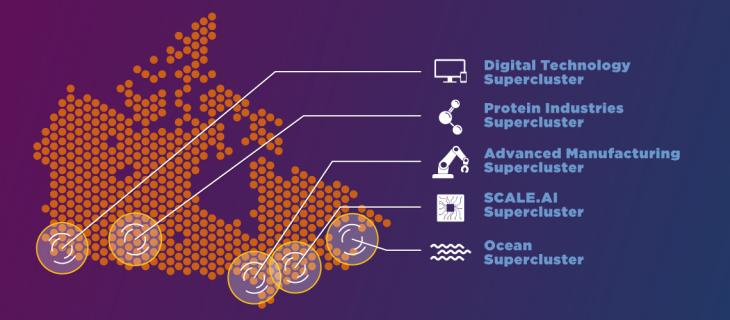
While the criteria did not specify such a requirement, winning bids were located in each of Canada's five regions: one on Digital Technology (British Columbia), Protein Industries Canada (Prairies), Next Generation Manufacturing (Ontario), Scale Artificial Intelligence, or Scale AI (Quebec), and Ocean (Atlantic Canada).
Former deputy minister John Knubley suggested that notions of regional equality may have animated the selection process as much as the desire to enhance existing areas of strength: the choice of five superclusters reflected the desire to ensure cluster activity beyond traditional urban technology centres.
Budget 2022 changed the name to Global Innovation Clusters (GICs) and extended the program with an additional $750 million in funding through 2028. The new funding was distributed on a competitive basis among the existing five clusters, which each received between $125 million to $177 million.
In announcing the program extension, ISED noted that the innovation clusters had adopted the following common missions: expanding their global presence; collaborating among the clusters to deepen their impact; fighting climate change; building more resilient supply chains; and supporting the growth and scale-up of Canadian companies.
The clusters would also aim to increase industry co-investment by raising their industry match ratio, resulting in further positive impact on job creation and GDP.
“The concept of strengthening geographically-based clusters was notably absent,” Wolfe and Southin noted.
How should the federal clusters program be assessed?
The discussion of the ISI/GIC program raises questions about the basis on which the clusters should be assessed and the degree of policy learning involved in their design, they said.
Should they be evaluated in terms of the original 2016 commitment to create a program to support networking and clusters among Canadian innovative and high-growth firms? Or should they be judged as an industry-led research program along lines consistent with ISED's consultation process and the 2017 Advisory Council on Economic Growth (ACEG) report?
One stream of analysis links the ISI/GIC to studies of place-based economic development, grounding the program in the literature on spatial dynamics, including industrial clusters, regional innovation systems, and entrepreneurial ecosystems.
This effort is frustrated by the lack of clarity around the nature of the program, including the lack of an actual definition of “superclusters,” Wolfe and Southin said.
The conceptual confusion around program definition and objectives makes it difficult to assess whether the program has achieved its objectives, they said.
Another analysis of the program also struggles with the ambiguity and contradictions in its design.
Wolfe and Southin noted that although the term “cluster” is embedded in the program's name, the ISI/GICs are not geographically constrained, with many of the constituent firms belonging to larger networks of national and international firms, consistent with the ACEG's proposal for “innovation marketplaces.”
“Thus, they fail to embody some of the key aspects of industrial clusters discussed above,” they said.
This conceptual confusion is reflected in the most recent evaluation of the GICs commissioned by ISED and done by Ernst & Young LLP, which uses terms from the different frames of clusters interchangeably, according to Wolfe’s and Southin’s report.
Further evidence of the spatial ambiguity of the ISI/GICs is found in the varying degrees of local versus national consortia partners.
For Scale AI, 56 percent of its initial projects were in Quebec, with 22 percent in Ontario. This was described as a product of investments being “made in geographies with a strong AI solution provider.” Scale AI has added a Waterloo office in addition to its Montreal headquarters.
For the Oceans Supercluster, 64 percent of project partners were from Atlantic Canada, with 36 percent in Nova Scotia, 21 percent in Newfoundland & Labrador, six percent in New Brunswick, and two percent in Prince Edward Island.
Next Generation Manufacturing reports that 62 percent of it partners were based in Ontario, 12 percent in Quebec, nine percent in British Columbia, nine percent in the prairie provinces, and seven percent in Atlantic Canada. The other two GICs do not provide a regional break down of their membership.
“It is little wonder that cluster analysts have struggled to understand and assess the initiative,” Wolfe and Southin said.
Few lessons learned and lack of trust hindered clusters’ implementation
From the authors’ perspective, a key issue is the degree to which lessons drawn from the cluster policy literature and prior evaluations of the NRC CI initiative were incorporated into the ISI/GIC program.
Some interviewees felt that ISED's desire to invest in emerging and cross-cutting technologies came at the expense of enhancing clusters of existing strength.
One interviewee lamented that the open-call approach lacked a level of intentionality in that it overlooked strategic innovation and technology assets. They regarded this as the result of too little strategic mapping of assets, saying: “. . . foresight? steering? No such document exists, even in ISED documents on the Innovation and Skills Plan.”
Interviewees felt the sectoral focus was diluted further by the government's insistence that winning bids incorporate members of runner-up consortia. This was described by a firm as resulting in overly broad superclusters without a specific focus on a technology or sector.
The resulting project portfolios spread funding widely across sectors, particularly for the Digital and Next Generation Manufacturing ISI/GICs.
The ISI/GICs were established as industry-led consortia empowered to select firm-based research projects. This design reflected ISED's belief that by listening to “what [industry] tell us needs to be done, we are actually going to get more for our money,” according to one interviewee.
However, initial tensions between ISED and the consortia delayed the launch of the consortia. Multiple interviewees attributed a significant portion of this tension to the scrutiny ISED was under from the Treasury Board Secretariat, with one interviewee saying: “. . . they are so afraid of backlash from picking the winners, they had to make the process too stringent and too unrealistic.”
Much of the ensuing delay stemmed from negotiations over conditions precedent for releasing the funds to the organizations.
An initial assessment of the program by the Parliamentary Budget Office indicated that the program was very slow to launch and substantially underspent its budget allocation in the first two years of operation. This delay was attributed to the challenge of getting the governance structures in place and the complexity of negotiating IP agreements for each consortium.
One interviewee summarized the lack of trust animating the relationship between ISED, central agencies and the clusters as “the pressure on the bureaucrats to account for every dollar spent put enormous pressure on ISED officials to micromanage an initiative.”
Assembling consortia of new actors, rather than building on existing cluster organizations, proved challenging.
Intellectual property agreements were another source of tension, with ISED wanting to ensure that publicly funded IP was as broadly accessible as possible.
Ultimately, the IP sharing conditions were left to the companies in each project to negotiate, with the requirement that foreground IP generated in the project be shared among participants in a manner agreed to by consortia firms.
Reflecting on the delay in establishing the consortia, one interviewee highlighted hesitancy and lack of trust on the part of business as a surprisingly difficult barrier: “Some of the major lessons that I have learned are it takes a lot of time and a lot of work with companies to get them to see the common interests in what they are doing and make sure that they are okay with the IP arrangements, and the funding arrangements, and everything else.”
Deputy Minister John Knubley noted that lack of trust on the government side was also a factor: “The Government of Canada introduced requirements that were perhaps too rigorous, some driven by the Treasury Board, concerning board composition, how to flow funding, and annual reporting, focusing on accountability to taxpayers. In hindsight, there might have been more flexibility as Superclusters were set up”
The Social Sciences and Humanities Research Council of Canada supported Wolfe’s and Travis’s research.




Events For Leaders in
Science, Tech, Innovation, and Policy
Discuss and learn from those in the know at our virtual and in-person events.
See Upcoming Events
You have 0 free articles remaining.
Don't miss out - start your free trial today.
Start your FREE trial Already a member? Log in
By using this website, you agree to our use of cookies. We use cookies to provide you with a great experience and to help our website run effectively in accordance with our Privacy Policy and Terms of Service.