
Engineering a quantum computing system “from the ground up:” Q&A interview with Stephanie Simmons at Photonic

Coquitlam, B.C-based Photonic Inc. grew out of an ambitious vision – to engineer a scalable solution for quantum computing from the ground up.
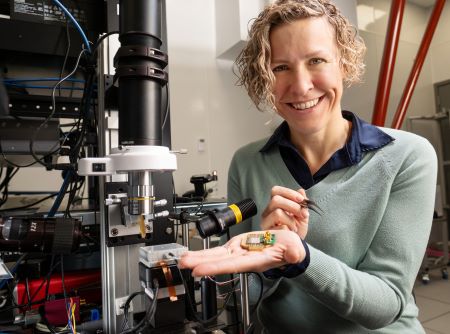
.jpg) Dr. Stephanie Simmons (photo at right), Associate Professor and Canada Research Chair Tier 2 at Simon Fraser University (SFU), and Dr. Michael Thewalt, an Emeritus Professor of Physics at SFU, were convinced that a fundamentally different approach would be required to support transformative quantum applications at scale.
Dr. Stephanie Simmons (photo at right), Associate Professor and Canada Research Chair Tier 2 at Simon Fraser University (SFU), and Dr. Michael Thewalt, an Emeritus Professor of Physics at SFU, were convinced that a fundamentally different approach would be required to support transformative quantum applications at scale.
These applications require huge quantities of connected, error-corrected qubits [the fundamental units of information in quantum computing], orchestrated to complete complex operations at any one time.
Photonic was founded in 2016, capturing their research into silicon T centres that demonstrate unique properties and marking the start of a new approach to quantum computing.
Commercialization efforts began in 2021, moving quickly from concept to system manufacturing. Photonic’s Entanglement First™ architecture guides the development of the company’s quantum computing platform. Every component is designed to scale up and scale out, enabling high-performance quantum computing with cost-efficient manufacturability and a compact footprint.
Simmons is the Founder and Chief Quantum Officer at Photonic, driving the technical vision for next-generation quantum technologies based on photonically-linked silicon spin qubits. She is a world-leading expert in quantum technologies, silicon spin-photon interfaces, condensed matter spin dynamics and control, silicon-integrated photonics, and quantum optics.
Simmons is the co-chair of the advisory board to Canada’s National Quantum Strategy, a Tier 2 Canada Research Chair in Silicon Quantum Technologies, and a Canadian Institute for Advanced Research Fellow in Quantum Information Science. At SFU’s Department of Physics, she leads the Silicon Quantum Technology research group.
She is an international speaker with over 30 publications, 60 keynote and panel talks, and numerous patents. Her work on developing CMOS-compatible scalable quantum technologies was awarded a Physics World Top Ten Breakthrough of the Year in 2013, and again in 2015. (CMOS-compatible refers to materials, processes or devices that can be integrated into standard Complementary Metal-Oxide-Semiconductor, or CMOS, fabrication lines without causing contamination or performance degradation).
Simons has been recognized with an Arthur B. McDonald Fellowship and as a Top 40 Under 40 in Canada.
Last month, Photonic raised $180 million in the first close of its latest investment round.
Simmons agreed to an Q&A interview, via email, with Mark Lowey, Research Money’s managing editor.
R$: Congratulations to Photonic on its latest funding round raise of $180 million. What will this funding enable the company to do on the technological side, to advance its technology?
SS: With this new funding, the company will be able to advance key product milestones toward commercialization. From the start, we’ve had a very clear understanding of the physics and the architecture that would be needed to reach the scale required to solve the most massive computational challenges.
We started the company knowing we had found the right type of qubit modality – optically-linked silicon spin qubits [a high-performance quantum computing technology that uses electron/nuclear spins in silicon to store information and photons for communication]. So, it's really been a process of working through the engineering challenges needed to scale those qubits and each layer in the stack. This funding will allow us to move further and faster on our mission to build scalable, fault-tolerant quantum computers that can deliver real-world impact.
R$: Photonic is accelerating the path to fault-tolerant quantum systems with its Entanglement First™ Architecture. What makes this approach unique compared with other quantum companies’ approaches?
 SS: Our approach is unique in that it is designed from the ground up – or the qubit platform up – to create scalable, distributed systems. To tap into the promise of quantum computing, you need systems with large numbers of highly connected qubits, and it became clear to me that it was not feasible for those qubits to be constrained to a single box. Modularity, or a distributed approach, is the key to getting to scale – we know this from classical computing.
The Entanglement First™ architecture is distributed by design, so it works very efficiently as a networked system. Avoiding the constraints of a single module enables us to network modules together without adding friction in the interface. Not every modality or architecture can do this.
It’s also designed for manufacturability. The Entanglement First™ architecture is based on a unique qubit modality that enables us to leverage the strengths of over 30 years of silicon fabrication for scale, with the networking capabilities of telecom for connectivity. Instead of trying to re-engineer a scientific prototype into a computer, we’re leveraging and adapting existing technology to accelerate the commercialization of the field.
R$: Do you expect Photonic’s approach will shorten the expected time to commercialization of utility-scale systems, and, if so, how?
SS: That’s our goal, and we’re approaching it from two complementary angles: 1) increasing the number of qubits available; and 2) reducing the qubit overhead needed to run the algorithms needed for meaningful applications in health care, energy and finance.
Our architecture is designed to scale up, meaning we can continue to increase the number of qubits in any given module, and scale out, meaning we can connect modules within a network without incurring bottlenecks or costs as the network expands in a coordinated manner. This combined approach lets us get to commercial scale faster than if we pursued either approach independently.
In parallel, we can shorten the timeframe to useful computing by requiring smaller systems, or fewer physical qubits, to run the same algorithms compared to alternative architectures. This is a direct benefit of our architecture and the types of codes it enables us to use. We have extensive connectivity between our qubits, both within and between modules, which allows us to use a very efficient class of error correction codes, called Quantum Low-Density Parity Check, or QLDPC codes.
We announced last year that we developed a new family of these codes that reduces the number of physical qubits required by more than 10 times, while maintaining the integrity of the calculation. We’re continuously innovating in this space – there's a lot going on behind the scenes.
R$: What is Photonic’s biggest technological challenge in getting to a utility-scale system?
SS: Like any other quantum computing company, our challenge is to get large numbers of high-quality logical qubits working together as quickly as possible. Our focus is on systems engineering – coordinating parallel paths of development of many interdependent subsystems in a product-driven way.
Photonic’s system is full stack, meaning we’re working on everything from the qubit itself to all the subsystems required to network these qubits together, as well as the most efficient error correction, software and compilers – all the parts that need to work perfectly in sync for quantum computing systems to do reach their full potential.
R$: Where does Canada stack up internationally when it comes to quantum research and, more importantly, commercialization of quantum technologies? Are we globally competitive?
SS: Canada’s greatest advantage in quantum is its head start in quantum research. I’m an example of the homegrown talent, having started my quantum journey here at the age of 16 in Waterloo. Decades of investment in research have paid off. The country has a deep bench of talent, institutions that are world class, and a collaborative ecosystem supporting the development and commercialization of companies that are globally competitive.
We have the scientific depth. The fact that three out of eleven companies [including Photonic] in Stage B of the U.S. Defense Advanced Research Project Agency’s Quantum Benchmarking Initiative are Canadian speaks to the strong foundations that have been built.
What I am excited to see is that we’re now doing more to support, as a nation, the commercialization of quantum technologies. We need to turn that early lead into a long-term economic impact. That means overcoming a tendency toward risk aversion, especially when it comes to scaling deep tech. If we wait until technologies are “proven,” we risk losing the return on investment and the talent we’ve trained.
Supporting homegrown companies now, and creating opportunities for them to grow here, is how we turn potential into prosperity. The recently launched first phase of the Canadian Quantum Champions Program is a great start on that front, and we’re looking forward to seeing how that progresses.
R$: Some quantum companies that were founded in Canada have relocated to the U.S.. Why do you think that happens, and is Photonic committed to staying and growing in Canada?
SS: While the core of our 150+ workforce is in Canada, we already have many fantastic colleagues working for Photonic around the world, particularly in the U.S., U.K. and Europe. We’re excited to grow all of those teams in the years ahead from our home in Vancouver and are proud to be a Canadian company with such a global workforce.
R$: The federal government, under its Canadian Quantum Champions Program (CQCP), awarded Photonic a contract worth up to $23 million. Is there anything more – say on the policy side – that government can do to support Canada’s quantum industry? For example, Canada isn’t as strong as some countries on patenting quantum technologies. Do we need something like the European Patent Office’s Observatory on Patents and Technology and its new platform on quantum technologies?
SS: Governments around the world have recognized the transformational potential of quantum technologies, and the importance of building sovereign capabilities. Many governments have already committed billions of dollars to quantum computing in particular, and it’s critical for Canada to continue building its own strategy accordingly. That means guiding investment, developing skills, securing supply chains, and anchoring deployment here at home – all of which require coordinated national leadership.
The first phase of Canada’s CQCP is a fantastic step towards that and provides meaningful support to help anchor Canadian companies in Canada and really strengthen the broader quantum ecosystem. Canada built a world-class foundation in quantum research, with decades of public investment creating a strong academic and talent base. Now we need to translate that into commercial success and lead the quantum economy worldwide.
As the competition intensifies over the years ahead, it will become clearer which companies are truly on a pathway to commercial-scale quantum computing. It will be vital for initiatives like the CQCP to continue to grow and scale accordingly for Canada to remain a leader on the international stage.
R$: What’s the role of the private sector in supporting and growing Canada’s quantum industry?
SS: One consideration is when it comes to private investment, is that deep-tech companies, which are effectively transforming scientific innovation into commercial products, have a different trajectory than digital ones. There is usually a longer timeframe and more capital required to get to market.
A core priority for us at Photonic is to make sure we're not just building something that’s scientifically impressive, but rather something that is commercially significant. That means building a deep understanding early on of the actual, real-world commercial potential of the various potential use-cases within quantum computing.
The relationships we have with leading firms like RBC and TELUS will play a key role in giving us that perspective from industry and helping to shape our focus areas accordingly. In parallel, we need more Canadian companies to be on the forefront of the adoption of quantum computing to truly build and benefit from a domestic quantum industry.
R$: How close are we, do you think, to seeing the world’s first practical, fault-tolerant, scalable, commercial quantum computer?
SS: We're closer than a lot of people realize. Certainly, close enough that the companies and government departments that can benefit from, or will be impacted by, these technologies should be putting it on their roadmaps. The commercialization of quantum computing is underway, and we’re excited to unlock its transformative potential – across industries from drug discovery and clean energy to secure communications, finance, and national security.
At Photonic, we don’t see our work as just building a computer. We’re building the foundation for technologies that will shape the next century.
R$
| Organizations: | |
| People: | |
| Topics: |




Events For Leaders in
Science, Tech, Innovation, and Policy
Discuss and learn from those in the know at our virtual and in-person events.
See Upcoming Events
You have 0 free articles remaining.
Don't miss out - start your free trial today.
Start your FREE trial Already a member? Log in
By using this website, you agree to our use of cookies. We use cookies to provide you with a great experience and to help our website run effectively in accordance with our Privacy Policy and Terms of Service.