
The Short Report: October 14, 2026

GOVERNMENT FUNDING & NEWS
 Prime Minister Mark Carney announced a $2-billion investment to deliver one million home retrofits across Canada. These energy-efficient retrofits will lower heating costs for Canadians and reduce emissions, the government said. Ottawa is launching a new National Heat Pump Rebate to help up to 820,000 households make the switch to more efficient electric heat pumps, by:
- Lowering the up-front cost of purchasing an electric heat pump: Eligible below-median- income households will receive a rebate of up to $10,000 for the purchase of an electric heat pump. Other eligible households will receive $2,000. Both rebates can be combined with existing provincial programs to bring the cost down even further.
- Providing help when it is needed most: Every year, about one million Canadian homes replace their heating system. More than 80 percent of the time, it is because the old system broke down without warning. This new program will confirm approval within 24 hours, and a heat pump can be installed as quickly as a furnace.
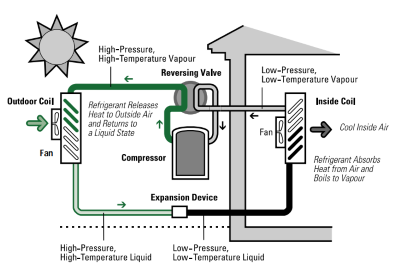 Heat pumps are more efficient, cleaner and safer than oil and electric furnaces. They will save an average of $1,400 a year for households currently heating with oil or electrical boards, the government said. Ottawa also is working with the Canada Mortgage and Housing Corporation (CMHC) and the Canada Infrastructure Bank (CIB) to help apartment building owners retrofit 280,000 units over the next eight years, by:
- Providing affordable financing for retrofits: Through its Multi-Unit Mortgage Loan Insurance product, CMHC will help retrofit up to 250,000 additional units. This CMHC product has already supported over 140,000 energy-efficient units to date.
- Unlocking investment in apartment buildings: Through its Building Retrofits Initiative, the CIB will support apartment and multi-unit residential building owners to retrofit 30,000 units.
- To advance building retrofits, the government is also renewing the Deep Retrofit Accelerator Initiative, which supports building owners through all stages of the retrofit process.
Combined, these measures will support one million home retrofits and reduce Canada’s emissions by over 25 megatonnes – the equivalent of taking nearly eight and a half million cars off the roads for one year, the government said. Prime Minister of Canada
Federal Minister of Agriculture and Agri-Food Heath MacDonald announced the upcoming launch of the $1-billion Food-Link Fund, a key component of the $3.2-billion National Food Security Strategy. The Food-Link Fund will strengthen competition and improve Canada’s food distribution network by investing in critical infrastructure that will help food move more efficiently from producers to consumers and give Canadians better access to affordable, locally produced food across the country. The Food-Link Fund will advance both large-scale and regional solutions through:
- The Food Terminal Fund, which will support the development and expansion of wholesale food terminals. Food terminals give farmers, food businesses and independent retailers a one-stop-shop where they can efficiently sell and source products beyond the supply systems controlled by large retailers. This will mean greater retail competition and more affordable choices for consumers, the government said.
- The Food Hub Program, which will support the creation and expansion of regional food hubs across Canada. Food hubs will give food producers access to the storage, processing, distribution and market connections they need to get more local food to communities.
The official application intake period for the Food-Link Fund will open October 14, 2026 and be available for eight weeks until December 11, 2026. Applicants will first submit an expression of interest and the applications that align with the fund’s objectives will then be invited to submit a full proposal. Agriculture and Agri-Food Canada
The Government of Canada’s planned major projects could attract $670.6 billion in additional investment between 2026 and 2030, according to a new study from the Business Development Bank of Canada (BDC), conducted with support from the Transition Accelerator think tank. However, Ottawa’s major projects push also could require 580,000 more workers by 2030, the study said. BDC surveyed 1,000 Canadian businesses, including 750 already involved in large projects and 250 interested in participating. Two-thirds of businesses expect to increase their involvement over the next 24 months, rising to 88 percent among high-growth firms and 77 percent among businesses in technology and primary sectors. Other findings are:
- Those investments could generate $443 billion in cumulative economic activity and boost Canada's GDP by 4.1 percent by 2030.
- Delivering these projects could require the participation of approximately 280,000 Canadian businesses.
- The survey suggests that 67 percent of SMEs involved in major projects expect to increase their participation over the next 24 months.
- Financing, capacity and procurement challenges remain key barriers for many SMEs. SMEs need better information about upcoming opportunities, smaller contract lots, reduced financial or bonding requirements, more predictable payment terms and procurement processes adapted to help them rapidly escalate their participation and better reflect their operational realities.
“If we help entrepreneurs scale through acquisitions, partnerships and productivity gains, Canada can create a new generation of medium-sized and large companies that will power our economy for years to come,” said Isabelle Hudon, president and CEO of CDC. The study identified five key areas at the centre of Canada’s $670-billion major projects pipeline:
- Housing and civil infrastructure: $220.1 billion.
- Energy: $159.8 billion.
- Defence: $153.7 billion.
- Mining and natural gas: $125.8 billion.
- AI data centres: $11.2 billion. BDC
Cold Lake First Nations (CLFNS) in northeast Alberta filed an application for judicial review in Federal Court challenging the Government of Canada’s decision to designate the Pacific Link Pipeline to the West Coast as a project of national interest. “CLFNS is taking this step to protect our Treaty rights, our lands and the Nation’s interests for future generations,” the First Nation said. Ottawa has repeatedly stated that Pacific Link and the oilsands industry’s carbon capture and storage Pathways Project are “mutually dependent.” CLFNS is seeking meaningful consultation on both projects, which Canada considers to be in the “national interest.” “As a Nation with direct involvement in the energy sector, CLFNS supports responsible development. Our Nation sits at the heart of in situ oilsands development in Canada. We want to ensure development is done right, with meaningful consultation and clear answers about the long-term impacts of projects in our region.” The Pathways project would be one of the world’s largest carbon capture and storage projects, capturing carbon dioxide from oilsands facilities and storing it underground within CLFNS’ traditional territory. The First Nation said it has been raising concerns with the federal government since 2023 about the potential environmental, geological and safety risks related to the proposed CO2 storage hub and the cumulative impacts of oilsands development in its territories. CLFNS said it has repeatedly asked Canada to consult with on both Pacific Link and Pathways. “Despite those efforts, Canada moved ahead with the national interest designation without meaningful consultation with our Nation.” CLFNS said it remains committed to working collaboratively toward a constructive path, “but responsibility to take the first step outside the courtroom now rests with Canada.” Cold Lake First Nations
The Alberta Court of Appeal ruled that the federal government's Impact Assessment Act is still unconstitutional. This was the second time the Alberta government had challenged the act, which sets out a process to review the environmental, economic, health and social effects of proposed projects like ports, mines and pipelines. In a 4-1 decision, the court said even though Ottawa modified the law after the Supreme Court struck down much of it in 2023, the new version still infringes on provincial jurisdiction. The Court of Appeal found that, among other things, the act still gives Ottawa the power to stop a project in provincial jurisdiction if it has even the smallest impact on federal jurisdiction. "While Parliament may have the power to create an impact assessment scheme that complements existing regulation in environmental matters, the [Impact Assessment Act] creates great uncertainty due to the potential for previously unpronounced standards to apply to designated projects," the court wrote. The court said while some of the changes the federal government made to the previous version of the act weren't constitutionally problematic, the law still gave Ottawa overly broad powers in areas of provincial jurisdiction. Ontario and Saskatchewan both backed Alberta in its legal challenge. “Alberta is calling on the federal government to accept the court decision and work with Alberta to repair this flawed law so it no longer undermines Canada’s ability to build and grow our economy,” Alberta Premier Danielle Smith said in a statement. But Ecojustice urged the Carney government to appeal the decision “and not abandon its responsibility to protect the environment and respect Indigenous rights.” CBC News, Govt. of Alberta
The Government of Canada is giving Canada’s mining industry too many tax breaks and it’s distorting the allocation of resources in the economy, according to a new report by economists at the University of Calgary School of Public Policy. Economists Philip Bazel and Jack Mintz recommend eliminating or scaling back targeted critical mineral incentives and exploration tax credits, reducing development deductions under the corporate income tax from 30 percent to 25 per cent, and reforming provincial processing allowances so they exempt only genuine processing income rather than extraction profits. “In the exuberance to find critical minerals, incentives have become excessive and poorly administered, thereby distorting the allocation of resources in the economy,” they say. Canada has one of the most competitive mining tax systems in the world, they point out. For most mining products, the overall tax burden in Canada is lower than in competing jurisdictions, “which means that more targeted tax incentives aren’t needed to attract investment.” Provincial mining taxes should be converted to cash-flow taxes that fully expense capital investments and allow unused deductions to earn interest, following British Columbia’s model, Bazel and Mintz recommend. “Such reforms would tax economic rents more efficiently while reducing distortions.” The federal government’s announcement in September that it will expand expensing from 15 percent to two-thirds of assets, which will enable companies to write off qualifying capital expenditures immediately rather than through time, “will result in an even more favourable treatment of mining in Canada compared to other countries,” Bazel and Mintz note. U of Calgary School of Public Policy
Nearly half of Canada's provinces and territories are calling on the federal Liberals to fulfil their election promise to expand eligibility for a mining exploration tax credit to help smaller mining companies get through their exploration phase. The Liberals' 2025 election platform said the government would expand the range of activities eligible for mineral exploration tax credits by including the costs of engineering and feasibility studies for critical mineral projects. The Association for Mineral Exploration, which recently launched a campaign to hold the government to its promise, said it's hoping to get that included in the upcoming federal budget. Nova Scotia, Manitoba, Saskatchewan, Alberta, British Columbia and Yukon have all written letters in support of the campaign. They say the measure would help projects move from exploration to production. A report from Ernst & Young, commissioned by the Association for Mineral Exploration, found 2,052 projects in Canada are currently in their early stages. The report said expanding the tax credits to cover feasibility and economic viability studies could generate 14,000 to 34,000 jobs over 10 years, on top of the projected best-case scenario of 184,000 new jobs in the sector. The report suggested increased spending in the mining sector is projected to generate $68 billion in GDP over the next 10 years. The report said that projection could increase by anywhere from $5.2 billion to $12.2 billion if feasibility and viability studies were covered by government tax breaks. The Canadian Press
The Government of Canada and the Government of Ontario announced more than $31 million in federal funding for six projects that will make it faster and easier for internationally educated health professionals to join Canada’s health workforce. This includes $20 million to support the creation of 50 additional positions per year, over four years, for internationally educated family physicians in the Ontario government’s Practice Ready Ontario program. This will result in up to 200 new family physicians ready to work in the province by 2028-29. A key focus of the program will be to improve access to primary care in underserved northern and rural regions, as well as Francophone communities in Ontario, with a specific stream for French-speaking internationally educated family physicians. The funding will also support five other projects across Canada that will provide enhanced resources and practical tools to help internationally educated physicians, nurses, occupational therapists and physiotherapists navigate provincial and territorial licensing requirements and prepare to work in the Canadian health sector. Health Canada
The Government of Alberta is investing almost $200 million to improve care and support independence through innovation in assisted living. Funding will be provided to projects that propose practical solutions for real challenges facing Albertans and their families, care providers and the assisted living workforce. Projects could include technology that improves care and quality of life, virtual and remote supports that help Albertans remain independent at home, new approaches to supporting the continuing care workforce, or community-based services that help people and caregivers access the support they need. The Assisted Living Innovation Grant Program will also fund research to identify approaches that improve care and could be expanded to other communities or care settings. Applications are open until November 6, 2026, with up to $50 million available through this initial intake. Eligible applicants include not-for-profit organizations and societies, continuing care operators, housing providers, service providers, First Nations and Metis Settlements. Govt. of Alberta
The Government of Canada introduced Bill C-40: Strengthening Canada’s Defence Sector, to establish the Defence Investment Agency (DIA) as a Crown corporation. This reform will provide the DIA with the authorities, operational flexibility, specialized expertise and organizational structure needed to deliver critical capabilities quicker, Ottawa said. The DIA will have greater commercial flexibility and more autonomous approvals, allowing it to work better with industry and deliver better value for money. It will maximize Canada’s generational defence investments to strengthen the country’s industrial base, supply chains and sovereign capabilities. This legislation:
- Creates the Canadian Corporation for Defence Investment, which will continue to operate under its existing name, the Defence Investment Agency. It will have more independence, its own board of directors, and greater authority to negotiate and manage contracts.
- Empowers the DIA to engage in defence production, procurement and investment activities in support of national defence and the operational priorities, capability requirements and acceptance criteria established by National Defence and the Canadian Armed Forces (CAF).
- Maintains the federal government’s oversight of the new Crown Corporation.
- Amends the National Defence Act to create an associate minister of National Defence for Procurement, who will be responsible to Parliament for the DIA, consolidate procurement and commercial authorities and strengthen accountability for procurement delivery within the National Defence portfolio.
- Integrates the DIA with the National Defence portfolio to further reduce red tape that slows procurement down and ensures that defence procurement in Canada is focused on equipping the National Defence and CAF with the tools they need to defend Canada.
The DIA was launched to accelerate procurement and use defence spending to strengthen Canadian industry, build sovereign capabilities, and catalyze investment in the Canadian defence sector. As a Crown corporation it will have the commercial tools to deliver on its mandate, Ottawa said. Defence Investment Agency
Federal Minister of National Defence David McGuinty and Alberta Premier Danielle Smith visited Canadian Forces Base Edmonton to highlight defence investments across Alberta. These ongoing investments are supporting the modernization of military infrastructure, expanding industrial capacity, advancing defence innovation and equipping the Canadian Armed Forces (CAF) with the facilities, capabilities and workforce it needs to defend Canada at home and contribute to operations around the world. Worth approximately $8 billion, these ongoing investments include:
- nearly $4 billion to support future fighter capabilities at CFB Cold Lake.
- $750 million for a new Chemical and Biological Laboratory and Blast Assessment Centre at CFB Suffield.
- $550 million to establish the western operating base for the Royal Canadian Air Force's CC-330 Husky fleet.
- over $580 million over the next three years for maintenance and repair work across CAF bases situated in Alberta.
Funds will also support the renewal and expansion of residential accommodations, operational facilities, logistics and warehousing capacity, training infrastructure, utilities, transportation networks and support services across the province. McGuinty also announced over $8 million for seven defence-related projects to be administered through Prairies Economic Development Canada under the Regional Defence Investment Initiative, the Regional Tariff Response Initiative, and the Regional Innovation Ecosystems program. National Defence
Markham, Ont.-based CyberWorks Robotics has a deal to supply and test its autonomous vehicles with the Canadian Armed Forces. CyberWorks was awarded the amended contract, worth more than $1 million, with the Department of National Defence at the end of August. The deal requires CyberWorks to deliver its next-generation, multi-role autonomous vehicles, which leverage deterministic robots and machine learning, to Canada’s military. CyberWorks’ tech will support “defence logistics, payload delivery, and reconnaissance operations in complex indoor and outdoor environments.” A CyberWorks spokesperson said in an email to BetaKit that the agreement, which expires in February 2027, also offers “a structured path” to “up to an additional $7 million in potential sales.” BetaKit
The Government of Canada introduced Bill S-7, the Cutting Red Tape for all Canadians Act. The bill proposes targeted amendments to reduce unnecessary regulatory burden under 31 individual pieces of legislation and their corresponding regulations administered by 11 federal departments and agencies. These measures address irritants and obstacles identified by stakeholders. They are expected to save Canadians and businesses time and money by streamlining processes, avoiding duplication, supporting innovation and expediting decision-making, while maintaining important health, safety and environmental protections, the government said. Last year, the government launched the Red Tape Review. Since then, progress has been made in removing unnecessary barriers, updating outdated rules and making practical changes that improve how government works for Canadians. The government said it intends to introduce new legislation on a recurring basis to continually remove unnecessary barriers that can emerge over time. Treasury Board of Canada Secretariat
The American consortium that runs federal nuclear science in Canada is working on a new fuel for nuclear reactors that would cut demand for Canadian-mined uranium. A briefing prepared in May for Natural Resources Minister Tim Hodgson lays out this consequence of the deep integration of U.S. interests in Canada’s nuclear program. The new fuel is branded “Advanced Nuclear Energy for Enriched Life (ANEEL)” by its Chicago-based developer, Clean Core Thorium Energy. It would be based on the radioactive element thorium and a type of uranium that Canada doesn’t produce. India is especially keen on the technology, said the briefing for Hodgson – which The Logic obtained through an access-to-information request – because the country wants to replace the imported uranium that fuels its nuclear plants with thorium it can mine for itself. India has a large and growing fleet of nuclear-power reactors that use a design derived from Canada’s Candu reactors. A few are out of service, but 21 of India’s 25 nuclear-power reactors are Candu-style pressurized heavy-water models and the country is building more, according to the International Atomic Energy Agency. Saskatchewan’s Cameco has a new nine-year, $2.6-billion uranium supply deal with India, signed during Prime Minister Mark Carney’s trip there in March. Hodgson’s briefing noted that “India has world-leading thorium deposits and sees ANEEL as a potential pathway to improve domestic energy security [by reducing imports from countries like Canada].” Canada’s national nuclear research effort, which is helping Clean Core answer India’s demand, is ultimately the federal government’s responsibility, but it’s in a corporate structure that puts day-to-day management in American hands. Hodgson oversees Atomic Energy of Canada Ltd. (AECL), the Crown corporation that was behind Candu nuclear reactors in the first place. AECL has a subsidiary called Canadian Nuclear Laboratories (CNL) that runs its research. But even CNL is little more than a shell for contracting that research out. The current contractor is an all-American-owned consortium of companies called Nuclear Laboratory Partners of Canada. It’s made up of BWX Technologies (a manufacturer of nuclear components and fuels, based in Virginia), Amentum (a nuclear engineering firm also based in Virginia) and Battelle (a non-profit research operation based in Ohio that manages multiple U.S. government labs). A fourth formal member of the consortium, Kinectrics, is based in Toronto; it was Canadian-owned until BWX Technologies bought it in early 2025. CNL’s chief executive and its vice-president of science and technology both come from the U.S. nuclear industry. The Logic
Federal Industry Minister Mélanie Joly announced a Strategic Response Fund investment of $23.8 million in Jubilant Radiopharma Inc. to modernize and expand its biomanufacturing facility in Kirkland, Que., to help meet the growing demand for radiopharmaceutical products. This investment will support Jubilant Radiopharma’s $94.5-million project to upgrade its Kirkland facility and establish it as a global centre of excellence for radiopharmaceutical production and research and development. The project will modernize production lines, create new production spaces and upgrade laboratory, storage and shipping areas for key radiopharmaceutical products. The project will also strengthen collaborations with Canadian universities, research institutions and small and medium-sized enterprises, focusing on areas such as artificial intelligence–assisted diagnostics and nuclear medicine research. Innovation, Science and Economic Development Canada
The Government of Canada and the Government of Ontario are investing $2 million to help small businesses in the agri-food industry expand operations and enhance food safety. Delivered through Ontario’s Food Safety and Growth Initiative, the funding will equip businesses with the tools and technologies they need to improve safety, increase efficiency and grow. The initiative will support small agri-food businesses that produce, process or service specific products, such as bagged salads, cheese and ice cream, and have fewer than 100 employees at the project location. Funding can be up to $75,000 per project and used for investments in food safety equipment and technology, food traceability systems and process improvements. Applications open on October 19, 2026. Businesses interested in applying can find program details and eligibility requirements here. Food in Canada
The former chief executive of Canada Health Infoway was terminated in part because his testimony at a parliamentary committee negatively affected the public image of the federally funded organization, Canada Health Infoway argued in a new legal filing. The long-time CEO, Michael Green, was dismissed April 29, days after he testified at a House of Commons health committee to answer questions from members of Parliament about the failure of PrescribeIT, a nearly $300-million federal project to get doctors to send their prescriptions electronically. Fewer than five percent of prescriptions flowed through the service by the time Infoway’s board decided to cancel it as of May 29, as The Globe and Mail previously reported. Green filed a wrongful-dismissal lawsuit on July 30, alleging that he had been made a scapegoat for the program’s failure. He argued that he was owed more than $3 million in damages. In a statement of defence filed October 1, Infoway argued that Green “was terminated for bona fide reasons and on a without-cause basis.” Infoway said its board had given Green performance ratings of “exceeds” and “thriving” in past years but downgraded his rating to “delivering” for the 2025-26 fiscal year because of concerns about his performance, “including the failure to establish a sustainable funding model for PrescribeIT.” Green’s appearance at the parliamentary committee “did not meet the board’s expectations for the CEO, and negatively impacted the public reputation of Infoway and its relationship with stakeholders,” Infoway said in the statement of defence. In June, Health Minister Marjorie Michel’s office said it was pausing funding for Infoway and ordered a third-party audit and strategic review of the organization. The Globe and Mail
The Government of Ontario asked provincial police to look into student financial assistance payments at private career colleges after auditors identified "serious concerns" about possible criminal activity and "egregious" use of public money. Colleges and Universities Minister Nolan Quinn said the ministry launched targeted inspections of career colleges last year in response to growing concerns about Ontario Student Assistance Program (OSAP) usage and asked KPMG in August to begin an audit. The Canadian Press reported that government officials who inspected three career colleges alleged in reports filed in court that they found evidence suggesting third parties were completing the coursework – sometimes entire courses in one day – and a few students who couldn't name their school or program. Those schools deny most of the allegations made against them, and they have not been proven in court. Quinn earlier this year drastically reduced the amount of OSAP grants that students at universities and publicly funded colleges could receive, while restricting career college students to OSAP loans. He cited "unsustainable" costs, but a freedom-of-information request by The Canadian Press showed that 95 percent of the year-over-year growth in 2024-25 was due to career colleges. A subsequent freedom-of-information request by The Canadian Press showed that most of that growth was concentrated among a small number of schools. Just seven career colleges accounted for about $385 million in OSAP grants in 2024-25, the same amount that went to students at all of Ontario's publicly funded colleges. The Canadian Press
The Government of Canada successfully priced its seventh issuance of Canadian-dollar-denominated green bonds, raising $2 billion in a new 10-year offering. This issuance saw robust demand from investors, with environmentally and socially responsible investors representing a significant share of buyers (44 percent). The final order book stood at over $3.6 billion. Federal green bond issuances support the growth of Canada’s sustainable finance market by providing a sovereign benchmark for other issuers and high-quality green investment opportunities backed by Canada’s AAA credit rating. Green bonds unlock private capital to speed up projects such as green infrastructure and nature conservation. These investments support economic growth, create jobs and help build a cleaner and more resilient Canadian economy, Ottawa said. Department of Finance Canada
Export Development Canada (EDC) is exploring ways to help assemble and finance stacks of Canadian technology in strategic sectors like AI infrastructure and critical minerals that can be marketed to global buyers. “We are raising our game, because others have been out there with that practice and playbook for some time,” CEO Alison Nankivell told The Logic. Although international commerce is conducted between firms, European and Asian governments have long used capital and diplomacy to boost the sales of their homegrown companies abroad. EDC is now working with Global Affairs Canada’s new Strategic Exports Office on a similarly coordinated toolkit to pitch “what Canada has to offer,” Nankivell said. The Crown corporation is also in talks with other national trade credit agencies to identify opportunities that could package products and services from companies in each country. For example, EDC sees an opportunity in the supply chain for digital infrastructure, which governments and tech giants plan to spend trillions of dollars building out to power AI systems. EDC has also mapped out the AI stack so it can pitch Canadian firms that make that hardware and software to data centre developers and funders in other countries, said Guillermo Freire, senior vice-president of the mid-market group. EDC could then finance any sales of technology and services that result. The new strategy of assembling and financing packages of technology for export isn’t restricted to AI. EDC also sees opportunities in other growing sectors like space, defence and the processing of critical minerals. The Logic
Following digital-money trails will be a priority for Canada’s new Financial Crimes Agency in the war against illicit finance, says Rob Stewart, deputy minister of the proposed law enforcement agency. Stewart, who has the task of getting the long-promised initiative off the ground, has spent months speaking to stakeholders ranging from policing agencies to private-sector experts to international partners. The Financial Crimes Agency (FCA) could launch as early as next year, depending on when Bill C-29, the legislation to establish it, passes, Stewart said. The bill, which was introduced in the spring and is currently being studied by MPs in a parliamentary committee, aims to more effectively target financial crimes. One of the skill sets that Stewart will be looking for when staffing the new agency is the ability to analyze cryptocurrency transactions, to address the growing use of virtual currencies by organized-crime groups to move money across borders. Canada’s abilities to prosecute complex money-laundering cases, seize proceeds of crime and supervise high-risk businesses such as virtual currency exchanges was flagged as weaknesses by the Financial Action Task Force report earlier this month. The FCA’s work force, which is expected to be around 230 to 250 people, mostly civilians, will be broken up into two categories: peace officers, and regular officers of the agency. The RCMP is expected to provide 150 staff on a temporary basis to help get the agency up and running, and a commissioner will be hired to oversee the operation, Stewart said. The Canadian Press
Canada's financial regulator has made frontier artificial intelligence the centrepiece of its fall risk update, warning that the pace of AI development has accelerated sharply since its spring outlook and that federally regulated institutions must strengthen their defences without delay. The Office of the Superintendent of Financial Institutions (OSFI) published its 2026 Semi-Annual Risk Outlook explaining how risks to Canada's financial system have evolved since the 2026-2027 Annual Risk Outlook released in April. While the four risks identified in the spring – real estate secured lending, non-bank financial institution risks, funding and liquidity risks, and other risks – remain in focus, OSFI singled out frontier AI as a development warranting focused discussion, noting that the rate of capability change is unprecedented. OSFI's central concern is that frontier AI models, defined as the most advanced and capable systems currently available, are compressing the window between vulnerability discovery and exploitation, reducing the time institutions have to assess emerging risks and deploy defensive measures. The regulator warned that ongoing advances in AI, including autonomous capabilities, are increasing the effectiveness, speed and sophistication of malicious cyberattacks. The update also flagged a structural concentration problem. A small number of providers currently dominate the development of frontier AI models and the cloud infrastructure used to deploy them. This concentration increases the potential for correlated disruptions if a critical provider experiences an operational failure, cyber incident, or service outage. Wealth Professional
Canada’s financial regulator is considering developing a new artificial intelligence “safety code” for financial institutions as increasingly powerful AI models and autonomous agents create fresh risks for the financial system. Speaking at the Global Risk Institute Summit in Toronto, superintendent Peter Routledge said the Office of the Superintendent of Financial Institutions (OSFI) has shifted from a largely hands-off approach to considering minimum standards for how banks use AI. Routledge said rapid AI advances were driving the shift, pointing to Claude’s latest foundational model Mythos and other frontier models that could be used for cyberattacks or illicit activity, as well as autonomous AI agents operating with minimal human oversight. The framework is still at an early stage. Routledge said there is no draft yet and no formally approved timeline for releasing it, though the consultation could come as early as spring. The safety code would go beyond OSFI’s previous AI advisory reports, Routledge said, and would likely build on the regulator’s work with the Global Risk Institute’s Financial Industry Forum on AI and its collaboration with the Financial Stability Board, an international organization. Routledge said Canadian banks are generally prepared for AI-related risks, but some are further ahead than others. OSFI wants to set a “minimum level of safety or resilience” across the system, limiting the risk that weaknesses at one institution spread to other counterparts. The Logic
The Department of Finance and the Canada Revenue Agency launched consultations on ways to modernize the federal framework governing registered charities, helping ensure they can continue to play their critical role in communities across the country. The consultations will seek feedback on how the legislative and administrative framework can better support the charitable sector, reduce unnecessary administrative burdens, adapt to advances in technology and digitization, and strengthen transparency and public trust. Canadians are invited to visit the consultation page and review the related consultation paper. They are also invited to share their views on modernizing the federal tax rules for registered charities and the Canada Revenue Agency’s administration of those rules, while protecting the integrity of charitable donation tax incentives. Submissions for this consultation will be open until December 3, 2026. Department of Finance Canada
Prairies Economic Development Canada (PrairiesCan) provided funding of over $11.2 million for eight organizations across Saskatchewan. The investments, delivered through the Regional Tariff Response Initiative and the Business Scale up and Productivity Program (BSP), will help businesses enter new markets and build long-term economic resilience during uncertain times. The two programs work hand in hand to support business growth and competitiveness. For example, Saskatoon-based Northern Nutrients Ltd. is receiving support under BSP to purchase, install and commission equipment that will expand production of its enhanced sulphur fertilizers at its new facility. PrairiesCan
*****************************************************************************************************************************
Open science is “not incompatible” with research, providing security protocols protect research data: Canada’s Chief Science Advisor
Open science is “not incompatible” with research security and science leaders and policymakers should “demystify” the false dichotomy between the two, says Mona Nemer, Canada’s Chief Science Advisor.
More than a decade ago, European Union policymakers were promoting open science, open innovation and open collaboration across the world. It was a political movement that aimed to make scientific research, data, software, publications and methodologies transparent, accessible and reusable for everyone.
But that rhetoric has changed over the past few years. After Russia invaded Ukraine in 2022 and Donald Trump came back to power in 2025, international partnerships have become more pragmatic. Countries are trying to implement protectionist policies and governments are increasingly worried about technology espionage.
According to Nemer, science can remain open if the sector can come up with improved security protocols that would protect research data from undue manipulation by foreign actors. “If anybody can fiddle with the with the data, then [open science] is actually quite dangerous and quite useless,” she told Science|Business.
Nemer spoke with Science|Business on the margins of the Hamburg Science Summit.
Universities and research institutions are increasingly vulnerable to attempted espionage and other types of foreign interference. In September, the U.K.’s domestic counter-intelligence service MI5 issued a security warning against collaborations with the China General Technology Research Institute.
And earlier this year, Germany’s Helmholtz Center for Information Security was criticised by federal research minister Dorothee Bär, who told a parliamentary hearing that “existing rules and systems” at the institute “were not suitable” for preventing leaks to China.
Nemer said universities and research institutions should perhaps follow the example of the private sector, as companies have been able to safeguard their research while still publishing results.
“I think that there is a level of research security hygiene that researchers and institutions need to just adopt,” she said. “You don't have to tell Sanofi or IBM how to safeguard their research, which they end up publishing anyway.”
While certain areas of research will not be open for collaboration with certain partners, in other areas cooperation is necessary even with researchers based in adversarial countries. “I stress this because politics change,” Nemer said. “Science and politics don't make for good fellows, and whether we like it or not, politics will influence certain things.”
Researchers will play an important role in “protecting the integrity of science,” she said. “I think that it's time that there's a commitment to a certain scientific compact, so that citizens don't think that science is actually an open door for espionage and for anti-nationalism.”
The U.S. government has indicated it wants to retreat from international science projects, including U.S. collaboration with Europe’s CERN particle accelerator and other big science labs. Science|Business
*******************************************************************************************************************************
The European Commission is considering taxing big U.S. tech companies through a broad levy on large corporations in an effort to raise revenues for the EU while avoiding a backlash from the Trump administration, the Financial Times reported. The European Commission was working on new ways to capture more income from tech firms such as Apple, Meta and Google without singling them out, the newspaper reported, citing six officials with knowledge of the discussions. Brussels was considering changes to its "Corporate Resource for Europe" (CORE) proposal that would require all companies operating in the EU with revenue of more than €100 million a year to pay an annual lump-sum tax contribution, the report said. In its current form, CORE requires these companies to pay a fixed annual levy of between €100,000 and €750,000, capturing only a small portion of a multinational company’s earnings. U.S. President Donald Trump in June threatened a 100-percent tariff on all goods from any country that imposes a digital services tax on American companies. Reuters
RESEARCH, TECHNOLOGY & INNOVATION
Women accounted for less than one-third of published authors in scientific journals, but workplace disparities may play a larger role than publication bias
A new study from the Laurier Centre for Women in Science (WinS) at Wilfrid Laurier University found that women accounted for less than one-third of published authors in a sweeping sample of Canadian scientific journals.
Notably, the percentage of women submitting manuscripts generally matched those published, suggesting that broader workforce disparities may play a larger role than publication bias.
The authors of the “Balancing the byline” study, published in the journal FACETS, analyzed more than 67,000 articles submitted to Canada’s biggest publisher of international science journals, Canadian Science Publishing (CSP), between 2010 and 2021.
It is the first-ever large-scale analysis of gender representation in Canadian science, technology, engineering and mathematics (STEM) journals.
“I expected to see a difference between the proportion of women submitting and women being accepted, and we didn’t find that,” says lead author Eden Hennessey, WinS research and programs director and Wilfrid Laurier University’s equity, diversity and inclusion data specialist. “It turns out there aren’t enough women submitting their work for publication in the first place, so it’s a more complex issue because we can’t just point toward a journal and problematic peer review processes. It’s a much larger, sociocultural phenomenon of imbalanced gender representation in STEM fields,” she said.
Women authored a higher percentage of publications within biomedical sciences, multidisciplinary sciences and biological sciences. In contrast, lower percentages were observed in engineering and physical sciences, a pattern that aligns with the underrepresentation of women in these fields.
“The evidence is pretty clear that we are not seeing gains in representation equivalent to the investments we’ve been making,” Hennessey said. “Even with federal programs, camps and workshops, we’re seeing diminishing representation in certain fields for women. In computer science, for example, we’ve seen a slight dip. Engineering and math remain low. On the other hand, we have achieved parity in biology.”
“So, it’s important to talk about sub-disciplines when we discuss authorship, as we’ve done in this paper. It’s also important to note that representation is only one facet of equity. Presence alone does not imply inclusion,” Hennessey said.
Just two percent of CSP articles were solo-authored by women.
This figure was generally higher in the physical sciences. In the Canadian Journal of Physics, solo-woman authors accounted for five percent of all publications. This deviation suggests that in certain fields, such as physics, individual women researchers have carved out niches, enabling them to produce solo publications.
“However, our analysis was consistent with broader studies showing that few people publish solo at all, and I think that’s an important note in this work,” Hennessey said. “Science remains a team sport and we are seeing more collaboration than ever.”
Across all journals, 36 percent of first authors and 27 percent of last authors were women.
“At the start of a research career, authorship order is critical,” Hennessey noted. “Being a prominent author on a publication opens doors, leads to funding opportunities and makes you viable on the tenure track. There are disciplinary differences in author order. In physics, for example, last author is the most prestigious, whereas in my field of social psychology you want first position.”
"As a mid-career researcher, it doesn’t hurt me at all to include the contributions of early-career researchers in publications, but it helps them immensely,” she said. “I think we should all be looking at our own spheres of control. What can I be doing in my own lab to open doors and expand who is getting opportunities?”
It matters who conducts research.
“We know that if women are represented as authors, the science changes,” Hennessey said. “We recently hosted Vincent Larivière at Laurier, who is arguably one of the best scholars in this area. He has data showing that we research what we care about. We research what’s relevant to our communities and our identities.”
“Just because we didn’t find a publication bias in one study doesn’t mean there aren’t any, so we are continuing to work with publishers and reviewers in that ecosystem to understand processes and how they affect people,” Hennessey said.
“We are going to do more qualitative work. Using whether or not a paper was accepted as an indicator of bias doesn’t tell us how an editor or peer reviewer engaged with an author, or the type of feedback they received. Our work for this paper was based on metrics, but behind every single data point is a human being.”
Efforts must continue to address systemic barriers for women in STEM, Hennesey said.
“Our work is a call to action, both for individuals and institutions. Who are we inviting onto research projects and grant applications? I encourage all researchers to check out the federal government’s Gender-based Analysis Plus course.
“Inclusion must also be structural. We have learned that it’s not just about bolstering a little girl’s confidence to go into STEM. If they walk into a situation where they’re experiencing discrimination or ostracism, we’ve encouraged them to enter a house we know is burning. To quote Shohini Ghose (professor, physics and computer science and NSERC Chair for Women in Science and Engineering at Wilfrid Laurier University), we need to fix systems, not women. Our work is focused on providing metrics that can be used for policy and resource creation. We need accountability measures and practical processes for reporting harm and bias so it’s possible for people to confront prejudice in a safe way.”
Said Hennesey: “This isn’t a problem that’s going to self-correct, so we need intervention at multiple levels.”
The research project was supported by the Natural Sciences and Engineering Research Council of Canada's Chairs for Women in Science and Engineering grant. Wildfrid Laurier University
*****************************************************************************************************************************
The Government of Canada announced that peer-reviewed articles resulting from research funded by Canada's three federal funding agencies must be freely available, without subscription or fee, at the time of publication. Through the revised Tri-Agency Open Access Policy on Publications, the agencies remain aligned with other research funders in Canada and globally, supporting a transparent research ecosystem and the mobilization of knowledge for the benefit of all. Sharing the results of research accelerates cross-sectoral progress and the ability to solve the complex challenges of our time, the government said. The revised Tri-Agency Open Access Policy on Publications (2026) applies to all peer-reviewed research articles resulting from work supported, in whole or in part, by any of the three federal research funding agencies' grants and Chair awards, including those administered by the Tri-Agency Institutional Programs Secretariat. The revised policy will come into effect on January 1, 2027 and apply to grants and chairs awarded on or after this date. The original version of the policy, published in 2015, will remain in effect on all agency grants awarded prior to that date. Govt. of Canada
A report on “global intelligence” ranked Canada 10th in a list of 80 countries that were analyzed, eight places ahead of the United States, but trailing the U.K., Australia and first-place Singapore. The report was produced by TradingPlatforms, a financial comparison website. To create its ranking, researchers combined several pieces of information. One was data from the Programme for International Student Assessment (PISA), an international study by the Organisation for Economic Co-operation and Development that tests the skills and knowledge of 15-year-old students in various countries. Researchers also looked at the per capita publication of high-quality scientific publications last year, and the average IQ scores from the International IQ Test, a website that has been active since 2018 and gathered more than 1.2 million scores last year alone. Canada’s PISA scores were relatively high, and it placed 6th in the number of scientific publications and 18th when adjusted for population. Its IQ averaged 102.09, putting it in 11th place in that category among a cluster of countries with scores between 102 and 103. Combined, these figures gave Canada a “smartness score” of 59.36 and a ranking of 10th place. Singapore topped the list with a score of 87.13, while New Zealand (59.9) and Britain (60.6) narrowly edged out Canada. The United States was 18th with a score of 53.88 and trailed Canada in all the categories. National Post
The Calgary-based Southern Alberta Institute of Technology (SAIT) unveiled plans for the Bissett Autonomous Aviation Park, a one-of-a-kind facility dedicated to the training, testing and certification of remotely piloted and autonomous aircraft. Made possible by a $30-million gift from Calgary philanthropist and long-time SAIT supporter David Bissett, the investment will pave the way for the future of autonomous aviation innovation, applied research and industry readiness in Calgary and Alberta. With $6 million earmarked to support student awards, this investment will increase access to remotely piloted aircraft systems (RPAS) education. Using advanced sensor technology and software to navigate flight with human oversight, RPAS innovation and technology is changing how industries can operate more efficiently and safely. Students will train, test and fly autonomous aircraft systems alongside industry partners at the facility, and work-integrated learning opportunities will connect them directly to companies building Calgary's aviation future. The Bissett Autonomous Aviation Park will integrate three key elements into a single ecosystem – remotely piloted aviation training, applied research and innovation and strategic industry engagement. Learners will be embedded across all three areas to deliver an immersive, full spectrum RPAS education with real-world practice and co-op placements alongside commercial operations. SAIT
Canada’s colleges plan to set up workforce development centres in India that would train people in the South Asian country to Canadian standards for jobs in aviation, artificial intelligence and other sectors Ottawa and New Delhi view as key to future collaboration. While trade negotiators have been talking tariffs and quotas in the push to reach a Comprehensive Economic Partnership Agreement by the end of this year, Colleges and Institutes Canada been working with Indian partners to flesh out a separate project to strengthen ties: the Canada-India Talent and Innovation Strategy. The goals of the strategy, launched days before Prime Minister Mark Carney met India’s Prime Minister Narendra Modi in New Delhi in March, are four-fold: to bring Canadian skills and expertise to priority industries in India; to better balance the movement of skilled professionals from one country to the other; to get economic benefit from that know-how and, finally, to do it all quickly. Colleges and Institutes Canada has been working with India’s skills development ministry on a plan to set up centres of excellence in India in sectors of shared interest to both countries: AI, critical minerals, agricultural tech, aerospace and clean energy, including nuclear reactors. The details are still being hammered out, but the general idea is to have the Indian partner provide the brick-and-mortar location while the Canadian college or polytechnic helps develop and deliver the curriculum and training, including through remote learning. The Logic
The European Space Agency (ESA), through its Exploration Preparation, Research and Technology (ExPeRT) team and in cooperation with the Canadian Space Agency, is seeking expressions of interest from Canadian universities and research institutes interested in hosting and supporting Spaceship Canada teams. A key element of ExPeRT are the Spaceships, representing agile innovation environments allowing early-stage researchers (students, graduate trainees and PhDs/postdocs) to quickly investigate novel operational concepts and new technologies at a relatively low risk and cost threshold. The main activities of the Spaceship initiatives focus on thematic areas relevant to exploration, human spaceflight and future Low Earth Orbit, Lunar and Mars locales, in line with the ESA Exploration Envelope Programme. Within these thematic areas, projects are emphasized to be pragmatic, demonstration driven and innovative in their scope. Promising projects may subsequently advance through other Technology Readiness Level-raising activities within ESA, national partner agencies or institutes, or become embedded as new capabilities within the hosting location. Four Spaceship activities are currently in operation: Spaceship EAC, Spaceship ECSAT, Spaceship France at CNES, and Spaceship Poland at Poznań University of Technology. Spaceship Canada would be the fifth of its kind, according to a call for expression of interest. Responses are due November 11, 2026. European Space Agency
The Nuclear Innovation Institute launched the Canadian Centre for Space Isotopes – the leading voice for advancing Canada’s space isotope sector. Building on the country’s longstanding leadership in medical isotope production, the centre will extend that same expertise into the space sector, driving research, policy and industry collaboration through 2030 – aligned with Canada’s commitment to double its isotope production. Radioisotope power systems play a critical role in space exploration. These systems generate electricity by converting the heat released from the natural decay of isotopes into a reliable source of power for probes, rovers and more. The centre’s expert panel brings a wealth of leadership, experience and advocacy in the space and energy sectors. According to the Canadian Space Agency, the space industry contributed $3.8 billion to federal GDP in 2024 – up 14 percent since 2019 – supporting more than 28,000 direct and indirect jobs across Canada. Nuclear Innovation Institute
Longueil, Que.-based rocket company Reaction Dynamics announced it has completed 50 tests in its new liquid-fueled engine development program. The company is now focusing on liquid-fuelled rocket engines instead of starting with a hybrid one for its planned first launch vehicle, called Aurora. The idea is that all-liquid engines will be more powerful and increase the launch vehicle’s payload capacity. Reaction Dynamics said it will use liquid-fueled engines not only for Aurora but also for Borealis, its medium-lift launch vehicle requiring larger payload capacities. Despite the technological shift, Reaction Dynamics said it is still targeting making its launch into orbit (planned for Maritime Launch Services’ Nova Scotia site) in 2028. Reaction Dynamics
The Toronto-based Metcalf Foundation launched a new Civil Discourse program, which will focus on four interconnected areas: local journalism; state capacity; democratic practice and spaces; and civic education. “These are not only areas of need; strengthening them is fundamental to everything else we are trying to achieve,” the foundation said. Local journalism lends facts and rigour to public debate at a time when misinformation runs rampant. State capacity determines whether good policy can actually be delivered. Democratic practice and spaces create the conditions for people to engage across difference. And civic education ensures the next generation has the tools to participate. “Collectively, these areas address something fundamental: a country’s ability to debate, decide and act together.” Foundations can play a unique role here – as interlocutor between private and public actors, between grassroots organizations and government funders, and across jurisdictions, the Metcalf Foundation said. The foundation said with the new program, it is “building relationships, investing early, experimenting deliberately and learning as we go.” Metcalf Foundation
Edmonton Unlimited is turning its focus to deep tech commercialization with a new program scheduled to start in 2027. Announced at Edmonton Startup Week, the Deep Tech Foundry program is designed to help founders with highly technical startups commercialize their innovation. Shaheel Hooda of Sprout Fund and Eecomobility president Amit Monga both partnered with Edmonton Unlimited to shape the design of the program, which has been in development for several months. The program’s first cohort of eight to 12 founders will launch in early 2027, with participating founders working through six core areas: problem and technology calibration; customer pain and market demand; technical milestones and decision criteria; IP strategy and freedom to operate; go-to-market and pilot conversion; and capital strategy and funding narrative. Organizers said they are targeting science- and engineering-driven companies that have shown early momentum but continue to experience commercialization questions. The first iteration of the program will include areas of focus like AI, energy, health, robotics, industrial innovation, and advanced materials. BetaKit
Toronto-based software startup BioRender, a scientific communication platform that standardizes the visual language of biology, announced the launch of Leo. Leo is designed to solve an emerging and critical problem: the erosion of trust in science caused by a proliferation of AI-generated images. AI I image generation is advancing at a breakneck pace, with new models arriving from major labs and startups every month. But researchers have quickly discovered that general-purpose AI doesn't have the necessary context or design expertise for science. It's as predictable as a slot machine: on rare occasions it gets it right, but it's often a game of re-prompting and disappointment (and token costs). More critically, general-purpose AI is now the driver behind a growing integrity issue, with erroneous images finding their way into websites, search results and scientific publications. Instead of repeated prompting, Leo guides researchers as they plan, sketch and build a figure that's accurate, clear and fully editable. Researchers approve sketches before Leo builds them. Leo draws on insights that BioRender has developed through nearly a decade of supporting scientists who create biological figures. Leo is available starting today for all BioRender users. To learn more or try Leo, visit biorender.com/leo. Business Wire
Canadian businessman, entrepreneur and philanthropist Jim Balsillie is jointly spearheading a new task force that will develop a blueprint for Canadian accountants and businesses to better benefit from the digital economy, the Chartered Professional Accountants of Ontario (CPA Ontario) announced. The Competitiveness and Value Creation Task Force will bring together executives and those active in trade and public policy, including John Ruffolo, founder and managing partner of Maverix Private Equity, Andrew Kennedy, chief financial officer at Capstone Infrastructure Corp., and Brice Scheschuk, managing partner of Globalive Capital Inc. Balsillie, who chairs the Council of Canadian Innovators, said Canada needs action and policies to address the fact that assets such as intellectual property, data and artificial intelligence are now critical drivers of economic growth and national sovereignty. Carol Wilding, chief executive of CPA Ontario, said the group’s first assignment is to develop a playbook to be released in the coming months that will offer “practical guidance” on 13 core focus areas, including international technical standards governing the digital economy and so-called intangible assets, such as intellectual property, AI and digital tokens. Balsillie has previously said Canada can capture a $500-billion opportunity if it overhauls domestic policies to mirror those of the United States that focus on owning and controlling key assets of the new economy, such as IP, data and AI. National Post
Ottawa-based defence company Calian Group Ltd. and Invest Ottawa announced the launch of the Northstar Defence Lab at Area X.O. Calian will build and operate the Northstar Defence Lab and serve as its defence integrator and orchestrator. Its founding ecosystem partners include ADGA, Anvil, Cohere, Evertz Microsystems Limited, Larus, TACTIQL, Tessellate Robotics and 123 Cyber, with Export Development Canada participating as an industry commercialization partner. Located at Area X.O’s Greenbelt site in Ottawa, the Northstar Defence Lab will provide a Canadian environment where technologies can be integrated, orchestrated, tested, technically validated and scaled safely as part of a broader system of systems. Developed by Calian in partnership with Area X.O, founded and operated by Invest Ottawa, and powered by Calian ATHORA™, the lab will bring together Calian VENTURES’ partners, Canadian innovators, defence original equipment manufacturers, defence solutions and technology partners to build integrated capabilities for Canada. The Northstar Defence Lab will be the first facility in Calian’s planned nationwide network of regional defence development labs. Calian
Edmonton-based SenseHuman AI has developed a hardhat imbued with AI machine vision, giving the wearer 360 degrees of worksite surveillance. The startup has already had traction, signing customers and completing pilots. SenseHuman’s technology uses four cameras and machine-vision software to create a 360-degree field of vision. If that software detects an imminent risk – like, say, a trench, ledge or tripping hazard – it sends a vibrating signal through the hardhat in the direction of the danger. SenseHuman can even custom-build the hardhats to factor job site rules – like standing three metres from a piece of operating machinery – into its risk assessments. In January, SenseHuman received $250,000 in pre-seed funding from OpenCircle Contractors Association, a non-profit construction industry association, alongside an additional undisclosed investor. The company later sold its first five units to OpenCircle and has 12 smart hardhats active in the field today. BetaKit
San Francisco-based OpenAI astounded mathematicians after releasing hundreds of new mathematical findings. The company published over 370 mathematical results across a variety of topics such as algebra, theoretical computer science and mathematical logic, showcasing what some of its most advanced artificial intelligence models are capable of. Last month, the company said solved the Navier-Stokes equation, one of the world’s toughest mathematical problems with a $1-million reward for anyone who cracked it. The achievement prompted concerns from leaders in the field who say that frontier labs should not be testing the most advanced mathematical problems on proprietary AI models that are not accessible to the broader field of mathematicians. The Institute for Advanced Study in Princeton, New Jersey, an independent group of mathematical experts, said it does not endorse the practice. “We believe that human understanding of mathematics remains of paramount importance. How, in this new era, can we work towards a new paradigm that includes human understanding of mathematics as part of responsible scholarly output?” A council of mathematicians asked OpenAI to at least stop using proprietary models that make it impossible for humans to understand how the AI reached its conclusions. OpenAI announced it would work with the Institute for Advanced Study in order to give “mathematicians a voice in how we move forward.” The Guardian
A new batch of tech firms is applying AI to the physical world, seeking to develop materials that perform better, cost less and fill critical industrial needs, as well as the manufacturing processes to practically produce them. Startups are training AI models on scientific literature and the results of their own experiments to simulate chemical and physical properties. Some firms have built so-called self-driving labs, which can autonomously make and test new formulations. San Francisco-based Periodic Labs is building “a system that can do the scientific method and has a deeper understanding of different areas of materials engineering,” CEO Liam Fedus told The Logic, resulting in a technology that “we think will be very foundational.” Periodic has an office in Montreal that leads the development of its machine learning systems. Toronto-based FL01 is also betting on its experimental hardware and the data it generates. The startup’s technology develops and tests coolants. FL01 has now added an AI model that identifies coolant candidates and can direct the self-driving lab to test them. Toronto-based Meissner is similarly applying AI to create new superconductors for quantum computing, nuclear fusion and other disruptive applications. The company is trying to develop devices that can move electricity without heat or loss, but don’t need to be chilled as much as current products. The Logic
Cambridge, U.K.-based crypto security researcher Justin Drake, in a post on X, recommended that digital asset holders begin planning for “bunker mode,” moving their holdings to new digital addresses before AI cracks the cryptography protecting them. Drake said OpenAI’s recent dump of hundreds of proofs for mathematical problems that humans haven’t been able to solve suggests “mathematical superintelligence is upon us,” leaving that cryptography vulnerable sooner than expected. He recommended that digital asset holders, starting with large and sophisticated ones, should consider moving the bulk of their funds to protected addresses that have never signed a transaction. However, while Drake said he believes there is cause for action, “a rushed migration would do more harm than good. Don't panic either. Moving assets to protected addresses is a simple, preventative step which does not require new cryptography or new wallets.” Justin Drake post on X
Toronto-based AI developer Cohere announced the company’s first office in Ottawa. “Cohere was founded in Canada, and we continue to believe deeply in the country’s role in the future of artificial intelligence. Ottawa’s deep technical talent, strong research community, and long history of technology innovation make it a natural place for Cohere to grow,” the company said. Adjacent to Lansdowne Park in one of Ottawa’s most vibrant and well-connected urban districts, the new office will give Cohere employees a dedicated space to collaborate and meet with customers and partners. Cohere currently has nearly 30 employees across the Ottawa region, spanning go-to-market, engineering, infrastructure, security and sovereign AI functions, with that presence expected to expand as the city plays a growing role in Cohere’s Canadian operations. Earlier this year, Cohere announced a naming-rights partnership that saw the city’s largest purpose-built convention and event facility become the Cohere Centre. Cohere also launched North 2, a new version of its system for automating work and running AI agents. The platform now lets businesses set usage limits, plug in AI models from competitors and give staff pre-built tools to speed up their adoption of the technology. Cohere
Canada’s biggest banks continue to rank among the world’s leading lenders on artificial intelligence. TD Bank returned to the top 10 in Evident AI’s latest ranking of banks’ AI capabilities, climbing three places, while RBC maintained its third-place position, behind JPMorgan and Capital One, for the third consecutive year. London-based AI benchmarking firm Evident assesses 50 banks worldwide annually on AI talent, innovation, leadership and transparency. Eight of this year’s top 10 banks are headquartered in North America, up from six when the index launched in 2023. Daniel Shackleford Capel, Evident’s managing director of banking, said North American banks have benefited from their scale, proximity to major hyperscalers and an early start on AI investment, pointing to TD’s acquisition of Layer 6 and RBC’s founding of in-house research lab Borealis. Canadian banks’ strong showing comes as AI adoption across the sector accelerates. The average bank’s score in Evident’s index increased 26 percent from a year earlier, nearly three times the average pace of improvement between 2023 and 2025. The Logic
Two First Nations are challenging the construction of Bell Canada's AI data centre south of Regina, saying the project is moving ahead without consultation or adequate information about its environmental impacts. Standing Buffalo Dakota Nation said in a letter to Bell president and CEO Mirko Bibic that the development in the rural municipality of Sherwood is being built on "unceded traditional Dakota territory" with neither consent nor consultation. "Our Nation has responsibilities to its members, its territory and future generations, and will determine its own position on this development through its leadership and independent review," the letter states. Carry the Kettle Nakoda Nation is separately calling on the provincial and federal governments, and Bell, to pause construction on the development until a proper environmental assessment is completed. The First Nation is also asking to be meaningfully consulted and accommodated under Treaty 4 rights. The Government of Saskatchewan, which has partnered on the project with Bell and George Gordon First Nation, says the artificial intelligence data centre is the largest private sector investment in Canadian history, bringing $52 billion in investment, up to 1,200 construction jobs and 600 permanent jobs to Saskatchewan. CBC News
In 2025, Massachusetts biopharma companies raised US$6.85 billion in venture capital across 197 rounds. That same year, Canada’s entire life sciences sector raised Cdn$837 million across 129 deals, its lowest total since 2018. “One U.S. state’s drug developers out-raised our whole sector by roughly 11 to 1,” Natalie Yeadon, founder and CEO of Augmentios and life science startup advisor, said in a LinkedIn post. “I keep hearing investors say Canadian founders need more hustle: less obsession with ownership and control, more speed and intensity,” she wrote. “They’re right that speed is the whole game in biotech. The first company with clean data wins the partnership, the next round and the best people.” The average Massachusetts round was US$34.8 million. The average Canadian life sciences deal works out to about Cdn$6.5 million, or roughly US$4.7 million. “A Boston company can run its experiments in parallel. A Canadian company with about a seventh of the fuel runs them one at a time, then stops to raise again. From the outside, that looks like a lack of urgency. From the inside, its arithmetic.” The ownership point cuts the same way, Yeadon said. Founders hold on tight to equity when every round is small and the next one isn't guaranteed. When capital is deep, giving up more of the company to move faster is a rational trade: a smaller slice of a much bigger, much faster outcome. “We can’t ask founders to behave like Boston founders while funding them like Canadian ones.”
Intensity takes:
- Rounds big enough to run programs in parallel, not one experiment at a time.
- Follow-on capital that founders can count on, so they aren’t fundraising every 12 months.
- Canadian investors willing to lead, not wait for a U.S. fund to set the terms.
“You can’t spring on a seventh of the fuel,” Yeadon said. “We need to solve the capital problem in Canada.” Natalie Yeadon LinkedIn post
Richmond, B.C.-based General Fusion Group Ltd. announced it achieved a world-first compressional plasma heating result with its large-scale Lawson Machine 26 demonstration, a key milestone on the company’s path to commercialize fusion energy. Using Magnetized Target Fusion, General Fusion has reached electron temperatures exceeding 12 million degrees Celsius, more than 1 keV, measured with both Thomson scattering and absolute extreme ultraviolet (AXUV) diagnostics, and accompanied by meaningful ion heating. The result demonstrates an ability to maintain the stability of a plasma while compressing it to the extraordinarily high pressures and temperatures required for fusion reactions to occur. The gold-standard Thomson scattering result, measured in collaboration with the UK Atomic Energy Authority (UKAEA), is detailed in a joint release issued by the two organizations and a technical paper co-authored by UKAEA. General Fusion’s MTF aims to achieve fusion in a practical and economical way, avoiding superconducting magnets and high-powered lasers, and using a liquid metal wall which enables the use of existing materials and, ultimately, durable machines. General Fusion
The German Research Foundation, Germany’s biggest research funder, said it is “concerned” after Berlin, plus several other European countries, endorsed a controversial U.S.-led science policy statement. On October 4, the White House announced that 16 countries, including Germany, the U.K., Italy, Greece, Bulgaria, Cyprus, Poland, Japan and South Korea had backed the Kyoto Vision for a Golden Age of Science. The document, agreed on the margins of the annual Science and Technology in Society forum in Kyoto, which gathers science ministers from across the world, appears uncontroversial at first sight. It’s a one-page statement, without any concrete measures, that touches on reducing administrative burden on scientists, experimenting with new funding models and the use of “super intelligence” in science, the Trump administration’s preferred term for artificial intelligence. However, what’s controversial is that much of the language in the Kyoto Vision reflects Science: A New Golden Age, a major policy document released by the White House in July. That document attracted criticism for deriding universities as “legacy institutions” and suggesting money be diverted to new research labs. In a speech in Kyoto on October 4, Michael Kratsios, director of the White House Office for Science and Technology Policy and the report’s author, said that the U.S. was seeking to “diversify the ways that we support research to meet our best scientists where and when they do their best work.” The worry is that the Trump administration may be using genuine dysfunctions in academia as a pretext to defund and disempower universities, which U.S. vice president J. D. Vance has labelled “the enemy.” A spokesperson for the German Research Foundation said it would “closely monitor whether the current U.S. administration uses the Kyoto Vision to restructure research funding to the detriment of research institutions such as universities and their autonomy.” On October 8, the White House announced that the Trump Administration, building on Kratsios’s report, “launched the most ambitious set of science initiatives in decades, representing over $6 billion in investments across the Federal Government, industry, academia, and philanthropy to usher in a New Golden Age of Science.” Science|Business
The Netherlands is getting a new innovation agency: the National Agency for Disruptive Innovation, known as NADI. The agency is intended to bring together researchers, companies and end-users to develop solutions to concrete societal and technological challenges. The government is allocating €260 million to NADI over the next five years. For 2027, €10 million is available, rising to €25 million in 2028, with a structural allocation of €75 million per year from 2029 onwards. The coalition agreement also provides for a capital injection of €500 million. Initiators had originally counted on at least €300 million in startup capital with annual government contributions of €150 million over five years, and the total budget could potentially reach €1 billion, but no firm agreements on that have been reached yet. NADI is neither a subsidy instrument nor an investment fund, but an operational organization that designs and manages problem-driven innovation programs. DutchStartup.ai
Japan declared a cybersecurity emergency, following a spate of attacks on its companies in recent weeks. Over 20 major firms, including convenience store chain Lawson and car rental operator Times Car, have reported attacks, according to The Financial Times, leading to the loss of tens of millions of pieces of customer data. This included 1.67 million customer email addresses from the booking system of JR East, the country’s largest rail operator. Japanese cybersecurity minister Toshiharu Furukawa said the situation was “extremely critical,” at a meeting at the National Cybersecurity Strategy Headquarters (NCSH). Masaaki Taira, head of the NCSH, called the situation an “emergency in cyberspace.” Masaki Hiraoka, managing director for north-east Asia at cybersecurity group Blackpanda, told the Financial Times that even if the recent spate of attacks hasn’t been explicitly linked to AI use, the technology is enabling hackers to carry out attacks that once required time-consuming investigations ahead of time. Japan recorded more cybersecurity incidents in the first nine months of 2026 than in all of last year, according to data from TrendAI shared with Reuters. PC Mag
VC, PRIVATE INVESTMENT & ACQUISITIONS
The Canada Pension Plan Investment Board (CPP Investments), AT&T Inc., and affiliates of Global Infrastructure Partners (GIP, a part of Black Rock) agreed to form a new U.S. fiber joint venture ( “JV) to bring fiber to more homes across the country. The JV will operate as a leading wholesale fiber commercial open access company. The investments by AT&T – America’s largest fiber provider – and GIP and CPP Investments will enable the planned acceleration of fiber builds in more communities across the country. The JV will help accelerate delivery of critical infrastructure needed to help meet America’s growing demand for high-performance advanced connectivity as AI begins to reshape network traffic. This supports AT&T’s plans to reach more than 60 million fiber locations by the end of 2030. CPP Investments
New York- and Toronto-based robot-training company Mecka raised US$60 million in a Series B funding round led by Sequoia Capital, backed by new investors including NVIDIA, M12 (Microsoft’s Venture Fund), Qualcomm Ventures and Samsung, with continued support from Kindred, Framework Ventures and Neo. Several American angel investors also participated in the round. Mecka has built sensor-filled hardware, software that pulls information from them, and models to make that data usable for AI training of robots. Mecka said the capital scales the company’s data infrastructure, deepens its internal research lab, and builds out commercial robot deployment — the data and deployment layer for robotics. Mecka
ApplyBoard, a Waterloo-region startup that operates a platform connecting prospective international students with universities and colleges, was the worst-performing Canadian startup in Fidelity’s portfolio in 2026, losing about two-thirds of its value over the past year. The asset management giant’s stake in ApplyBoard is now worth about $5.4 million, down from about $113 million at its peak in 2021, according to Fidelity’s annual filing for its Canadian funds. Richard Rémillard, an Ottawa-based financial services consultant and former executive director of the Canadian Venture Capital & Private Equity Association, said the decline is likely significant enough to drag down Fidelity’s overall returns from its Canadian startup investments, which could make other foreign investors think twice before deploying their own capital. ApplyBoard’s valuation soared to $4 billion in 2021 amid looser immigration policies during the pandemic, which made it easier and more attractive for international students to come to Canada. Vancouver-based Hootsuite, which makes social media management software, posted the second-largest one-year decline in Fidelity’s portfolio, losing almost half its value. The Logic
Toronto-based startup Polygrade raised $9 million in previously unannounced seed funding from U.S. investors. Polygrade raised the funding across an initial US$3.3-million round from American Family Ventures, Nine Four Ventures, Hustle Fund, Room, and Pillar in early 2025 and a US$3-million cheque from Construct Capital this July, both through simple agreements for future equity. Polygrade sells software that uses agentic AI to reduce the time and cost required to address home warranty claims for warranty companies, suppliers and service providers across the United States. Launched a year and a half ago under the name ProPay with a focus on helping contractors get paid faster, the startup recently rebranded to Polygrade to reflect its evolution into a firm aimed at improving the full warranty claim process, from diagnosis to resolution. Polygrade plans to use this capital to grow its seven-person team with forward-deployed engineering hires to help new clients integrate its tech, as well as go-to-market staff as it expands beyond founder-led sales. BetaKit
Victoria, B.C.-based holding company Tiny Ltd. completed its acquisition, for approximately $1.9 million in cash, of the assets comprising Oso Cloud. Oso is an enterprise software business that provides authorization software companies build into their products to control what each user can see and do. Customers use it to meet enterprise-grade access-control and security requirements without building and maintaining the system themselves. At closing of the acquisition, Tiny said Oso Cloud had approximately $5.3 million in annualized recurring revenue and served approximately 80 customers in security, fintech and developer software, all on recurring subscription contracts, including several multi-year agreements. Tiny
Toronto-based mobile commerce platform Reactiv acquired New York-based competitor Kin Commerce to expand Reactiv’s client base and integrate new social features. Financial terms weren’t disclosed. Reactiv was founded in 2023 by former Shopify employees. The acquisition comes on the heels of Reactiv’s previously undisclosed US$6-million seed extension round, which closed earlier this year and brought its total external funding to date up to approximately US$12 million. Reactiv
New York-based marketing platform Zeta Global agreed to acquire Toronto-based Senso AI, a Y Combinator-backed AI engineering company whose technology helps power Zeta’s Generative Engine Optimization offering. Financial terms weren’t disclosed. Saroop Bharwani, Senso’s co-founder and CEO, and the Senso team, will join Zeta. Zeta said the acquisition will bring additional technology in-house, add AI engineering talent and deepen Zeta’s connectivity to frontier models. The company said that combined with the Zeta Data Cloud, Senso will accelerate Zeta's solutions that help enterprises optimize and remediate how brands reach customers across leading AI platforms, including ChatGPT, Gemini, Claude and Google AI Overviews. Zeta
Corporate takeovers involving Canadian companies collapsed in the third quarter, while fundraising efforts by domestic businesses soared to near-record highs. Just 401 transactions involving a Canadian buyer or seller were announced during the third quarter, according to a report from London Stock Exchange Group Data & Analytics. That is less than half the historical average and a substantial drop from the 460 reported in the second quarter, which was already the lowest deal count for any three-month period since at least 2005. Peter Castiel, the chair of Stikeman Elliott LLP, the top legal adviser for mergers and acquisitions in Canada for the first nine months of 2026, attributed the slowdown to U.S. President Donald Trump’s continuing trade war. “For manufacturing, services, goods, that has for sure put a damper on the volume of transactions because, with that uncertainty, buyers and sellers try and figure out the discount on that,” Castiel said. “So I think people are holding their breath. They want to see what happens post-Trump and ‘Should we wait or not wait?’” Despite fewer deals overall, the ones getting done tend to be much larger. The third quarter saw roughly US$68.6 billion in transactions involving Canadian companies, a 16-percent increase relative to the latest 10-year third-quarter average. As for fundraising, Canadian companies issued $11.6 billion in equity during the third quarter, more than tripling equity issuance levels from the same period in 2025 and nearly doubling the most recent 10-year average. Corporate borrowing rates have also remained robust, with Canadian companies issuing $32.9 billion in bonds during the third quarter. That is 71 percent above the most recent 10-year average and does not include loonie-denominated corporate bonds issued by non-Canadian companies, also known as maple bonds. The Globe and Mail
REPORTS & POLICIES
Ottawa needs a “significant shift” in how it operates, including making and implementing policy decisions
The federal government needs to consider implementation issues at the front end of policy decision-making to deliver successful projects, according to a memo from the Montreal-based Institute for Research on Public Policy (IRPP) think tank.
In addition, program design should be simplified to improve delivery and reduce costs, and the “challenge” function of central agencies such as Treasury Board and the Department of Finance need to be rebalanced with a “lift” function, says the memo by Graham Flack and Peter Wallace.
“Projects should be funded to enable success, including through realistic costing ranges. There should be greater delegation of project authority, with more timely approval of interim decisions for complex projects,” they say.
The Canadian government has an ambitious agenda for change, they point out. The translation of bold intent into meaningful impact will depend critically on successful implementation of policies and programs.
“In our experience, recent governments in Canada have struggled with the mechanics of implementation. Too often, they have failed to achieve their stated policy goals, resulting in delays, increased costs, inefficiencies and public controversy,” Flack and Wallace say.
Flack held deputy minister positions in five federal departments, including as secretary to the Treasury Board. Wallace has 40 years of senior service in all three levels of government, including as Ontario’s deputy minister of energy and deputy minister of finance and treasury board. He is currently the chair-designate of the Ontario University Pension Plan, a senior fellow at the C. D. Howe Institute and a fellow at the Munk School of Global Affairs & Public Policy at the University of Toronto.
The federal government has failed to sufficiently build implementation considerations into the original policy decision, they say in their memo. Also, current internal processes create unnecessary complexity, delay and friction.
“Implementation considerations need to be at the heart of federal government decision-making,” they say. “Sequencing of the cabinet review process needs to be altered so that implementation issues are canvassed from the beginning.”
The track record of speedy and successful implementation in crisis situations, such as the COVID-19 pandemic and the 2008 global financial crisis, shows that timely delivery is possible when implementation issues are brought to the fore, Flack and Wallace note.
“The issue is that public servants are operating within an unnecessarily complex and risk-averse rule set, and political actors do not have sufficient visibility on implementation issues at the front end of the decision-making process.”
Policy decisions involve both individual departments and central agency oversight. Any initiative requiring a policy change or regulatory change approved by cabinet is first subject to review by internal departmental personnel. The Department of Finance, Treasury Board Secretariat and Privy Council Office also exercise oversight.
“In our experience, Treasury Board ministers can be surprised by the powerful constraints revealed during the more detailed review,” Flack and Wallace say.
“In particular, the time and detailed planning required for information technology delivery, procurement and successful negotiations with provincial, municipal and private-sector delivery partners can result in unmet ministerial and public expectations.”
Ontario uses a different model than the federal government. In Ontario, policy proposals first go to a cabinet sub-committee for initial or preliminary endorsement. The Treasury Board of cabinet then undertakes a more detailed review of fiscal and resource implications.
Final approval occurs at the cabinet level, with ministers able to review both cabinet sub-committee and Treasury Board of cabinet reports.
Australia builds program design and implementation assurance into the cabinet and budget submission process. The cabinet secretary is authorized to reject submissions that do not contain all the information the cabinet requires to assess the implementation challenges of a proposal. There is no later Treasury Board process.
Both models provide cabinet decision-makers with an integrated picture of both policy intent and the time, resource and partnership requirements for successful implementation, Flack and Wallace say.
The integration of cabinet and Treasury Board reviews imposes discipline on both the timing and volume of information needed for decision-making, encouraging consolidation and clarity for ministers.
“The federal government should adopt one of these models to ensure operational and implementation issues are considered at the front end of the cabinet decision-making process,” they recommend.
Treasury Board and its Secretariat (TBS) are guardian institutions that oversee federal spending, set administrative policies and ensure accountability for public funds.
Along with its sister institution, the Department of Finance, TBS has generally fulfilled this role by exercising a “challenge” function over departmental requests. Much of the TBS review is focused on detailed verification of new departmental requests.
Finance and TBS are also guardians of the fiscal framework. Their systems are designed to challenge new spending requests. They usually suggest final allocations that are lower than what the department identified as necessary to achieve implementation.
“Spending avoidance is a core design feature of the system. Meanwhile, accountability for implementation rests with departments who must live with those decisions,” Flack and Wallace note.
Risk aversion and spending avoidance are meant to ensure responsible stewardship of public spending, they acknowledge. “But when government decisions require an accelerated operational tempo, these features can become serious impediments to successful delivery.”
They recommend that the federal government build realistic costing ranges with appropriate contingencies in funding decisions. “Government priorities should be resourced to maximize the chance of success, not just minimize the initial fiscal impact.”
When departments don’t have the ability to move project money between fiscal years, it prevents them from taking advantage of opportunities to accelerate, they note. Large projects should be given multi-year flexibility in allocating their spending, they say.
Flack and Wallace also point out that costing announcements made too early in the process often end up underestimating the true project cost and contribute to a perception that a project has been mismanaged and gone over budget.
“The federal government should either include a wider range of potential costs in the early announcement or delay announcing cost estimates until the project planning is further advanced.”
They also recommend that government delegate greater project authority and provide more timely approval for interim decisions.
Central agencies like Finance or the Treasury Board need to be aware that, in some cases, their own review processes may become a barrier to successful implementation, they say.
Central agency approval processes operate on specific cycles that can be slower than the pace required for real-world decision-making on projects with significant technological, partnership or intergovernmental elements.
The savings from strong oversight and control can be vastly overwhelmed by the actual and opportunity costs imposed by process requirements, they say. For complex projects, time delays related to approvals or additional funding can materially increase overall costs and delay delivery.
One of the measures retained after the COVID-19 pandemic was a much more streamlined submission and approval process for lower-risk initiatives. “This should be expanded.
Departments with high implementation capacity and lower program complexity should be given greater freedom to implement without further oversight.”
Treasury Board should delegate more ongoing oversight and approval responsibilities to central agency leaders to ensure timely decision-making, Flack and Wallace say. Access to contingency funding should be delegated to officials at the Department of Finance.
“The key point is the need to delegate outside of the political level to allow for faster decision-making,” they say.
Treasury Board and its Secretariat are generally focused on assessing and constraining the risk of new proposals. “New” is treated with caution and diligence and subject to greater scrutiny.
“This is a disincentive to innovation, despite the fact that innovation is a critical ingredient to advancing projects more efficiently,” they say. “The focus on ‘new’ comes at the expense of assessing existing programs and the risks of maintaining the status quo.”
“Overall, in a world of rapid change where timely delivery is critical, we believe that central agencies need to shift their balance of effort from the ‘challenge’ function, focused on reducing risk in departmental proposals, toward the ‘lift’ function, focused on enabling departments to get proposals implemented quickly.”
When it comes to program design, Flack and Wallace point out that adding complexity almost always increases the cost of delivery and makes tasks more challenging to automate.
For example, Canada’s employment insurance system is one of the most complex income support systems in the world, they say. It is the result of dozens of decisions across different governments which have continually added to its complexity.
“This complexity increases program delivery costs, makes it almost impossible to scale in a crisis, and greatly increases the risks and costs of moving the system to a modern digital platform.”
They recommend that as part of an internal red tape reduction exercise, Treasury Board should require all departments to review existing programs for simplification opportunities. These could include everything from changes to core program rules to administrative and process changes. Flack and Wallace also recommend that governments consult on policy design before releasing political platforms.
Political parties should be able to consult departments on implementation issues when developing their campaign platforms, they say.
The political actors developing the platform generally have little experience in implementation, they note. They are also not directly involved in the implementation of their proposals.
“No CEO would announce the launch of a major new product without consulting their engineers and operations managers on how it might best be built and by when, but this is increasingly what is happening with campaign commitments.”
Canadian political parties currently don’t have the option of consulting with the public service on their draft campaign commitments. While the Parliamentary Budget Office has a mandate that allows political parties to indirectly consult the public service on costing issues, it is not permitted to assess the feasibility of proposals.
By contrast, Australia has had guidelines in place since 1976 that allow confidential consultations with the public service on implementation issues associated with potential policies. Australia’s Guidance on Caretaker Conventions, first passed in 1987, allows political parties to filter out non-feasible proposals or change their design before announcing them, so there is a better prospect for successful implementation.
“The Canadian government should adopt a similar approach as that taken by Australia’s government,” Flack and Wallace recommend.
“Taken together, these changes involve a significant shift in how the federal government operates,” they say. “They alter the division of roles, responsibilities and accountabilities.”
“We believe that inaction itself is a bigger risk than moving forward with some uncertainty. Given the current context facing the country, we believe that this bias toward action is justified and necessary.” Institute for Research on Public Policy
******************************************************************************************************************************
Canada needs a bigger bet on quantum, right across the board
OPINION
By Sean Lee
Sean Lee is the acting CEO of Quantum Industry Canada. This op-ed first appeared here in iPOLITICS.
Canada is a global leader in the race to build the first large-scale fault-tolerant quantum computers.
At the same time, we’re also world-class in quantum sensing, communications, cybersecurity and enabling infrastructure. It’s time Canada expands its vision to see our opportunity across the whole quantum ecosystem. At stake are billions of dollars, thousands of jobs, and the future of sovereign capabilities with wide-reaching economic and security implications.
To date, at least five Canadian companies and non-profits have built quantum computers. While companies and governments around the world are investing in their own quantum computers, they’re also investing in Canadian quantum companies.
But quantum is more than computing.
Imagine a ship that can navigate without GPS, or a mining company that can find critical minerals without digging. While quantum computers often dominate the headlines, quantum sensors are already quietly providing us with new, vital capabilities.
Quantum communication allows distant parties to establish encryption keys that protect their private messages, while making it impossible for an eavesdropper to listen in without giving themselves away. Picture what that means for Canada’s defence and security establishment.
Canada is also a leader in quantum cybersecurity. As quantum computers advance, digital networks – banks, power grids, or government records – will need to be upgraded to post-quantum cryptography. Canadian organizations are standing on guard with quantum-resilient upgrades that are already market-ready.
Behind all of that sits a supply chain that powers the global quantum industry: cryogenics, photonics, control systems, software, materials, advanced manufacturing and more. Canada is a world leader in the technologies, components and processes that underpin quantum systems.
These capabilities are just as important for Canada’s long-term success, even if quantum computers get most of the headlines for now. Canada wins by investing more funding in areas of quantum, not spreading funds thinner.
It’s understandable that governments have a low tolerance for risk, especially when investing in emerging technologies. However, without significant and sustained support for our domestic sector, we put ourselves in unnecessary peril. Governments that refuse to choose have still made a choice.
Our Canadian companies will scale somewhere else. Our intellectual property will go with them. We will end up paying licence fees on technology invented in Canada by Canadians – a scenario we have already watched play out with AI.
The way to manage the risk, benefit from the economic boom, and be a player in setting international standards and rules is for Canada to make a bigger bet on quantum, right across the board.
Canada can and must back a range of technologies, including the companies that make the parts quantum tech depends on. Some will stall. Others will pay off faster than anyone expects. That is how any serious investor handles uncertainty, and it is how other nations are approaching quantum.
In March, the United Kingdom announced £2 billion in funding for quantum technologies, including more than £400 million for quantum sensing and navigation and £90 million for quantum infrastructure.
The United States has also invested in quantum corporations and quantum-safe cryptography, while directing government agencies to prioritize next-generation quantum sensor projects.
It is a more dangerous and divided world. Canada’s Defence Industrial Strategy says we should build quantum capability at home. Canadians must be assured we have the technology and know-how to protect and defend ourselves and our allies.
That means more than computing. We need quantum sensors, quantum cybersecurity, quantum cryogenic infrastructure and more.
We’ll never lead every category of quantum capabilities or have a fully Canadian quantum supply chain. International partnerships that enable knowledge exchange, expertise mobility, and resource access are an important part of why Canada’s quantum companies already play a critical role globally.
A study released last month with industry groups from the United States, Europe, the United Kingdom, Japan, Korea, India and Canada surveyed 160 quantum companies; 90 percent rely on at least one foreign supplier. Canada ranks among the top five locations for both suppliers and customers. Nobody builds this alone.
The idea that you cannot lose what you do not bet simply doesn’t apply to quantum.
Canada cannot maintain quantum players without a broad ecosystem to sustain them. The government should bet big on scaling across the sector, and back those bets with procurement and other activities that support demand and drive continued innovation. If it doesn’t, we risk folding while others go all-in with Canada’s chips. iPOLITICS
*****************************************************************************************************************************
Nearly half of workers in Canadian heavy industry are now using AI, but formal training from employers is lacking
Nearly half of workers in heavy industry are now using artificial intelligence but formal training from employers is lacking, according to a new report by Edmonton-based Punchcard Systems.
The report included a survey done in partnership with Angus Reid, of 1,00 working Canadians including those in construction, manufacturing, agriculture and utilities, alongside service sectors like professional services and public administration.
Based on the survey’s findings, AI adoption is being driven by workers using a chatbot or general-purpose AI tools on their own, well before most companies have implemented formal AI tools and guidelines on how to use them throughout the business.
“Some are getting hours back every week by using AI tools. Others have quietly picked up a new task: checking whatever the AI produced before anyone else sees it. Some also report new AI responsibilities without a change in title or pay,” says Sam Jenkins, co-founder and managing partner at Punchcard, a custom software development company.
Workers in heavy industries report lower AI use and less formal employer support than those in other industries. Their trust also varies by task, with more trust in routine information and paperwork than in decisions affecting worker safety, he said.
The report’s findings include:
- 94 percent of AI users surveyed across industries report reworking (making a meaningful correction or partly redoing AI’s work before using it) at least some AI-generated output.
- 44 percent of AI users say AI has affected their role. AI has affected the roles of 42 percent of AI users in heavy industry, and 48 percent of AI users in other industries.
- 10 percent of workers have new AI duties without a change in title or pay.
- 65 percent of AI users across industries report saving time with AI, while 35 percent report none. People who report saving time estimate an average of 6.1 hours a week for the group reporting savings.
- For routine information, 68 percent trust AI with review and nine percent trust it completely. For decisions involving worker safety or physical risk, those figures fall to 27 percent and two percent. In both cases, trust more often comes with a check of the work.
- 15 percent report a minor problem with AI-generated output and three percent report a serious one, such as a safety incident or financial loss. 24 percent reported catching errors before they caused a problem.
- 64 percent of workers surveyed across all industries report no formal employer support for AI.
- 24 percent report at least one form of formal support.
- 68 percent of workers surveyed in heavy industry report no formal AI support from their employer, compared with 54 percent in other industries. Construction had the highest reported share without formal AI support among the heavy industries surveyed. Punchcard Systems
*****************************************************************************************************************************
[Editor’s note: Research Money will be highlighting news stories, reports and op-eds about agriculture and agri-food leading up to our annual conference, Food for Thought: Catalyzing Agri-Food Solutions in an Uncertain World, April 21-22, 2027, at the National Arts Centre in Ottawa].
Why “vertical farming” is not a fix for our food system
OPINION
By Richard Bloomfield
Richard Bloomfield is a PhD candidate in Geography and Environment at Western University. This commentary first appeared here in The Conversation.
The Canadian government launched its first-ever National Food Security Strategy in June 2026. The strategy aims to invest $750 million to increase year-round Canadian production of fruits and vegetables, including on so-called vertical farms.
These multi-storey towers and warehouses filled with fresh produce glowing under artificial light may seem like the future of food. Promoted as climate-resilient, land-saving and a positive form of urban development, vertical plant factories, commonly referred to as vertical farms, are drawing investment from governments and venture capital alike.
What we refer to as vertical plant factories are fully enclosed buildings or warehouses where artificial lighting, wiring, plumbing, engineered substrates and climate control systems replace sun, soil and seasons. These systems are largely oriented toward producing leafy greens and berries.
We recently took a closer look at the claims made about vertical plant factories. We examined the claims made by leading Canadian vertical farm developers and how those claims have been covered in major Canadian news outlets.
We argue that vertical plant factories are not a solution to the problems of industrial agriculture. Instead, they represent a problematic continuation of its contradictory logic.
Vertical plant factories are widely promoted as a sustainable response to mounting environmental crises and future food security challenges. They are also touted for using less water and less land.
Yet, they often require enormous amounts of energy and extensive digital infrastructure that monitors and controls production, while replacing functions otherwise provided by ecological processes and farmer knowledge.
Growing plants in a sealed building means replacing the free energy of sunlight with high-powered LEDs and temperature and ventilation systems that run around the clock. Furthermore, equipment like lighting, wiring, tubing, microchips and so on must be frequently replaced as they break down or get outdated. The result is a far more material- and energy-intensive system of production than is typically conveyed.
An important limitation of vertical plant factories is that they cannot grow staple crops. Instead, many focus on high-margin items like lettuce, microgreens and berries.
These high prices per volume are required to pay the enormous energy and infrastructure costs associated with plant factories. In fact, several high-profile bankruptcies in recent years have plagued the industry.
The types of fresh produce grown are often nutritionally limited foods that are prohibitively expensive for low-income consumers. So claims vertical plant factories can help address food insecurity into the future are misleading.
The fact that the Food and Agriculture Organization of the United Nations does not include leafy greens in global hunger statistics is telling.
Enough food is produced globally to feed the population, but prioritizing distribution remains a problem.
The politics of continuity
Why, then, do these systems continue to attract support from investors and policymakers?
Part of the answer lies in what Sharon Stein and Evan Bowness call the “politics of continuity.” They use this to describe the struggle over what contemporary societies seek to preserve amid deepening environmental instability, what they are willing to do to achieve these ends and who bears the costs.
In the food system, the politics of continuity is visible in efforts to maintain existing expectations of abundance even as the ecological conditions and resource intensity that make them possible become more uncertain.
Canadians have grown accustomed to supermarket shelves stocked year-round with fresh produce. Vertical plant factories promise to sustain this expectation instead of adapting food systems and consumption patterns to ecological limits.
Vertical plant factories are a vivid example of the politics of continuity. Our point is that enormous technological and material investments are being mobilized to preserve the expectation that a particular version of the present can be sustained into an increasingly unstable future.
Proponents of vertical plant factories argue they promote growth and preserve consumption habits without sacrifice. This is a compelling sales pitch. For governments, they promise sleek, high-tech solutions that can serve to divert public resources toward speculative systems, while ecologically sound and community-based food alternatives remain overlooked.
Vertical plant factories command extensive energy and resource budgets – for example, 4.4 kilowatt-hours per kilogram of lettuce produced. They also command attention, policy space and imagination.
One of the great risks in this sort of capital-intensive response is that it draws attention away from better and more feasible solutions, such as the urgent need to improve access to land for new farmers. They also replace farming knowledge and labour with increasingly automated systems.
In short, attempts to preserve things as they are can foreclose other possible futures. Rather than asking how food systems might become more ecologically grounded, fair and resilient, vertical plant factories frame the question in narrow terms: how can technology allow us to meet our current expectations of abundance?
This does not mean vertical plant factory technology can never be useful. In Canada’s North, at relatively small scales (inside shipping containers, for example) and using solar power instead of diesel fuel, it could be possible to produce fresh greens in ways that make economic and environmental sense and reduce the reliance on long-distance shipping.
However, broader claims about plant factories cannot credibly invoke food security or be cast as a response to the harms of industrial agriculture.
If governments are serious about building a better food system, they need to stop chasing technological fantasies and start supporting more grounded alternatives. That means investing in farmers, land access and place-based knowledge rather than capital- and material-intensive towers of leafy greens and berries.
The challenge is not to decide which technologies can keep the existing food system going, but to ask what is worth carrying forward, what needs to change, and whose futures our choices make possible. The Conversation
*****************************************************************************************************************************
Canada’s National Food Security Strategy forgot the ground it stands on
OPINION
By Asim Biswas
Asim Biswas is a professor and Canada Research Chair in Digital Agriculture at the University of Guelph. This op-ed first appeared here in The Globe and Mail.
Canada has released its first National Food Security Strategy, and for a plan devoted to feeding the country, it has little to say about the ground in which that food is grown.
The strategy is needed, and overdue. Backed by more than $3 billion over 10 years, it sets out to loosen the grip of the five chains that control three-quarters of the grocery market, build food terminals and hubs, process more of what we grow at home, and expand year-round production under glass. The diagnosis is correct and the plan deserves credit for treating food as national resilience.
Yet one absence is striking: the word “soil” scarcely appears. There is a plan for the terminals, trucks, processing plants and greenhouses, and almost nothing for the thin layer of living topsoil that produces most of what Canadians eat. A food strategy built on everything but the soil is a house designed without a foundation.
The strategy is candid about where food dollars go. By its accounting, farmers receive about 11 cents of every dollar Canadians spend on food, processors 23 cents and retailers 16 cents. Ottawa reads those figures as a reason to invest downstream, and the logic is sound. But that 11 cents isn’t just a cost to be cut with cheaper fertilizer; it’s the soil’s productive capacity – which we can build up or let erode.
The case for looking upstream is one the strategy itself makes. It cites the Organisation for Economic Co-operation and Development’s estimate that climate change could reduce global corn yields by 16 percent by mid-century and recalls the 2021 drought that cut Prairie wheat production by 37 percent in a single year. Its main response is $750 million for greenhouses and vertical farms – worthwhile, but limited.
Greenhouses excel at cucumbers, tomatoes and peppers; they do not produce the wheat, canola and pulses, the backbone of what Canada eats and exports. The most cost-effective insurance against the next drought is soil that holds more water and carbon, on the open acres where most of our calories are grown.
Fertilizer illustrates the point. The strategy notes that Canada imports roughly 35 percent of its fertilizer, and that a quarter of the world’s traded nitrogen passes through one chokepoint, the Strait of Hormuz. The instinct is to secure more supply. The complementary, often faster measure, is to reduce demand: A farmer working healthy soil can grow the same crop with less imported nitrogen. Lowering what we need is itself a form of sovereignty.
The strategy’s most valuable opportunity is one the government has already created elsewhere. In March, the same Agriculture Minister, Heath MacDonald, committed Canada to a National Agricultural Soil Health Strategy, developed with the Soil Conservation Council of Canada and reinforced by Senator Robert Black’s Bill S-230, the National Strategy for Soil Health Act. That bill, which has passed the Senate and now sits before the House of Commons, would recognize soil as a national asset essential to food security.
Yet the food strategy barely references it. Two initiatives from the same department, aimed at the same goal, advance on separate tracks. The single most useful revision would bind them, so the food strategy rests on the soil strategy, not beside it.
The clearest place to begin is data. The soil strategy already names improved data collection among its priorities. The food strategy’s organizing promise is “more choice, more control, more Canada,” yet control depends on measurement, and Canada estimates rather than measures how much carbon its farmland holds, whether that store is rising or falling, or which soils are most at risk.
We map our minerals and inventory our forests in detail, but we largely estimate the asset beneath the food system. A national soil-information system, modern digital soil mapping paired with credible measurement and verification, would turn “control” into something a farmer in Saskatchewan and a minister in Ottawa could act on.
None of this requires reopening the strategy. It requires connecting it to the soil work already under way, and funding soil health as the climate and productivity investment it is.
A country’s capacity to feed itself rests on a thin layer of topsoil we have long treated as free and permanent. It is neither. The terminals and the greenhouses are worth building. But a food-security strategy that omits the soil has overlooked the one thing on which all the rest depends. The Globe and Mail
*******************************************************************************************************************************
Federal Bill C-39 is a “massive corporate giveaway” that impacts the environment, First Nations and workers: Canadian Centre for Policy Alternatives
The federal government’s Bill C-39 is “a massive corporate giveaway” that clears the way for greater corporate profit at the expense of everything else, according to a commentary from the Canadian Centre for Policy Alternatives (CCPA).
The bill, the Building Canada Strong Act, contains a wide array of major changes to federal law, on issues ranging from climate to Indigenous rights to the right to strike and the approval of infrastructure.
The government is framing the bill as part of its agenda to “build Canada strong,” “a slogan that federal policymakers never tire of trotting out,” the authors say.
Ottawa says the proposed law is aimed at strengthening the economy. But “in this case, “the feds are offering up the environment, First Nations and workers to the bulldozer,” they say.
Authors of the commentary are Jon Milton, editor on the CCPA’s communications team; Hadrian Mertins-Kirkwood, senior researcher and political economist at the CCPA; and Rachel Pettigrew, research assistant at the CCPA.
Bill C-39 cleared second reading in the House of Commons, following a vote on October 8, and is headed to a special committee. The Conservatives joined the Liberals in voting to send the bill to committee for study. After the committee reports, the bill still would require third reading in the House and consideration by the Senate.
The CCPA’s commentary authors say Bill C-39 comes as little surprise, given the systematic dismantling of Canada’s climate policy over the past 18 months, “but the federal government would really prefer that we not talk about climate change in the context of Bill C-39.”
The term “climate” does not appear in the government’s backgrounder promoting the bill at all. The bill itself includes only obligatory references to existing climate commitments, which are framed as one consideration among many for determining project approvals.
Instead, the authors contend, Bill C-39 chips away at various environmental protections that currently exist in the Impact Assessment Act, Canadian Environmental Protection Act, Species at Risk Act, Fisheries Act and Canadian Navigable Waters Act. Generally speaking, these changes:
- Accelerate assessment timelines, which means less fulsome reviews.
- Give federal ministers more power to unilaterally approve project proposals.
- Privilege commercial considerations when setting project conditions.
“Taken together, the changes in Bill C-39 will make it easier to approve new oil pipelines and other projects with significant environmental impacts,” the authors say.
The bill even allows the environment minister to permit limited construction activities on major projects before environmental assessments are complete.
The biggest red flag in the bill is the designation of “regions of national interest” – geographic areas in which proposed projects may bypass the usual assessment processes, the authors say.
While the bill does not name any regions specifically, the authors say “it is easy to imagine which parts of the country the federal government may be keen to label as sacrifice zones, including Ontario’s Ring of Fire, Alberta’s oilsands and various B.C. pipeline corridors.”
Canada is already 20 years behind on its climate goals, with no plan to meet the 2050 net-zero emissions target, they note. “Bill C-39, if implemented, would make it even harder to turn things around.”
The federal government has a constitutional duty to consult and accommodate First Nations, Inuit and Métis peoples when projects may affect their rights. The government has said Indigenous groups have called consultations burdensome, duplicative and difficult to navigate.
Bill C-39’s answer is consolidation: one consultation process per project, per Indigenous community, the authors say. “Streamlining consultations does little to address the underlying problem of how these processes are ultimately structured and who carries the burden.”
Indigenous nations are repeatedly asked to assess project impacts and share generations of knowledge about their territories, within timelines and rules designed by non-Indigenous governments and project developers.
Impact assessments, which are supposed to identify a project’s impact on communities and the environment, have historically centred on Western science. Indigenous perspectives contributed within those frameworks can be taken out of context or treated as a supplement.
The bill calls its approach a “strengthened Crown consultation,” yet it gives Nations no new authority nor resources, the authors point out.
Meaningful consultation requires that First Nations have the time and capacity to gather evidence and deliberate when their communities and lands could be permanently altered, they say. The one-year timeline can be paused for consultation, but the Crown decides when.
The bill also lets the minister authorize early site work before an impact assessment decision. “Once work begins, changing or stopping a project becomes more difficult.”
Assembly of First Nations (AFN) National Chief Cindy Woodhouse Nepinak has warned the government against rushing the bill through parliament. The AFN is also seeking legal counsel, a sign that First Nations may be gearing up for a legal fight.
The labour movement has been on alert for months about potential coming restrictions on the right to strike among federally regulated workplaces, the authors say.
Ottawa engaged in a “consultation” earlier this summer that was poorly advertised and hastily concluded – generally a sign that policymakers have already made a decision about which direction they’re planning to take, they say.
That decision is now on the table with Bill C-19. Section 107 of the Canada Labour Code allows for the labour minister to unilaterally order a work stoppage to end in order to secure “industrial peace.” The provision has been the subject of a major backlash from Canadian workers, most notably when Air Canada workers ignored the law and engaged in an “illegal” strike after being ordered back to work in 2025.
The reforms in Bill C-19, according to labour minister Patty Hajdu, would create “guardrails” around federal use of Section 107. Except those “guardrails” mostly revolve around a simple requirement that the government declares ending the labour stoppage to be in the “national interest,” the authors note. “How would that be determined? Well by the labour minister, of course.”
“Previous iterations of Section 107 were subject to union court challenges, which threatened to undo the government’s favourite tool entirely, and these changes would likely nullify those challenges, forcing the process to begin anew.”
More importantly, the changes would also formalize the minister’s unilateral power to break strikes, since that power previously rested on a somewhat novel interpretation of the Canada Labour Code, the authors say. “Now that power would be fully formalized and more difficult to legally challenge.”
“All this together amounts to an unprecedented attack on the right to strike – and would make Canada’s government strikebreaking powers the most significant of any G7 country by far.”
A wide variety of labour unions have condemned the proposal, and many are promising court challenges against it. The national executive board of the Canadian Union of Public Employees (CUPE), the largest union in Canada by membership, has unanimously declared that it intends to defy the law if it is applied to a CUPE strike.
“The message from the federal government is quite clear: everything is on the menu,” the authors say. “By making C-39 their signature piece of legislation for this parliamentary session, this government is signalling that the door is wide open for every one of corporate Canada’s demands, no matter the impact on the rest of the population.” Canadian Center for Policy Alternatives
THE GRAPEVINE – News about people, institutions and communities
Dana O’Born took over as chief of staff to Defence Minister David McGuinty on October 6. O’Born was most recently chief strategy officer at the Council of Canadian Innovators (CCI) as well as managing partner of CCI’s lobbying offshoot Signa Strategies. A former staffer in the Ontario Liberal government, O’Born joined CCI in July 2016, shortly after ex-BlackBerry co-CEO Jim Balsillie and then-OMERS Ventures CEO John Ruffolo set it up to advocate for the interests of Canadian tech firms. The Hill Times
The Government of Canada announced that 60 of Canada’s top educators have received 2026 Prime Minister’s Awards. Teachers and educators received awards in one of three categories:
- Teaching Excellence.
- Teaching Excellence in Science, Technology, Engineering and Math (STEM).
- Excellence in Early Childhood Education.
Awards at regional and national levels were given in each category. All 2026 award recipients are listed here. These awards celebrate educators who demonstrate outstanding leadership, exemplary education practices and a commitment to preparing students to succeed in Canada’s innovation-based economy. The government also launched the nomination period for the 2027 Prime Minister’s Awards for Teaching Excellence, Teaching Excellence in STEM and Excellence in Early Childhood Education. Canadians across the country are encouraged to nominate an exceptional educator who is making a difference in their community. Nomination forms will be available online until January 13, 2027, at 11:59 pm PT. Innovation, Science and Economic Development Canada
Federal Minister of Transport Steven MacKinnon announced the appointments of Mathieu Paquette, as VIA Rail president and chief executive officer, and Neil Parry as chief executive officer of the Canadian Air Transport Security Authority (CATSA), each for a five-year term. Paquette brings extensive leadership experience, with over 25 years across the transportation, mining and manufacturing sectors, including serving as chief communication and human resources officer at VIA Rail. He has served as interim CEO since February 2026. Parry brings extensive organizational experience, with over 20 years at CATSA, where he has served as interim president and CEO since June 2025. Prior to that, he held other senior leadership positions such as CATSA’s senior vice-president and vice-president, operations. Transport Canada
La Caisse de dépôt et placement du Québec demanded that Blythe Masters, CEO of the U.K.-based fintech FNZ, step down last month, after La Caisse became frustrated with the company’s performance, according to the Financial Times. La Caisse, FNZ’s largest investor, valued its holdings in the company at at least $3 billion as of December 31, 2025. La Caisse also brought in restructuring veteran Stephen Welch as executive group chair and interim CEO to steer the company’s financial turnaround. La Caisse and CPP Investments had joined other major shareholders in pushing for governance changes after losses mounted as FNZ expanded through acquisitions. The fintech, whose wealth management software is used by banks including Barclays and Santander, reported US$1.4 billion in pre-tax losses last year, nearly double the previous year, and has raised money from investors four times since 2024. The Logic
Toronto-based Kepler Communications Inc. named Caitlin Marsh as president of Kepler’s U.S. subsidiary, Kepler Communications U.S., three months after she joined the company in Toronto as vice-president. Kepler sells the company’s optical data relay service to American government and commercial customers. The company has launched 33 satellites, and the first tranche of its relay network entered commercial service in August. Marsh will also oversee its work on computing in orbit and on carrying other organizations’ payloads aboard Kepler spacecraft. Marsh brings 15 years of experience building and scaling advanced technology businesses and programs across aerospace, national security and commercial markets. Kepler
McGill University researchers Chanhong Cao and Justin Puma were among a team awarded this year’s Ig Nobel Technology Prize for their work with mosquito-based 3D printing. Dubbed “3D necroprinting,” the process involves using proboscides (mouthpieces) from deceased mosquitos as nozzles to print highly precise structures. Researchers noted that while traditionally manufactured micro-nozzles can cost upwards of $80 each and can be extremely brittle, mosquito proboscides are cheaper, consistent in size, and made of 100-percent organic material. Researchers hypothesize that this technology could one day be used to produce detailed components like microfluidic chips. The Conversation
The Université de Sherbrooke (USherbrooke) received a $10-million donation to support metabolic brain health research. This donation from businessman and philanthropist Eric Sprott will be used to accelerate the work of USherbrooke Professor Stephen Cunnane, who focuses on brain energy metabolism and neurodegenerative diseases. Research will focus on understanding the links between glucose, insulin, and ketones with the aim of finding ways to prevent cognitive decline in aging populations. Université de Sherbrooke
Western University’s Ivey Business School received a total of $8 million from Ivey family members Rosamond and Richard Ivey. The funds will be used to create the Chair in Leader Character at the Ian O Ihnatowycz Institute for Leadership, create the Richard W. Ivey Family Chair for AI in Business, and provide research and postdoctoral fellow funding. Rosamond also made a $500,000 donation to the university’s unrestricted Western Fund. Western University
As part of a broader effort on the front of quantum computing, the Royal Bank of Canada signed multi-year partnerships with the University of Toronto (U of T) and University of Waterloo. The partnership with U of T is expected to help advance quantum growth at the bank, support talent development and result in PhD fellowships and conference sponsorships. With UWaterloo’s Institute for Quantum Computing, RBC will establish a quantum talent initiative aimed at developing skills in quantum information science and quantum technologies. RBC
York University's Global Strategy Lab received $9.6 million from global health philanthropy organization Wellcome to support its AMR Policy Accelerator. The accelerator catalyzes scientific research and evidence-based policy to support governments as they act on the ongoing crisis of antimicrobial resistance. To date, projects have included research to inform global governance mechanisms, the creation of practical policy tools to support implementation of national action plans on AMR and providing capacity strengthening activities to over 200 AMR policymakers, international organization staff and civil society partners in 75 countries. York University
R$




Events For Leaders in
Science, Tech, Innovation, and Policy
Discuss and learn from those in the know at our virtual and in-person events.
See Upcoming Events
You have 0 free articles remaining.
Don't miss out - start your free trial today.
Start your FREE trial Already a member? Log in
By using this website, you agree to our use of cookies. We use cookies to provide you with a great experience and to help our website run effectively in accordance with our Privacy Policy and Terms of Service.