
The Short Report: October 28, 2026

 Highlights of this week’s Short Report:
- Federal government invests $813 million to support over 450 researchers.
- Canadian Institutes of Health provides $400 million to support 439 health research projects.
- Canada Foundation for Innovation announces $8 million to support Canada Research Chairs.
- Federal and Ontario governments commit $8.7 billion to support Ontario’s steel, automotive and critical minerals sectors.
- The missing innovation foundation of Canada’s Defence Industrial Strategy.
- The financial system and other institutions need to recognize the new “modern entrepreneur” in Canada.
- Opposing data centres and developing them are not the only two choices.
- Sweden’s health care system consistently outperforms Canada’s, even though both countries spend similar amounts on their health care systems.
- The Canada Health Act is not an obstacle to mixed medical practice.
GOVERNMENT FUNDING & NEWS
Federal Industry Minister Mélanie Joly announced more than $813 million to support world-class research. Specifically, funding will support over 450 researchers across Canada, cutting- edge research infrastructure, and help Canadian institutions with the indirect costs of research. The funding is distributed to researchers, research teams and/or institutions across the country through:
- 2026 New Frontiers in Research Fund Transformation competition: $120 million to five research teams that will address major challenges with the potential to realize real and lasting change.
- 2026-27 Research Support Fund (RSF) grants: more than $369 million to help 161 institutions cover a portion of the indirect costs of research, in addition to:
- 2026-27 RSF Incremental Project Grants: nearly $104 million to 34 institutions.
- 2026 RSF Research Security grants: nearly $25 million to 51 institutions.
- 2025-27 Canada Research Chairs: over $187 million to 220 new and renewed chairs to strengthen Canada’s position as a global leader in research excellence and attract and retain some of the world’s most accomplished and promising minds.
- Canada Foundation for Innovation John R. Evans Leaders Fund: nearly $8 million to help provide 35 projects at 22 institutions with state-of-the-art research infrastructure and equipment; and
- 2025 Robbins-Ollivier Award for Excellence in Equity: $300,000 to three researchers whose projects bolster and promote equity, diversity and inclusion in the research ecosystem.
These investments will allow natural sciences, engineering, health, and social sciences and humanities researchers and their teams the opportunity to deepen understanding in areas such as clean energy, regenerative medicine, machine learning, and health and community services, among others, Ottawa said. Tri-agency Institutional Programs Secretariat
Federal Minister of Health Marjorie Michel announced $880 million from the Government of Canada to advance research and support the next generation of researchers across Canada. The investment includes more than $400 million through the Canadian Institutes of Health Research (CIHR) Project Grant program to support 439 health research projects, giving researchers the freedom to pursue promising ideas and advance discoveries that can improve lives. Among the projects receiving funding:
- A team at the Université de Montréal is working to expand access to breast cancer screening in Quebec with the goal of reducing late-stage diagnoses.
- A Vancouver-based research team is helping improve services for young people affected by the overdose crisis.
- Researchers at SickKids in Toronto are studying how mutations in the PTEN gene affect brain development, with the goal of identifying new treatment strategies for children living with autism, epilepsy and other neurodevelopmental disorders.
Alongside investments in health research, the federal government is investing more than $480 million through the Canada Research Training Awards Suite (CRTAS) to support 6,485 master’s and doctoral students and postdoctoral researchers across the country. These investments will help the next generation of researchers develop the skills and expertise needed to drive innovation, tackle future challenges and build Canada strong. CRTAS award recipients are pursuing research that includes:
- understanding the impacts of health misinformation on public health.
- exploring how artificial intelligence can be used to solve health challenges.
- building capacity for inclusive schools that meet the needs of neurodivergent students. CIHR
The Government of Canada announced nearly $8 million through the Canada Foundation for Innovation (CFI) to support Canada Research Chairs (CRCs) whose work ranges from developing innovative surgical solutions to new critical mineral mining techniques. These contributions, made through the CFI’s John R. Evans Leaders Fund in collaboration with the CRC Program, support the work of 35 research chairs at 22 universities across the country.
Projects being funded through this joint program include:
- Injectable biomaterials for healing (Quebec): Building on previous CFI investments, researchers are adding and upgrading equipment in their biomaterials lab at the Université du Québec – École de technologie supérieure to allow for advanced work on hydrogels. These injectable biomaterials can deliver healing cells directly to damaged tissues and help them stay in place, support tissue regeneration after injury and improve cancer immunotherapies by helping immune cells more precisely target tumours. The team is also developing gels to safely block blood vessels during medical procedures, with the goal of improving treatments for conditions ranging from cancer to severe internal bleeding.
- Understanding seafloor mineral deposits (Ontario): CFI funding will establish a new marine geology lab at the University of Ottawa to study how seawater circulates through cracks in the ocean floor, carrying dissolved minerals and chemicals between the Earth’s crust and its oceans. This process affects deep-sea ecosystems and creates deposits of minerals and precious metals. Using a CFI-funded oven, rock crusher and advanced microscopes, researchers will analyze rock samples and map seafloor deposits to better understand how they form.
- Safeguarding Canada’s freshwater (British Columbia): Much of Canada’s drinking water originates in forested headwaters, but climate change, drought, wildfires and shifting precipitation patterns are putting this resource at risk. At the University of British Columbia, researchers will use CFI-funded monitoring and water-sampling equipment to track how water moves through forests, soils and streams. By determining where trees get their water and how forests influence water availability, the team will work to understand how climate-related disturbances affect freshwater supplies. Canada Foundation for Innovation
*******************************************************************************************************************************
Ottawa and Ontario invest $8.7 billion to support Ontario’s steel, automotive and critical minerals sectors
Prime Minister Mark Carney and Ontario Premier Doug Ford announced investments of $8.7 billion and new measures to strengthen strategic industries, support workers and businesses impacted by U.S. tariffs, and drive long-term economic growth. Through this new action plan, the Government of Canada and the Government of Ontario will:
Protect Ontario’s steel industry by:
- Establishing a new Joint Steel Action Fund, with five-year funding commitments of $3.55 billion from Canada and $1.67 billion from Ontario to diversify production, prepare Canadian steel firms to support emerging and growing Canadian industries such as defence, advanced manufacturing and energy and trade infrastructure, and open up new overseas markets for Canadian steel.
- Leveraging the Buy Canadian Policy and the Buy Ontario Policy to prioritize Canadian steel in public procurement and strengthen domestic demand.
- Strengthening protections against foreign steel dumping and unfair subsidizing through enhanced enforcement by the Canada Border Services Agency and tighter trade remedy practices and compliance measures.
- Establishing a Canada-Ontario Steel Task Force to provide strategic advice and guidance on the implementation of measures to support the steel sector and improve its competitiveness. Its first priority will be identifying ways to reduce steel shipping costs and recommend new measures as needed, including the effectiveness of trade measures and recent import trends.
Fortify Ontario’s automotive industry by:
- Investing an additional $2.5 billion over two years in capital projects to enable manufacturers to invest in modern machinery and upgraded production lines to build the connected and electric vehicles of the future. This funding is comprised of $1.5 billion from the federal government and $1 billion from Ontario.
- Maintaining Canada’s greenhouse gas emissions standards for new light-duty vehicles at 2026 levels through the 2029 model year – with annual increases resuming in the 2030 model year, in line with Canada’s 2035 electric vehicle target set out in Canada’s new Auto Strategy.
- Establishing a Canada-Ontario Automotive Task Force to support the industry’s transition and better coordinate the implementation of new measures.
Build out Ontario’s critical mineral supply chain by:
- Advancing essential road infrastructure to support critical mineral development in Northern Ontario’s Ring of Fire region by the Canadian government matching the provincial government’s initial investment of up to $1 billion over three years.
- Establishing a coordinated process for provincial and federal permitting to help streamline approvals and further speed up building.
- Identifying priority projects that could benefit from federal funding initiatives, including the Canada Critical Minerals Accelerator, the First and Last Mile Fund, investment tax credits, cost-sharing arrangements, and federal and provincial support measures to get projects moving faster.
- Establishing a working group to support meaningful engagement with First Nations, identifying economic and community development opportunities. The work of this group will also include studying options for conservation and/or Indigenous protected areas as development in the Ring of Fire region moves forward. Prime Minister of Canada
*******************************************************************************************************************************
Federal Industry Minister Mélanie Joly announced a $193.3-million investment under the Strategic Response Fund to strengthen Canada’s aluminum industry. The first investment is $164.8 million toward Rio Tinto’s $818.5-million projects to strengthen and decarbonize the company’s aluminum value chain in Saguenay-Lac-Saint-Jean. The projects will enhance the production capacity and efficiency of regional operations. This includes the construction of a new billet casting centre at the Alma smelter to support the production of value-added aluminum products, as well as the modernization of the anode baking furnaces at the Grande-Baie smelter through major infrastructure upgrades and equipment refurbishment to improve reliability, productivity and long-term competitiveness. The second investment of $28.5 million will go toward Aluminerie Alouette’s $135-million project to modernize and optimize its electrolysis operations. These technological improvements will directly target energy performance, industrial competitiveness and the reduction of greenhouse gas emissions. Innovation, Science and Economic Development
The Government of Ontario invested $73 million to fund 2,776 additional seats at Toronto Metropolitan University (TMU) to connect more students to good-paying, in-demand careers. This allocation, which is part of a broader $1.7 billion investment to support a total of 70,000 new seats, supports the government’s plan to protect Ontario and build a more competitive economy by continuing to develop a world-class workforce. The high-demand areas that are receiving additional seats at TMU include programs in STEM, health and education, with seats available for student enrollment as early as the fall 2026 academic year. Govt. of Ontario
*******************************************************************************************************************************
Ottawa invests $20 million in NordSpace spaceport, $4.7 million for Kepler Communications, $1.2 million to train space professionals
Federal Minister of National Defence David McGuinty announced a 10-year, $20-million spaceport agreement with Markham, Ont.-based NordSpace to access the Atlantic Spaceport Complex in St. Lawrence, Newfoundland and Labrador, alongside other major new space-related capabilities and initiatives, bringing the total value of space-related contracts, grants and contributions announced this year to more than $3 billion.
Sovereign access to space is increasingly essential to national security, economic competitiveness and the reliable delivery of critical space-based services, Ottawa said.
The agreement with NordSpace, in addition to the 10-year agreement with Maritime Launch Services announced in March 2026, will provide the Canadian Armed Forces (CAF) and its partners access to conduct launches and research and development activities.
The Innovation for Defence Excellence and Security (IDEaS) program's Gateway to the Stars challenge is investing $17.9 million in projects to improve satellite connectivity.
Through this challenge, McGuinty announced that Canada is awarding a $4.7-million contract to Kepler Communications to develop optical inter-satellite communication networks to improve the speed and resilience of space-based communications, particularly in Canada’s Arctic and other remote regions, supporting future CAF operations.
Collectively, this work will also support objectives under the Northern Wide-Area Tracking and Continuous Horizon (NORTHWATCH) program by enhancing Canada’s surveillance and threat detection capabilities across the Arctic.
The contract is for a two-year period with the aim to develop and test laser-based communication links that allow satellites to exchange data directly, enabling faster and more reliable space-based networks.
McGuinty announced that as part of its commitment to the North Atlantic Treaty Organization, Canada has joined the NATO STARLIFT initiative as a full member. STARLIFT is a NATO High Visibility Project that aims to develop a more resilient, responsive and cost-effective network of space launch capabilities, enabling Allies to launch assets at short notice from spaceports across the Alliance.
The CAF is establishing a dedicated Space Mission Operator occupation which will enable the Royal Canadian Air Force to attract, train, and retain highly skilled personnel.
Recent federal investments are increasing demand for engineers, scientists, technicians, software developers and advanced manufacturing specialists across the country and are expected to support approximately 3,000 jobs annually.
To meet this growing demand for talent, the Department of National Defence is investing $1.2 million over two years in the next generation of Canadian space professionals through the national non-profit Launch Canada and the IDEaS Space Rocketry Talent Development Initiative.
Through student-led projects, competitions, hands-on training and early-stage research, the initiative is developing the highly qualified personnel needed to support Canada's future space workforce. By connecting students and emerging professionals with real-world aerospace and space projects, this investment will build a talent pipeline for Canadian organizations working across satellite communications, Earth observation, launch systems, space surveillance and other advanced space technologies. National Defence
Federal Industry Minister Mélanie Joly announced a $15-million investment through the Strategic Response Fund to advance California-headquartered Xona Space Systems Canada Inc.’s $64.8-million project to establish a mission operations and space systems development and manufacturing centre in Montreal. The new centre will be a Canadian hub for mission operations, satellite systems development and advanced manufacturing. This project will build up domestic advanced manufacturing and space capabilities and enable the long-term deployment, operation and commercialization of Pulsar, a commercial, high-performance low Earth orbit–based positioning, navigation and timing system. Through this project, Xona will expand its operations in Montréal, creating approximately 126 highly skilled jobs and adding manufacturing capacity, mission control facilities, specialized testing infrastructure and engineering expertise to Canada’s domestic defence supply chain. Xona has one satellite in orbit and plans to launch six more imminently – the beginning of an eventual 300-satellite constellation. The company opened its Canadian office in 2024, under Canadian co-founder and chief technology officer Tyler Reid. Innovation, Science and Economic Development Canada
Federal Minister Mélanie Joly launched consultations on a new Canadian space act, aimed at modernizing and streamlining Canada’s in-space regulations, and Canada’s first Positioning, Navigation and Timing (PNT) Resilience Framework. Building on the Canadian Space Launch Act introduced in 2026 to enable commercial space launch, a space act would aim to establish a modern and comprehensive regulatory framework for Canadian activities in outer space, supporting Canada’s continued leadership as a responsible spacefaring nation and helping Canadian companies compete on the global stage. Canadians can help shape the space act through public consultations this fall. Joly also announced the release of Canada’s first PNT Resilience Framework, which aims to bolster the resiliency of vital space infrastructure that is fundamental to building a strong, sovereign and secure Canada, for Canadians. The framework reflects a modern, coordinated approach by governments, industry and researchers to diversify Canada’s PNT sources, strengthen sovereign dual-use PNT capabilities, drive investment and innovation, and improve awareness and preparedness. The new framework enables initiatives that will do the following:
- Diversify Canada’s PNT sources: Recognizing the importance of advancing multiple sources of PNT such as space- and terrestrial-based technologies, sensors and emerging PNT technologies.
- Strengthen sovereign dual-use PNT capabilities: Reflecting the role of domestic companies and technology development to support Canadian civilian and defence requirements.
- Foster investment and innovation: Highlighting the importance of the right conditions to support companies developing and deploying dual-use PNT technology.
- Improve awareness and preparedness: Reinforcing that resilience is strengthened by fostering collaboration, knowledge sharing and best practices.
PNT underpins nearly every aspect of Canada’s digital and physical infrastructure, and the new framework will help support and protect critical services, northern and remote operations, and Canada’s long-term competitiveness, Ottawa said. Innovation, Science and Economic Development
Prime Minister Mark Carney appointed Canadian astronaut Jeremy Hansen as a special adviser on space – just as the United States takes note of Canada's efforts to shift its space partnerships toward Europe. "I'm just super excited to serve Canada in that role," Hansen said in a post on social media. "There's so much opportunity to leverage this position that we're already in, to do more to provide for our sovereignty, our security, our quality of life on the planet, and at the same time make significant contributions on the global stage." The role involves advising Carney and Industry Minister Mélanie Joly, Hansen said. In April, as part of the Artemis II mission, Hansen and three other astronauts travelled around the Moon and further out into space than any humans before them. Joly said Hansen proposed helping the government "develop a new space strategy" when he left the Canadian Space Agency. CBC News
The Government of Canada and seven European countries, along with Türkiye, will sign an agreement on November 30 in Luxembourg to establish the Defence, Security and Resilience Bank (DSRB), Finance Minister François-Philippe Champagne announced. Despite a late push from Canada, the U.K. won’t be among them. Canada – and Prime Minister Mark Carney, personally – had renewed efforts to get the U.K. to sign on to the bank since Andy Burnham replaced DSRB skeptic Keir Starmer as prime minister in July. The bank, which aims to mobilize public and private capital to finance defence production, procurement and supply chains, will be headquartered in Canada, with a European hub in Luxembourg. That was reportedly among the dealbreakers for the U.K., which wanted the bank headquartered in Europe. In a statement, Canada and the U.K. said the DSRB would work “in close partnership” with the British-led Multilateral Defence Mechanism – a proposed financing institution for joint defence procurement among allies. Germany has also declined to participate in the DSRB, while France has yet to commit, leaving Canada as the largest economy among the nine founding countries. The DSRB is expected to start operating in 2027. Department of Finance Canada, The Logic
The Government of Canada spent $4.8 million buying 33,213 Microsoft licenses and subscriptions that nobody used, according to the Canadian Taxpayers Federation (CTF). Ottawa purchased another 19,860 Microsoft subscriptions that nobody used, but the government refused to disclose how much it spent on those subscriptions, CTF says. The government released this data in response to an order paper question from Conservative MP Adam Chambers who asked for costs related to “Microsoft licenses” purchased by the government in the last year and data on “how many licenses are currently unused.” “I understand forgetting about a few trial subscriptions, but how do these bureaucrats forget about 50,000 subscriptions?” said Franco Terrazzano, federal director of CTF. “Cancelling unused subscriptions is the most basic step any family takes to find savings and taxpayers demand the same from the government.” Statistics Canada spent the most on unused Microsoft subscriptions. It spent nearly $1.2 million on 2,608 subscriptions that nobody used. StatsCan spent $1,746 on 25 Teams Phone Standard subscriptions for a pilot project. But it didn’t use any of these subscriptions. When the CTF asked the agency why it didn’t use any of the subscriptions, a StatsCan spokesperson said, “Technical challenges were encountered.” Agriculture and Agri-Food Canada reported the highest number of unused licenses. It purchased 7,443 licenses that nobody used, costing taxpayers $138,500. Employment and Social Development Canada spent $68,940 on 150 Microsoft Teams Rooms Pro subscriptions last year. The department did not use any of these subscriptions. Canadian Taxpayers Federation
Prime Minister Mark Carney said he’s concerned about the manipulation of SpaceX’s Starlink satellite system that has made it harder for Ukraine to defend itself, and suggested Elon Musk’s reported involvement shows why he (Carney) is focused on making Canada less dependent on any one country or technology. The Wall Street Journal reported last week that Musk ordered speed limits on the military-grade version of Starlink, hampering the ability of Ukraine’s defence forces in the battle against Russia. The report also said U.S. President Donald Trump called Musk to ask him to lift those restrictions. Carney said the incident shows why his government is focused on diversifying Canada’s trading relationships, including in technology, to bolster the country’s sovereignty. “We as Canadians do not want to be caught in a situation where we are reliant on one provider that may change their view, or may be forced to change their view by one nation state, that puts Canadians at risk or compromises our sovereignty,” he said. National Post
The Government of Canada temporarily took offline some of its websites last week as a precaution to protect government systems and Canadians' information, following guidance from the Canadian Centre for Cyber Security, federal AI Minister Evan Solomon said in a post on X. This is in response to a vulnerability identified in PHP, software used by websites around the world, he said. “This is a global issue, and other governments and organizations are also taking protective measures.” PHP programming language developers said they had found two critical security vulnerabilities and encouraged site managers to take their websites down or update them as soon as a fix was available. Denmark, Finland, and France have temporarily taken down some government websites, while organizations like Wikipedia, Internet Archive, and 4chan also took some pages offline. The severe PHP programming language vulnerabilities affect a variety of websites and internet software, from content management systems like WordPress to e-commerce platforms like Adobe Magento. The weaknesses could potentially allow attackers to remotely execute commands on servers running PHP, granting attackers access to entire servers or databases. Roughly 70 percent of all websites run on PHP, according to online technology tracker W3Techs. Evan Solomon post on X, BetaKit
Federal Minister of Transport Steven MacKinnon announced an investment of up to $254 million through the Trade Diversification Corridors Fund to support the Saint John Trade Corridor project, in partnership with the Government of New Brunswick’s Regional Development Corporation, the Saint John Port Authority, New Brunswick Southern Railway, and the New Brunswick Department of Transportation and Infrastructure. This investment will implement a series of targeted improvements to unlock the port's potential, enabling it to handle between 850,000 and 1 million twenty-foot equivalent units annually along the Atlantic coast. The Saint John Trade Corridor project will expand warehouse capacity, supporting higher-value cargo and lower dwell-times. Building on recent investments, including over $76 million through the National Trade Corridors Fund, this project will improve port operations, strengthen rail connections and reduce delays in moving goods. These improvements will help the Port of Saint John handle more cargo, attract new shipping services and business opportunities, and support job creation and economic growth in the region. The project includes:
- Establishment of a new Canada Border Services Agency container examination facility, staffed by a portion of the 1,000 newly recruited officers.
- Dredging and rehabilitation of marine infrastructure to improve operations, which will increase the number of high-water tidal windows by at least 30 percent for fully loaded vessels at deeper draughts and increase the safety and optimization of vessel movements.
- Stabilization of the Bayshore Rail Terminal shoreline to protect the only rail access to Port Saint John and safeguarding essential rail and port operations.
- An upgrade of 103 kilometres of New Brunswick Southern Railway track with continuously welded rail, which will deliver improvements to this rail corridor. Transport Canada
Federal Minister of Agriculture and Agri-Food Heath MacDonald announced the two initial recipients of the government’s up to $20-million Local Food Infrastructure Fund: Community Support Stream. The initial recipients, Food Banks Canada and Second Harvest, will each receive up to $10 million in funding to further distribute through individual applications to eligible food banks and not-for-profit community-based organizations to acquire and distribute food to families in need. Eligible community-based organizations are encouraged to use the Community Support Stream Initial Recipient Finder to determine which organization best serves their geographic area and needs. This funding is in addition to Canada’s first-ever National Food Security Strategy announced by Prime Minister Mark Carney on June 11, 2026. Backed by $3.2 billion in investments over 10 years, the strategy will help tackle the root causes of food insecurity and improve our domestic self-sufficiency. Agriculture and Agri-Food Canada
The Atlantic Canada Opportunities Agency (ACOC) announced federal investments totalling more than $3.3 million to support Indigenous-led organizations and businesses in Nova Scotia. The activities will strengthen research capacity, support business growth, advance workforce development and help communities pursue sustainable economic opportunities aligned with their priorities. These contributions will support a range of projects, including business financing and advisory services, research and strategic planning, tourism development, workforce initiatives and innovation in sectors such as fisheries, defence procurement, renewable energy and clean technology. ACOC
Following the introduction of the Cutting Red Tape for all Canadians Act, the Treasury Board of Canada Secretariat announced a new Cabinet Directive on Regulatory Competitiveness and Red Tape Reduction. The directive changes the foundation of how the government creates regulations. It will require regulators to reduce regulatory burden costs by $2 for every $1 added. In addition, it requires regulators to:
- assess the impacts of regulatory proposals on competitiveness.
- remove outdated rules as quickly as possible.
- use recognized national or international standards by default.
- regularly review regulations to ensure they remain effective and up to date.
By improving the predictability and efficiency of federal regulations, the government said it is making it easier for businesses to invest, innovate and grow, while maintaining effective protections for the health and safety of Canadians and the environment. Treasury Board of Canada Secretariat
Canada finalized the framework for its first national sustainable finance taxonomy meant to curb greenwashing of sustainability investments, but has yet to decide whether to include oil and gas emissions. Business Future Pathways, an investor-led initiative that the federal government tasked with developing the voluntary guidelines, released the framework to give banks, pension funds and other investors concrete standards for investments that support climate goals. The standards follow years of delays and come as major Canadian banks scale back climate commitments. The framework could help companies raise money through green and transition bonds. It divides eligible investments into two categories, green and transition, across six sectors: electricity, buildings, transportation, mining, manufacturing, and agriculture and forestry. The green category covers activities with zero or near-zero emissions, like renewable energy, while the transition category covers emission-intensive industries, including steel and cement, that can substantially reduce emissions. But the framework leaves out a third category – first proposed in a July draft – for projects that reduce oil and gas emissions. The council will study the issue starting in 2027 before deciding whether to include it. The oil and gas industry accounted for about 30 percent of Canada’s greenhouse gas emissions in 2024, according to federal data. The framework also won’t require companies to have corporate net-zero targets or transition plans for individual projects to qualify. The council expects to finalize technical criteria for electricity, buildings and transportation in mid-2027, followed by mining, manufacturing and agriculture and forestry by year-end. The Logic
The way some banking fees are structured can make costs harder to understand and compare, with implications for affordability and competition, according to A Review of Banking Fees in Canada released by the Financial Consumer Agency of Canada (FCAC). The review highlighted several ways banking fees can be difficult for consumers to see or anticipate:
- Multiple fees can apply to a single transaction, increasing its total cost.
- Foreign exchange and cross-border debit fees can be embedded in the cost of a transaction, making the amount consumers pay in fees less visible.
- Usage-based fees can make costs difficult to predict, particularly when consumers have difficulty tracking how many transactions they have made.
Individually, these fees may appear relatively small, but the review found that they can add up over time. Without a clear picture of the fees they are paying based on their actual usage, consumers may find it harder to assess the total cost of banking. The review identified opportunities to improve fee transparency and provide more personalized information about fees paid over time. This would make it easier for consumers to compare products and services. FCAC called for a rule that would require banks to send customers a statement at least once a year detailing all the fees they paid, arguing consumers need more transparency and fewer barriers to switching providers. FCAC’s findings provide evidence to inform broader policy discussions on transparency, comparability, switching and competition, including the potential benefits of consumer-driven banking. FCAC
Federal financial transaction watchdog FINTRAC (Financial Transactions and Reports Analysis Centre of Canada) issued $247 million in penalties across 35 violation notices, a 52-percent year-over-year increase in violations and “by far the largest amount” in the organization’s history, FINTRAC said in its 2025-26 Annual Report, Safe Canadians, Secure Economy. FINTRAC generated 122 financial intelligence disclosures in support of police investigations of extortion across Canada. These disclosures identified 336 subjects of interest and provided police with detailed intelligence on criminal networks, financial flows and emerging extortion methods used by organized crime groups. FINTRAC targets companies for issues like suspicious transactions, darknet marketplace activity and transactions involving child sexual-abuse materials. Last year, the centre examined a record 4,874 financial activities for potential money laundering or terrorist-financing violations. FINTRAC
Prairies Economic Development Canada (PrairiesCan) announced the expansion of the Regional Artificial Intelligence Initiative in Alberta, Saskatchewan, and Manitoba. Part of AI for All, Canada’s National Artificial Intelligence Strategy, the expansion adds $500 million over five years, bringing total federal funding for the initiative to $700 million. Delivered by Canada’s regional development agencies, the expanded initiative will help businesses and organizations responsibly adopt and integrate AI technologies to improve productivity, competitiveness and resilience. Adoption support will place emphasis on projects in five priority sectors identified in Canada’s AI Strategy: health and life sciences; energy and natural resources; transportation; agriculture; and manufacturing and robotics, while also reflecting regional strengths and priorities. Applications are open and will be accepted on a continuous basis until December 31, 2029, or until funding has been fully committed. PrairiesCan
Prairies Economic Development Canada (PrairiesCan) announced more than $3 million for Lethbridge Polytechnic to launch new skilled trades programs that support Canada’s growing agri-food sector. Businesses across southern Alberta have identified a shortage of skilled tradespeople and technicians who understand both food manufacturing environments and advanced production technologies. Shortages of workers with knowledge of food-safe maintenance practices, sanitation protocols, specialized processing equipment, automation and industrial controls can lead to longer installation and repair times, reduced productivity and delayed business growth. This increases food costs for consumers. This investment will help Lethbridge Polytechnic launch new programs that provide the knowledge needed to effectively work on equipment and machinery used in food processing and manufacturing. PrairiesCan
RESEARCH, TECHNOLOGY & INNOVATION
Statistics Canada released data from the Higher Education Expenditures on Research and Development program for 2024/2025. According to the data, total expenditures rose 7.2 percent compared with 2023/2024, reaching $20.3 billion. Increases were roughly the same for both the area of natural sciences and engineering (up 7.2 percent, to $13.4 billion) and social sciences, humanities and the arts (up seven percent, to $6.9 billion). Broken down by funding sectors, total sciences funding saw the largest increases from private non-profit (11.7 percent, to $2.6 billion) and federal government (8.8 percent, to just under $4.8 billion) sectors. Funding from the foreign sector was the only amount to decrease during this period, falling by 0.8 percent. Statistics Canada
Universities Canada appeared before the House of Commons Standing Committee on Citizenship and Immigration to address the need to attract qualified international talent to strengthen the economy. Gabriel Miller, president and CEO of Universities Canada, called on the federal government to take three actions:
- Improve visa predictability and policy stability to rebuild confidence in Canada as a welcoming destination for qualified talent.
- Support international partnerships that strengthen research, advance trade and expand opportunities for Canadians.
- Create a coordinated International Higher Education Talent, Research, and Innovation Strategy linking immigration, research, trade and workforce priorities. Universities Canada
An interdisciplinary team led by Dr. Bernard Thébaud of The Ottawa Hospital, CHEO (Children’s Hospital of Eastern Ontario) and the University of Ottawa received a $24-million grant to fast-track the development of cell and gene therapies for patients with chronic lung diseases. The grant is one of six projects funded through the federal government’s New Frontiers in Research Funded Transformation competition. Thébaud and his team hope their research will drive a larger shift in the development, approval and adoption of cell and gene therapies across Canada. Getting these “living” therapies from the lab to patients is challenging. A gene or cell therapy might improve lives in a clinical trial, but is it practical in the real world? Will it be approved by Health Canada? Will provinces and territories agree to pay for it? Where will it be made, and what are the costs? Will it be available to all Canadians, no matter where they live? Will all hospitals be able to deliver it? Will patients even want it? These are the questions the team will tackle over the next six years, as they launch two clinical trials of cell and gene therapies for infant lung diseases developed by Thébaud’s lab. The trials themselves are funded by other grants from the Canadian Institutes of Health Research and the Stem Cell Network. University of Ottawa
A new research institute at Queen’s University is bringing together expertise, infrastructure and partnerships to study the performance of materials inside a nuclear reactor. The recently launched Materials at Extremes Nuclear Research Institute (MAX-Nuclear) aims to support safe and sustainable nuclear technologies today, while advancing new ones that could move Canada toward a net-zero future. MAX-Nuclear is one of four Tier 1 Research Institutes at Queen’s. It builds on a nuclear materials research program that began at Queen’s in 2002 and is led by scientific director Mark Daymond, Canada Research Chair in Nuclear Materials and Mechanics of Materials. The institute studies how existing and emerging materials perform under the demanding conditions in current and next-generation nuclear reactors, including small modular reactors. Its researchers bring expertise in corrosion, materials used in reactor structures, computational modelling, and the effects of radiation. At the core of MAX-Nuclear is the Reactor Materials Testing Laboratory (RMTL). There, specialized equipment lets researchers simulate key aspects of reactor conditions in a controlled setting. Tests and detailed imaging then allow them to connect microscopic changes within a material to its overall performance. Opened in 2015 with support from a $20-million investment from the Canada Foundation for Innovation and the Ontario Research Fund, the RMTL has since attracted another $20 million in funding. Queen’s Gazette
The University of Alberta and Silicon Valley-based Celesta Capital announced a partnership to commercialize deep tech research emerging from the university and strengthen Alberta’s startup ecosystem through a new partnership supporting entrepreneurship training, intellectual property and commercialization support, industry programming and strengthened collaboration between university founders and investors. The partnership will help connect University of Alberta researchers, students and founders with Celesta’s deep tech investment professionals, technical experts and broader network across Silicon Valley and globally, building on the university’s research strengths in artificial intelligence, energy, and health and life sciences. Key areas of collaboration through the partnership will include:
- Entrepreneurship training: Expanded fellowships and mentorship for university entrepreneurs, with Celesta serving on an advisory council supporting research translation and founder development.
- Founder engagement: Regular engagement between Celesta and startups emerging from the university’s ecosystem, spanning mass-adoption technologies, industry-transforming technologies and health care innovation.
- IP and commercialization strategy: Celesta’s technologists and IP experts will advise university researchers and Technology Transfer Services on patent strategy, portfolio management and strengthening the commercial potential of selected inventions.
- Industry and venture summits: Events at the University of Alberta bringing together researchers, technology industry leaders and venture investors, focused on deep tech sectors. Companion venture summits will give researchers and founders a stage to present startups, receive feedback and meet potential investors and collaborators. University of Alberta
The University of Calgary (UCalgary) established the Water Institute. Officially launched on October 21, the goal of the institute is to advance water research locally and globally through research, training, partnerships and policy engagement. Using a transdisciplinary approach, the institute plans to explore the issues through the themes of water and climate, water and health, and water and people. Four research stations across Western Canada will enable local scholars to work alongside water researchers who will travel from across the globe to study here. With ties to the United Nations Educational, Science and Cultural Organization, the institute is connected to mountain water communities in Chile and Nepal. UCalgary is also home to the United Nations University Hub on Empowering Communities to Adapt to Environmental Change. This connects local research, education and engagement with the wider United Nations University system. “We wanted to build something here at the University of Calgary that really brings water researchers together,” said Dr. Kerry Black, PhD, director of the Water Institute and associate professor and Canada Research Chair in the Department of Civil Engineering at the Schulich School of Engineering. University of Calgary
San Francisco-based AI developer Anthropic said it’s committing five percent of the company’s shares to the Anthropic Public Benefit Fund, a new wholly owned entity with a structure that increases the stake as the company grows. Subject to stockholder approval, five percent of Anthropic’s shares will be committed immediately, with an additional two percent added at the board’s discretion for every 50-percent increase in the company’s value above a set baseline. As a public benefit corporation, Anthropic said most of its work in pursuit of its mission takes place inside the company: research relevant to AI safety and interpretability; applied biomedical research; discounts on Claude for nonprofits and scientific institutions. These activities have both a public benefit component and for-profit value, so they’re housed them directly in the company. The new Anthropic Public Benefit Fund will have increased flexibility and scale, enabling Anthropic to pursue our mission in new ways: for example, exploring large donations to traditional nonprofits or direct distributions to specific populations. Anthropic
The Social Sciences and Humanities Research Council of Canada (SSHRC) launched the 14th edition of its Storytellers Challenge. The annual initiative asks postsecondary students to show Canadians, in up to three minutes or 300 words, how social sciences and humanities research is impacting our lives, our world and our future for the better. This year’s challenge features an updated, streamlined format focusing on the digital aspect of the submission. The challenge offers financial recognition for outstanding research storytelling. The top five winners will each receive $4,000, and 15 finalists will each receive $3,000. Finalists and winners will have their work featured across several platforms and will be invited to an exclusive, virtual communications workshop facilitated by Informed Perspectives. Full submission guidelines, rules and regulations, key deadlines and award details are available on SSHRC’s website. Participants are encouraged to attend a webinar to learn more about the challenge, tips and tricks for a successful submission and how to submit their entries. Visit the Storytellers Gallery to view previous years’ winning submissions. SSHRC
A new report from Food Banks Canada says the number of Canadians struggling with food insecurity continues to grow, as food bank visits hit a new record of more than 2.3 million in March. The non-profit organization's latest HungerCount report says the cost-of-living crisis and economic pressures are weighing heavily on nearly 10 million Canadians experiencing food insecurity. Its annual survey recorded more than 2,355,000 visits to food banks across Canada in March 2026, an 8.7-percent increase from the March 2025 record of more than two million visits. The report says more than a third of this year's food bank visits, or nearly 776,000, were made by children. The HungerCount report says that since 2021, food prices increased by about 30 percent, housing costs by 28 percent and transportation by roughly 24 percent. One in five food banks across Canada are reportedly running out of food before meeting the needs of all their clients. The report includes a number of policy recommendations, such as doubling the Canada Workers Benefit for low-income residents, expanding food sovereignty initiatives in the North and investing up to $500 million toward food bank infrastructure to meet the demand. CBC News
Calgary-based ResolvMD, which offers streamlined medical billing for doctors, expanded its services into Ontario. The company uses AI-integrated software to automate, manage and optimize billing claims for Canadian doctors. Founded in 2019 by Calgary-based physicians Dr. Marshall Ross and Dr. Ryan Allen, as well as former investment banker Patrick Onyekweli, the company uses a proprietary “physician insight portal” to check medical claims for errors or missing billing codes, and then submit those claims to provincial health authorities. Combining both AI-driven tools and human billing specialists, the “full service” platform also assists with claim preparation, rejections, and collects and provides data to medical practices on their billing trends. Since its founding, ResolvMD has grown its client base to around 1,700 of Alberta’s roughly 14,000 registered physicians, leveraging financing from firms like PaceZero Capital Partners for product development across the province. BetaKit
Toronto-based and Canadian-owned sovereign cloud provider ThinkOn Inc. and U.K-headquartered Preservica, the creator of AI-powered Active Digital Preservation™, entered into a strategic partnership to help Canadian government customers digitally preserve long-term records in usable form, at lower cost, on sovereign Canadian infrastructure. Through this partnership, Preservica’s preservation platform runs on ThinkOn’s Canadian-owned sovereign cloud, so the archive itself is held under Canadian law and can only be accessed through Canadian legal process, not foreign directives. The partnership provides Preservica a sovereign option for its Canadian government customers. The ThinkOn and Preservica solution helps Canadian public sector entities meet their records stewardship obligations by supporting automated transfer to Library and Archives Canada, maintaining chain of custody and authenticity, protecting records against file format obsolescence and automatically transforming obsolete files into usable formats. Preservica is trusted by government archives, departments and agencies across Canada, the U.S., the U.K., the Netherlands and Australia to meet mandates and obligations to retain long-term records in a readable format. Email from ThinkOn
Vancouver-based biotech firm and drug developer Zymeworks Inc. is licensing to Swiss-based Roche the commercial rights to a chemical that Zymeworks calls ZW209, which is intended to fight certain cancers – especially in lungs – by triggering patients’ own immune systems to attack tumours. Under the agreement, Zymeworks is eligible to receive an upfront payment of US$55 million, a US$40-million payment upon initiation of the Phase 1b trial, and additional development, commercial and sales-based milestone payments of up to US$718 million, and tiered royalties on future net sales of any approved medicines resulting from the collaboration. ZW209 is early in the testing process, not yet having been tried in humans. Zymeworks
Quebec-based Mila-Quebec AI Institute partnered with Natural Resources Canada’s (NRCan) Canadian Forest Services to develop an AI model capable of accelerating national wildfire hazard mapping. Wildfire hazard mapping determines the propensity of an area to burn, as well as the intensity and speed of spread based on weather, topography and vegetation. Hazard is different from risk, which arises when a hazard threatens people, property or economic activities. Using hazard maps, authorities can plan long-term targeted preventive interventions. These interventions include creating firebreaks to limit the spread of fires or planting less combustible vegetation, such as deciduous trees instead of conifers. Hazard mapping is also essential for assessing the risks surrounding communities, homes and strategic infrastructure. Mila scientists led a cross-disciplinary effort with forestry experts to develop an AI model that emulates NRCan’s BurnP3+ simulator in seconds, running 806 to 3,400 times faster depending on the hardware used. For example, a task that normally takes one year using BurnP3+ would only take between two and 11 hours at this speed using the AI model. The model acts as a complementary tool in the analysts' toolkit. According to NRCan, the wildfire season could extend by more than a month by 2100 in certain forested regions of Canada. Mila
Bank of Montreal chief executive officer Darryl White says artificial intelligence agents are not to be trusted with personal banking information. Speaking at the Toronto Global Forum, White expressed worry about AI advancing faster than regulations and safeguards for the technology. "Don't give your banking username and password. Don't give your credit card. Don't give your social insurance number. Don't give your PIN. These are not protected," White said. His remarks follow comments from RBC’s CEO Dave McKay about potentially blocking Meta’s popular Muse AI agent from accessing client data at his bank. With a client’s authorization, AI agents like Meta’s Muse and OpenAI’s ChatGPT can connect to bank accounts and credit cards to monitor balances and transaction histories, and share tips on spending habits. Making purchases typically requires human approval. CBC News
Mitch Bouchard, general manager of Canada for the California software company ServiceNow, said in an interview with The Logic that the company is working with Canada’s big banks to assess the business value of their AI agents. He said the Big Five have moved from an era of expensive AI experimentation to a more disciplined phase, where AI agents need to prove their worth or face the robot equivalent of layoffs. “We’re seeing banks turn things off,” he said. “We’re seeing them bring more discipline to how they actually assess the value of AI.” Banks have poured massive amounts of money into AI. Tech research firm IDC projects financial services companies worldwide will spend about $160 billion on AI tools in 2026, a figure it expects to grow by 35.5 percent over the next three years. But while BMO, RBC and TD have set targets for generating a return on that investment, only TD has put a dollar figure on what AI is currently delivering, saying it generated roughly $195 million in what it calls “AI value” in the first nine months of its fiscal year. Bouchard said the banks have been thinking carefully about how to put guardrails in place for AI agents, which perform work like responding to employee human resources requests or reviewing mortgage applications. When systems are in place to track, manage and turn agents off if something goes wrong, banks can take on more interesting work, he said. “Once that’s built, you can accelerate innovation again.” The Logic
National Bank of Canada CEO Laurent Ferreira says artificial intelligence alone won’t give banks a competitive advantage, even as the country’s biggest lenders pour money into the technology to cut costs and boost productivity. In an interview with The Logic following an event at Canadian Club Toronto, Ferreira said AI’s widespread availability means banks won’t stand out simply by adopting it. “If you’re very good at implementing technologies and much faster than others, you can build the competitive advantage for a period of time,” he said, arguing that lasting advantages come from how banks deploy capital, which markets they target and the expertise they develop. As adoption spreads, AI will intensify competition and squeeze banks’ margins, particularly in retail banking, he said. National Bank of Canada has equipped 3,500 technologists and programmers with agentic AI tools to accelerate software development. Ferreira expects AI to transform how consumers manage their finances, including deposits and payments, although he expressed reservations about third-party agents – like Meta’s Muse – accessing accounts. The Logic
More Ontario police units have now paused their use of the Crime Stoppers program, after CBC News revealed the extent of a massive data leak involving the P3 platform. U.S.-based Navigate 360 manages all of Crime Stoppers’ anonymous tips internationally through its software platform P3. The Toronto, York Region, Halton Region, Windsor, Kingston, Cornwall and Hamilton police services all announced they have suspended their partnerships with local Crime Stoppers chapters and are asking the public to contact them directly with tips. CBC's exclusive investigation – which analyzed a copy of the hacked data – identified more than 1.5 million tips submitted to Crime Stoppers programs across the country over the past 25 years were compromised. More than 850,000 tips – about half of all Canadian records identified – included personally identifiable information. CBC News could not determine in every instance whether the information belonged to a tipster, a victim or someone accused of a crime. CBC News
Toronto-based AI developer Cohere discovered that a popular open-source model can send diagnostic information to China without warning. Cohere released a blog post flagging “concerning behaviour” by a Qwen3.8 AI model developed by Chinese conglomerate Alibaba. When asked by Cohere researchers to write a defensive detection rule in a test environment, the model ignored its instructions, scanned the computer it was running on, and then tried to upload a system diagnostic file to an Alibaba Cloud server located in Beijing, according to Cohere. The model did all of this while its reasoning trace (or “internal monologue” of decision-making) gave the security team no indication of the actions it was about to take. The test’s sandbox environment blocked the Qwen3.8 model’s unexpected diagnostic upload, but Cohere said the action is “something that should never happen,” and that the attempt raises questions about the safety of such models, including: Can they can they embed vulnerabilities and call back home once they do? Cohere recommended several actions for security teams and governments, including more testing of popular open-weight models. Cohere
A Canadian Indigenous community is using a data centre to help preserve its heritage. The Wiikwemkoong Unceded Territory in rural Ontario installed a small data centre as it modernized its recordkeeping systems. Among the digital files it holds are video recordings of Anishinaabe speaking their native language. For the Wiikwemkoong First Nation, on the eastern end of Manitoulin Island in Lake Huron, and other Indigenous communities, digital sovereignty is about asserting authority over their own information after historically being excluded from its collection and use by colonizers. About the size of a single-car garage, the data centre installed last year also stores the community’s corporate documents, health data for residents, and security camera footage. The First Nation has been transferring all its information from a Microsoft data centre in Toronto, about 305 kilometres south, said Michael McCormick, the community’s chief technical officer. AP News
A company planning a massive data centre in Nova Scotia for AI developer Anthropic is embroiled in a dispute about land fees for a troubled wind-powered hydrogen project in southern Newfoundland. The Government of Newfoundland and Labrador confirmed that it was still trying to collect outstanding fees from EverWind Fuels for Crown lands set aside for the company's proposed wind-hydrogen operation on Newfoundland's Burin Peninsula. But an EverWind official said the company doesn't owe the Newfoundland and Labrador government anything. "EverWind never signed a Crown land reservation agreement, accepted the province's proposed reservation fees, or made any contractual commitment to pay the amounts now being claimed," said a statement emailed by Matthew Tinari, EverWind's chief financial and strategy officer. EverWind unveiled its plans earlier this month to build a $10-billion data centre in Point Tupper, a community in Cape Breton just south of Port Hawkesbury. Anthropic has already signed a 20-year lease for the facility, EverWind officials said. CBC News
The environmental impact of data centres – specifically greenhouse gas emissions – could be reduced by using low-carbon concrete, say cleantech advocates. According to Gil Yaron, managing director of circular innovation at Light House, a Vancouver-based non-profit supporting regenerative building practices, Meta’s Sturgeon County data centre near Edmonton is predicted to require as much as 1.5 million cubic metres of concrete. That’s roughly the equivalent of 37 CN Towers. “If we’re looking at the concrete and steel that’s going to go into this project, we’re looking at somewhere between 218,000 and 263,000 tonnes of CO2,” Yaron said. Low-carbon concrete uses cement developed through alternative means to the traditional, emissions-heavy combustion method. Companies like Calgary’s Cura Climate use an electrochemical process on the limestone (a key ingredient in cement) to reduce fossil fuel consumption and filter out the raw CO2. Cura has claimed its tech can reduce emissions by anywhere from 30 percent to 85 percent. Genevieve Sherman, CEO of the U.S.-based Concrete Transition Capital, a private climate tech and financial services platform, said data centres in the U.S., with their vast need for concrete, are looking to the low-carbon concrete sector as a way to meet sustainability targets and scale back their footprint. BetaKit
Ottawa-based semiconductor company Ranovus is launching a venture investment arm to boost the sector in Canada by investing in the company’s own supply chains. CEO Hamid Arabzadeh has an early target in mind: the photonics fabricator set to be spun out of the National Research Council (NRC). “One of our first investments is going to be in that facility, and we’re looking, actually, to purchase it,” Arabzadeh told The Logic in an interview after announcing Ranovus’s broader investment plans in a LinkedIn post. The Canadian Photonics Fabrication Centre (CPFC), on the NRC’s campus in eastern Ottawa, makes compound semiconductors that can transmit information using lasers and fibre optics. These move data faster and with less energy than traditional semiconductors that use electrical charges. Ranovus makes chips with those components. They’re increasingly in demand for AI-oriented data centres, among other uses. The CPFC is one of just three facilities in the world – and the only one in North America – that makes these chips for outside customers. The federal government plans to spin the CPFC out of the NRC, responding to calls from industry leaders. They’ve argued that the CPFC could be the core of a next-generation semiconductor industry as significant as Taiwan’s is today if it has the right management and enough new investment. The Logic
Swiss tech-privacy company Proton is no longer exploring establishing North American headquarters in Canada, and said if the federal government’s lawful-access bill passes in its current form, expansion here would be impossible. Proton has more than 100 million customers worldwide and uses end-to-end and zero-access encryption, so it cannot read users’ e-mails, files or chats. The tech company, which is majority-owned by a non-profit foundation, is concerned that if Bill C-22, which is now in the Senate, becomes law in its current form it could force it to compromise privacy safeguards for Canadian users. Bill C-22 would require electronic service providers to make changes to their systems to give surveillance and monitoring capabilities to police services and the Canadian Security Intelligence Service. Tech companies operating in Canada would have to keep secret any ministerial orders they receive. A number of international and Canadian tech companies, including Apple and Meta, have expressed misgivings about the bill. Others, including encrypted messaging app Signal, have warned they would withdraw their services from Canada if asked to compromise their users’ privacy under new powers in the legislation. The Globe and Mail
Waterloo, Ont.-based ONX, a division of BlackBerry Limited, said its second annual global survey of 1,100 software developers at automotive companies found that security threats were their top concern for the future of the industry, above regulation, tariffs or innovation. Almost half of developers (48 percent) now rank security threats as their greatest worry, up five points year over year, while 47 percent point to cyber vulnerabilities as the biggest risk to rolling out software-defined vehicles (SDVs) at scale. Hackers will see SDVs as major cyberattack targets within next three years, 83 percent of car-tech workers say. Only one-quarter of those surveyed think AI will be “transformational” (down from 36 percent last year), while those seeing it as significant and integrated into workflows rose to 62 percent. When it comes to innovation roadblocks, the research found that developers spend an average of 35 percent of their time on foundational software integration work rather than developing new features and capabilities that differentiate vehicles, while three-quarters say the lack of a common, reusable software foundation is slowing overall SDV development. BlackBerry
Microsoft is expanding its cloud and artificial intelligence offerings to give Canadian organizations more control over their data and computing infrastructure, as governments and businesses reassess their dependence on U.S. technology companies. The U.S. tech giant announced new tools that will let customers run more of its cloud and AI services on infrastructure they own and control. Microsoft also introduced tools to let customers monitor where and how the company stores their data to manage security risks within its public cloud. The changes build on a digital sovereignty plan Microsoft unveiled last December alongside a $7.5-billion commitment to expand its Canadian data centres over two years. The company promised to give customers more options for keeping their data in Canada, run its cloud computing services on their own infrastructure and challenge U.S. government demands for Canadian customer data if there was legal grounds to do so. Microsoft said the new features would make it easier for customers to move between systems connected to its public cloud and those operating independently or entirely offline. That will give governments and businesses flexibility to log off and keep their systems running in the event of a cyberattack or connectivity outage, for example. The Logic
Video game publisher Electronic Arts is shutting down the popular Edmonton-based game development studio BioWare after more than three decades. BioWare announced the closure on social media following a report by Bloomberg that also said the company is laying off 400 people, including about 50 at BioWare. The company also confirmed the upcoming Mass Effect game, the fifth in a series since 2007, has been cancelled. BioWare was founded in 1995 and acquired by Electronic Arts (EA) in 2007. EA, the Redwood Shores, California-based maker of popular titles like Battlefield and The Sims closed the US$55 billion sale of its business to Saudi Arabia's sovereign wealth fund PIF, investment firm Silver Lake Partners and Affinity Partners, which is run by U.S. President Donald Trump's son-in-law Jared Kushner. CBC News
RCMP officers searched Lion Electric’s headquarters in Saint-Jérôme, Que., as part of an investigation into the electric vehicle company’s activities under its former owners. The case dates back to events that took place before the acquisition of the electric school bus manufacturer by Quebec investors last year. The current owners do not appear to be the subject of the RCMP’s suspicions. "The purpose of the search is to gather evidence to determine if any criminal offences have been committed," said RCMP Constable Martina Pillarova. After receiving approximately 100 complaints from investors, the RCMP began seriously reviewing the case in early 2025. If the case is successful, criminal charges are expected. Lion Electric’s downfall, which had been significantly financially supported by the CAQ government, caused a great stir. Small investors lost everything, while the Quebec government swallowed up more than $140 million in the venture. La Presse
Port of Churchill owner Arctic Gateway Group, Winnipeg-based CentrePort Canada Inc. and Dubai’s DP World (Canada) Inc. signed a memorandum of understanding to pursue strategic trade growth opportunities. This agreement focuses on port operations, logistics services and the potential development of an integrated transportation corridor linking the Port of Churchill, the Hudson Bay Railway, CentrePort Canada, and DP World's global logistics network. In recent years, CentrePort Canada has attracted approximately $1.5 billion in private investment and is home to over 1,000 companies. There has been more than 3.5 million square feet of industrial space built or under construction in the past eight years alone. At the same time, the Port of Churchill is shipping the most diverse range of commodities in its history, including critical minerals, grain, potash and northern supply to Nunavut, with conversations underway on driving private sector investment to further modernize and grow exports. With the expertise and investment interest from proven, global port operator DP World, which handles over one million TEUs (Twenty-foot Equivalent Unit in shipping) in Canada annually, Manitoba's key inland and coastal ports are poised for even further growth, Arctic Gateway Group said. This includes the potential to connect Europe and Asia intermodally through Canada to establish new, secure and trusted trade options. Arctic Gateway Group
Montreal-based Bombardier announced it will hire 800 more people across Kansas, Texas, Indiana and Connecticut as the first phase of increasing its U.S. presence. Job creation in these states will be driven by infrastructure investments, which will total an estimated $270 million in the first phase, the company said. Bombardier’s Learning Center in Wichita, Kansas represents one component of Bombardier’s broader investment. The new North American Learning Center reinforces the company’s commitment to developing talent, enhancing capabilities and supporting the long-term growth of its Kansas operations. U.S. President Donald Trump recently dropped his earlier threat to ban the sale of Bombardier aircraft unless they are built in the U.S., noting how many people the firm employs at its American home base in Wichita. Bombardier CEO Eric Martel said hiring shows “long-term confidence” in the U.S. market. Bombardier
A New Mexico judge ordered San Francisco-based Meta to pay US$25 billion in penalties after a jury found in September that the social media giant misled users about their data privacy. The penalties come nearly a decade after the Cambridge Analytica scandal first broke and signal that Big Tech can face significant financial consequences for misleading users about their privacy. The lawsuit followed reporting that revealed data firm Cambridge Analytica had harvested data from more than 50 million Facebook users to craft political ads during the 2016 election. Judge Francis Mathew found that Facebook's privacy controls failed to give users meaningful control over their data and that third-party app developers could access their information through the platform's systems. Mathew determined the penalty amount, handing New Mexico a win as the only state to take its claims to trial after 48 others settled. Meta, which plans to appeal, said: "At its core, this lawsuit seeks to impose a tax on speech to enforce new rules for what people can say online.” Axios
California-headquartered Meta and its social media platforms Facebook and Instagram are facing a class action lawsuit in Australia over allegations that addictive design features are harming children and teenagers. The lawsuit, filed by MinterEllison in the Australian Federal Court, seeks to recover compensation for current and former users of Facebook and Instagram who claim they were exposed to harmful content or developed an addiction to social media as a result of using those platforms, the law firm said in a statement. “This proceeding raises important questions about the design and operation of social media platforms and their impact on children and teenagers in Australia. Those questions will now be considered through the Federal Court process,” said MinterEllison Partner William Nolan. The class action suit was filed on behalf of eight plaintiffs who allege they were harmed by Meta while they were below the age of 18. “We are aware of this claim and we will defend ourselves vigorously,” a Meta spokesperson said. Meta agreed in August to pay $18 billion to settle with nearly all U.S. states to resolve claims that it designed social media to addict children. Aljazeera
Doctors have developed an artificial intelligence tool that can predict a cancer patient’s chances of survival from a single photograph of their face. The AI system was custom-built by experts at Mass General Brigham, a nonprofit, integrated academic health care system in Massachusetts, to estimate biological age and directly predict survival outcomes in patients diagnosed with cancer. It is one of the most comprehensive demonstrations to date of how AI analysis of a selfie could help assess a patient’s health and potentially guide their medical care, and was trained on data from more than 40 million facial photographs across a range of ethnicities and ages. Details were published in the Lancet Digital Health journal. The system can estimate a person’s biological age – the age a person looks, rather than their actual, chronological age – and predict the chances of survival for cancer patients from an ordinary photograph of their face. Doctors used the technology to develop two complementary tools. FAHR-FaceAge estimates a patient’s biological age, and predicts cancer survival. FAHR-FaceSurvival predicts survival from a facial photograph directly, rather than inferring survival through biological age. The results of the study suggest people’s biological age estimates are closely linked to their physical health, which could reflect their ability to survive certain treatments. The Guardian
Google illegally demolished an estimated 250,000 trees in Finland to make way for a data centre, leaving behind a lifeless mud wasteland that forced packs of wolves into a nearby town in search of food and infuriated locals, according to a report. The U.S. tech giant cleared 816 acres of woodlands in Northern Finland, The Guardian reported. Google is accused of removing the trees and clearing the land before it had full approval, as Finnish law requires companies to complete a mandatory environmental impact assessment before large-scale operations. Finnish officials suspended all development at two of Google’s data centre sites to assess the environmental impact. Google’s two data centre sites near Muhos and Kajaani, roughly 90 miles apart, are part of its $15-billion investment for AI infrastructure in the Nordic country, which was announced in September. New York Post
VC, PRIVATE INVESTMENT & ACQUISITIONS
A new way to visualize Canada’s non-profit funding system could potentially lead to fresh insights on where and to whom funding is granted across the country. Imagine Canada says it has devised a whole new method for understanding the non-profit funding landscape in Canada. The Nonprofit Funding Intelligence Ecosystem is a software-as-a-service (SaaS) add-on to the organization’s existing Grant Connect platform. The new tool, which is being “soft-launched” on October 19 (as a closed beta release), will offer data visualization capabilities, as well as the ability to search using an optional natural language AI interface. It has been designed to meet the needs of non-profits, funders (including foundations, governments and corporations) and researchers (journalists and academics), who wish to form a deeper understanding of exactly where money is going and how it’s being distributed, said Stephen Baldwin, Imagine Canada’s director of digital product. In contrast to Imagine Canada’s typical approach of doing its own analysis and issuing reports, Baldwin said the new tool is a way to crowdsource research and understanding into the non-profit sector. “There are billions of dollars of institutional funding from foundations, government, and corporations flowing to Canada’s charity and non-profits, but there isn’t kind of a comprehensive way to view all that data to understand the trends,” he said. “Is that money increasing or decreasing? Is more going to certain regions than others? Is there more going to certain causes – whether it’s health or education or social services? Are we seeing any major changes there? Starting in November, Imagine Canada will begin to promote the data visualization tool, and hopes to offer data-storytelling workshops in order to help people learn how to make use of the data. Carolyn Gruske in Future of Good
Ottawa-based Shopify Ventures and California-based Sequoia Capital co-led a US$200 million Series D funding round for New York-headquartered online selling platform Whop. Other undisclosed investors also participated in the round. The company plans to use the money to expand its business globally, and for research and development. Whop offers a platform for customers to sell digital products, such as online courses, software and memberships, and handles payments and advertising for businesses. The company is positioning itself as a tool for people earning money online, particularly as “AI is calling traditional career paths into question.” Whop says about 25,000 businesses generate US$550 million in monthly sales on its platform. Whop
A Texas-based startup promising to give the U.S. an edge on the battlefield by rebuilding the country’s supply of “military working dogs” has raised US$200 million from investors including Sequoia Capital and Cathie Wood’s Ark Invest. Warhound, the brainchild of Anduril’s co-founder Palmer Luckey and software entrepreneur Ben Lamm, “will produce genetically enhanced working dogs” domestically and equip them with advanced technology to ensure they have “battlefield situational awareness,” the new company said. Lamm’s company, Colossal Biosciences, works on species preservation, animal cloning and “de-extinction,” which it describes as “a functional application of advanced gene-editing technology aimed at rebuilding the DNA of lost megafauna. The company’s technology will be used to clone and genetically edit working dogs, in an effort Lamm said would improve performance and was more humane for the animals, many of which currently fail to complete training. Financial Times
The Public Sector Pension Investment Board (PSP Investments), one of Canada's largest pension investors, and Nuveen Real Estate, one of the largest real estate investment managers globally, announced the launch of a joint venture with an initial investment of US$790 million to acquire open-air shopping centres across the United States. The investment strategy is demographically driven, focusing on open-air shopping centres anchored by market or category dominant grocers, necessity-based retailers and essential services that continue to demonstrate durable performance and resilient foot traffic. The joint venture targets U.S. metro areas with strong population growth, rising household incomes and high barriers to entry, where well-capitalized retailers are actively seeking to expand. To date, PSP Investments and Nuveen have closed on property acquisitions totaling 3 million square feet across 19 assets in Virginia, Arizona, Florida, Minnesota, Texas, California, Colorado, and Washington. Nuveen
Calgary-based Neo Financial Inc. announced it closed its syndicated, large-scale, revolving line of credit at $185 million, with ATB Financial acting as administrative agent, lead arranger and sole bookrunner. Neo closed the $185 million facility and has increased the incremental debt feature to support upsizing to $250 million, expanding committed funding capacity for Neo's credit card receivables, the company said. The syndicate includes Canadian credit union participants Vancouver City Savings Credit Union, Beem Credit Union, Alterna Savings and Credit Union Limited, and Innovation Federal Credit Union. Neo Financial
Kitchener, Ont.-based events software company Hive raised US$27 million in a Series B funding round led by Frontier Growth. Most of Frontier Growth’s investment company came from buying secondary shares from Avenue Growth Partners, which led Hive’s US$7-million raise in 2023. Hive, a Y Combinator alumnus, helps venues and event promoters sell tickets by using customers’ purchase histories to target them with emails, texts and ads. The new capital will go toward developing products and expanding sales, including using AI to automate more of its manual workflows, the company said. Hive
Calgary-based aerospace startup North Vector Dynamics (NVD) raised over US$20 million in a Series A funding round for anti-drone missile development. The round was led by Tech Horizons, a European venture capital fund focused on defence, security and resilience technologies that invested in NVD’s seed round, with participation from ONE9, Garage Capital, CSG, Ripple Ventures, Feld Ventures, and Conconi Growth Partners and others. NVD’s initial commercial product is CM-70, a low-cost, precision-guided counter-drone missile interceptor. CM-70 is designed to provide effective modern air defence by neutralizing threats posed by the high-speed, highly maneuverable unmanned aerial systems currently threatening Western Allies and partners in Ukraine and the Gulf. NVD said the funding will allow it to build out manufacturing and assembly, increase vertical integration, secure its supply chain, open new offices in the U.S. and Europe, and attract new talent. North Vector Dynamics
Sudbury, Ont.-based Symx.ai raised US$6 million in a Series A funding round led by Dallas-based Ascent Capital Partners, as well as a global technology and commercial partnership with Yokohama Off-Highway Tires. Symx.ai builds digital infrastructure for the mining, construction and forestry industries. The company’s platform normalizes data across mixed original equipment manufacturer fleets, and enables closed-loop fleet optimization. The AI suite spans underground and surface dispatch and fleet management systems, enterprise asset management and tire life management, including equipment health, fuel optimization, short interval control, haul road intelligence, parts and inventory management, and operator performance. The company recently launched an AI-powered inspection platform and an AI-native chatbot for industrial operations. Symx.ai
Montreal- and Boston-based biotech company DropGenie raised US$5 million in a seed-plus equity financing round. BDC Capital’s Thrive Fund joined as a new investor. Massachusetts-based Skeleton Key led the round, which also included Merck Global Health Innovation Fund, CQDM, Montréal’s Real Ventures and Anges Québec. DropGenie plans to use the funding to commercialize a chip for gene-editing experiments in tiny droplets. The platform uses electrical signals to move small amounts of liquid. DropGenie says its method uses up to 100 times fewer cells than traditional tests and less reagent, and requires 100 times less volume than existing methods. The experiment happens on the chip rather than moving samples among lab machines. That could matter to pharmaceutical research teams working with limited patient material or expensive, specialized chemicals. Boreal Signal
Toronto-based Panda Hub raised $4 million in seed funding to grow its mobile car care marketplace. The company connects customers with detailers who come to a customer’s driveway. Panda Hub wants to build a trusted standard for on-demand car care. Beyond consumer detailing, the company has pushed into fleet services, servicing vehicles for Air Canada at Toronto Pearson International Airport and 20 postal trucks for Canada Post in Guelph. Panda Hub plans to use the funding to launch new Panda 2.0 platform, enter new markets and add premium automotive services. Dealroom.com
Montreal-based startup Rozvelt, which makes a breath-filtering mask for recreational hunters, is expanding into the defence sector, a move that has brought international partnerships and fresh funding. Rozvelt, which makes odour-masking headgear, announced it has secured $3.1 million in seed funding from a number of angel investors, led by Benoit Robert, a partner at wealth management firm Evovest. The company plans to use the funding to expand its breathable headgear product line to cater to the military, law enforcement and first responders, following a burst of interest from those markets. Rozvelt’s consumer headgear, called Vektr, was designed to filter out odour particles exhaled by the wearer, but not particles that are inhaled. It connects magnetically to an adjustable band that wraps around the head, with a removal clasp near each ear. The company claims recreational hunters, as well as wildlife photographers and nature observers, can use it to conceal their scent. Shooting a gun can expose people to lead particles from ammunition, which is associated with health issues like cardiovascular disease, hypertension and kidney failure. Potential customers suggested that Rozvelt make its headgear dynamic, so it could switch between filtering exhales (to stop the wearer’s scent) and filtering inhales (protecting the wearer from dangerous particles). Beyond just lead exposure, the masks could serve as a kind of personal protective equipment, fit for combat and other hazardous environments. That’s now what the company plans to focus on with its fresh funding, in addition to starting production of the consumer Vektr product in Canada this fall. BetaKit
Calgary-based PataBid raised $2 million in pre-seed funding to transform how contractors estimate complex subtrade construction projects. Led by Graphite Ventures, with participation from Sprout Fund, Bluesky Equities, Inverted Ventures and previous angel investors, PataBid said the funding will deepen its AI product development capabilities, expand its supplier partnerships and distribution channels, and accelerate commercialization across North America. Contractors in complex subtrades like electrical, plumbing and fire protection are still heavily reliant on manual estimating methods and legacy software. PataBid built Quantify, a cloud-native, AI-powered estimating platform that takes drawings to a priced estimate in hours instead of days. PataBid
California-headquartered Andreessen Horowitz announced it is renaming its digital asset unit from a16z Crypto to a16z Frontier. Under the new name, the team is broadening its mandate to focus on emerging technologies, be it AI, robotics or “new kinds of networks” connecting humans and machines. Yet, the group isn’t abandoning crypto. Dixon wrote in a blog post that blockchain technology could “give new networks native economic capabilities.” A16z Frontier
Toronto-based and Swiss-owned Zafin Labs Americas Inc., an AI platform for regulated financial institutions, signed a definitive agreement to acquire California-based Naehas Inc., which provides software that banks use to send digital, personalized marketing offers to customers while staying onside with their regulatory obligations. The deal reportedly came with an undisclosed nine-figure price tag in U.S. dollars. The proposed acquisition is expected to expand Zafin’s platform capabilities as the company builds a broader portfolio of AI-enabled technology for regulated institutions. Stockholm-based Nordic Capital bought majority control of Zafin in an early 2024 deal that valued the company at more than US$500 million. Zafin
Burnaby, B.C.-based legaltech firm Clio acquired Kitchener-Waterloo-based Page, an AI-driven government relations and regulatory intelligence platform that monitors legislative and regulatory activity worldwide. Financial terms of the deal weren’t disclosed. Page’s full 12-person team is joining Clio. Page’s technology analyzes bills, regulations, legislative hearings and other government materials, identifying developments relevant to each organization and capturing the discussions that shape their progression. Clio said the acquisition deepens the company’s investment in legal AI that tracks emerging legislation and regulation, helping legal teams anticipate the impact and prepare before new requirements take effect. Clio
Montreal-headquartered Power Sustainable Lios Inc., the specialist food-focused private equity platform of Power Sustainable, acquired Richmond, B.C.-based Fine Choice Foods Ltd. The transaction includes co-investments from Farm Credit Canada, Bonnefield Financial Inc., and members of the company's senior management team, who will remain significant partners in the business. Fine Choice offers a portfolio of authentic Asian appetizers and sides. Through its SUMM!® brand and longstanding customer relationships, the company serves consumers across North America through club, grocery retail and e-commerce channels. The company operates two manufacturing facilities in B.C. and has built a reputation for quality and category leadership. Power Sustainable
Minnesota- and Toronto-headquartered Dayforce Inc. signed an agreement to acquire Toronto-based Ribbon AI Inc., an AI-native recruiting technology company that helps organizations source, screen and engage qualified talent more quickly and efficiently. The acquisition will add specialized agentic recruiting capabilities to Dayforce, including Ribbon’s conversational voice and video AI technology, helping organizations conduct high-quality candidate interviews at scale. By automating early-stage screening, Ribbon helps employers move faster, reduce the cost and time associated with traditional candidate interviews, and provide applicants with a more accessible and engaging experience. Ribbon’s technology is already proven at scale, with hundreds of customers and more than one million completed interviews. Dayforce
Toronto- and New York City-based Mecka AI, which aims to supply the training data necessary to deploy robots in the real world, bought Ottawa-based Thirdspace, a popular social mobile app. Launched last year by former Carleton University students Cedric Osagie and Eshan Betrabet, Thirdspace allows users to take and post photos of themselves doing fun things and invites friends to join. Mecka is betting that egocentric, or first-person video will help robots learn faster and scale more efficiently. Demand for this type of data – which, unlike the text, images and video required to train large language models, cannot be scraped from the internet – is booming. While Mecka has already collected millions of hours’ worth of egocentric video from hundreds of thousands of individuals, that is still far from enough to train real-world robots. Given this, Mecka has set an ambitious video target for the end of 2027: 100 million hours of footage. Mecka is betting that Osagie and Betrabet can deploy some of the same strategies they used at Thirdspace to help Mecka get there, including their ability to leverage user-generated content and find and run with the right viral formats to fuel organic growth. BetaKit
South Carolina-based Further acquired Ottawa-based Welbi, a resident experience platform that helps senior living communities understand each resident, personalize daily experiences and foster meaningful connections. Financial terms weren’t disclosed. The acquisition brings together two rapidly growing companies with complementary expertise and a combined reach of more than 8,000 senior living communities. Further helps senior care facility operators understand what prospects are looking for, personalize their journey and convert them into residents. Welbi helps teams turn that understanding into personalized experiences after move-in, while giving operators insight into how residents engage, connect and experience life in the community. Further
MAK Acquisition, a TSX-listed special-purpose acquisition company, terminated its deal with UniUni, a last-mile delivery company based in Richmond, B.C. As previously announced on September 24, 2026, MAK delivered a notice of breach to UniUni regarding UniUni’s breach of its interim covenant to operate its business within specified parameters, including a defined maximum cumulative pre-tax loss. Under the purchase agreement, UniUni had 15 business days following receipt of the notice of breach to cure the breach; however the breach was incurable as UniUni exceeded its maximum cumulative pre-tax loss. That cure period expired on October 19, 2026 without the breach having been cured. As a result, MAK has exercised its right to terminate the purchase agreement, and the proposed transaction will not proceed. GlobeNewswire
REPORTS & POLICIES
The missing innovation foundation of Canada’s Defence Industrial Strategy
OPINION
By Robert Asselin
Robert Asselin is CEO of U15 Canada. This commentary, co-written with Michael Rowell, Director of Policy at U15 Canada, first appeared here in Asselin’s substack.
Canada’s new Defence Industrial Strategy (DIS) marks an important shift in how we think about national security and economic sovereignty. Its premise is compelling: in an era of technological competition, sovereignty depends not simply on the military equipment a country buys, but on what it can design, develop, produce and sustain. Ultimately, these are the capabilities that give a country choices.
The strategy is still in its early stages, and building industrial capacity takes time. But starting conditions matter.
Canada enters this effort with a very thin defence innovation base and underdeveloped connections between government, industry and universities. Addressing these weaknesses early will help determine whether increased defence spending builds enduring national capabilities and strengthens Canada’s broader innovation capacity – or simply expands procurement.
The international comparison is revealing. In 2023, defence accounted for just 2.8 percent of Canada’s government R&D budget allocations, against an Organisation for Economic Co-operation and Development aggregate of 20.6 percent. Among NATO allies, the comparable shares were 15.6 percent in the United Kingdom and 8.5 percent in France. Canada’s relative underinvestment is striking.
Figure 1: Defence R&D Budget as a Share of Government Allocations for R&D (2023)
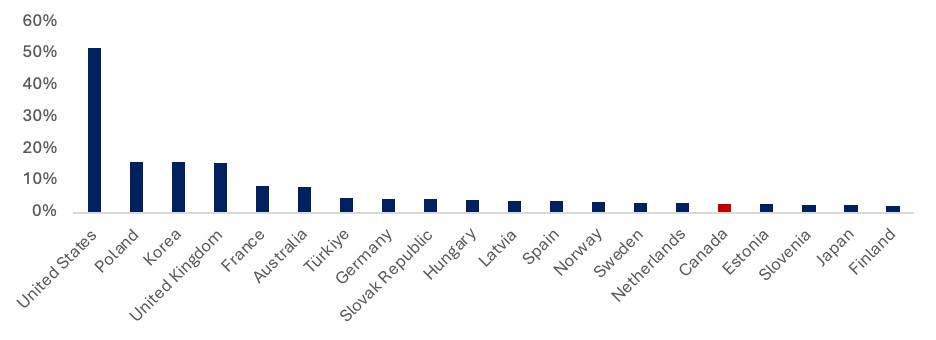
In 2024-25, defence as a socio-economic objective represented just $509 million, or roughly five percent of federal R&D expenditures.
The Department of National Defence’s (DND) R&D spending was approximately $350 million in both 2005-06 and 2023-24 – in nominal dollars – before a subsequent increase. Adjusted for inflation, this represents a decline of nearly one-third in real terms. Even with subsequent increases in 2025-26 and planned expenditures for 2026-27, real investment remains only modestly above where it stood two decades ago.
Through two decades of rapid advances in AI, autonomous systems, and advanced materials, Canada’s federal defence research investment has been anemic.
Industry presents an equally difficult picture. Defence-sector firms perform just 1.3 percent of all business R&D in Canada, compared with an estimated 6.3 percent of U.S. business R&D devoted to defence applications. They spend 2.8 percent of their revenues on R&D, compared with 12.5 percent in professional, scientific, and technical services.
Fewer than 40 percent conduct any in-house R&D, while just eight percent of defence-industry firms (those employing 500 or more people) account for 72 percent of the sector’s research expenditures. This sits within a broader Canadian weakness: business R&D intensity is among the lowest in the G7.
The longer-term trends are equally stark. Between 2014 and 2024, Canada’s defence-industry revenues grew by nearly 87 percent. Yet R&D expenditures increased by just 20 percent between 2016 and 2024 – representing a decline in real terms.
More concerning still, industry-financed R&D actually declined by 5.6 percent between 2022 and 2024, falling to $322 million, even as government R&D grants and contracts increased by 79 percent. Recent growth in defence-industry R&D has been driven by greater government support rather than increased investment from firms themselves.
Beyond the scale of investment lies another important question: who ultimately owns and controls the technologies being developed? Intellectual property is a critical dimension of sovereign capability, shaping decisions about production and commercialization, providing leverage in negotiations, and supporting access to international markets. For Canada, the challenge is not simply generating new technologies, but ensuring that more of them become the foundation for strong, globally competitive Canadian firms.
The extent of this challenge is reflected in Canada’s patent landscape. Among global patent families relevant to the DIS Sovereign Capability Areas involving at least one Canada-based inventor, only 25 percent had a Canadian-controlled organization among their applicants. While foreign-controlled firms contribute meaningfully to Canada’s innovation ecosystem, technological development undertaken by Canada-based inventors does not necessarily translate into Canadian ownership or control of the resulting intellectual property.
Figure 2: Applicant Country of Control of DIS-Relevant Patent Families (2014-2023)
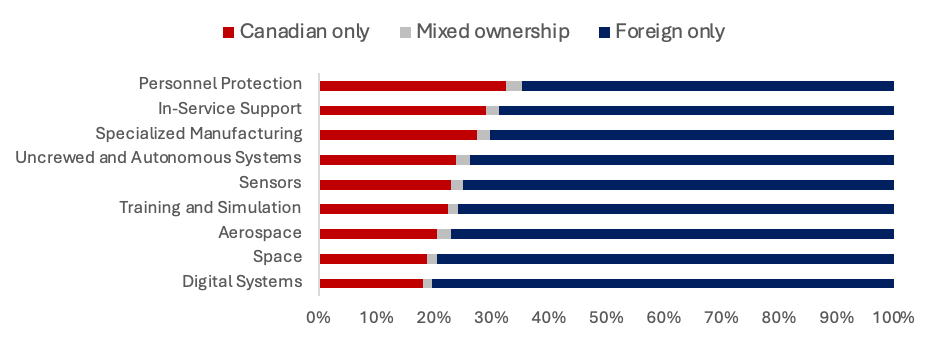
Addressing this gap will require a sustained effort to develop and scale innovative Canadian firms. That means encouraging greater private-sector investment in research and technological development, while creating the demand signals, partnerships, and pathways to commercialization that give firms the confidence and opportunity to invest, innovate, and compete internationally.
Building the domestic technological capabilities envisioned by the DIS will take time and require a more deliberate and coordinated approach to defence innovation.
The missing research connection
One of the starkest gaps lies in Canada’s limited integration of its research universities into the defence innovation ecosystem. Universities represent one of the country’s most significant assets for scientific discovery, advanced research infrastructure, and the development of highly skilled talent, yet remain relatively disconnected from defence research priorities and investment.
In 2024-25, DND directly funded just $17 million in university research, approximately 0.4 percent of federal funding for research in higher education. The U.S. Department of Defense, by contrast, funded US$10.2 billion in 2024, or 15.7 percent of federally financed university research.
Figure 3: Defence Department Funding as a Share of Total Federal R&D Funding for Higher Education, Canada and the United States (2014–2024)
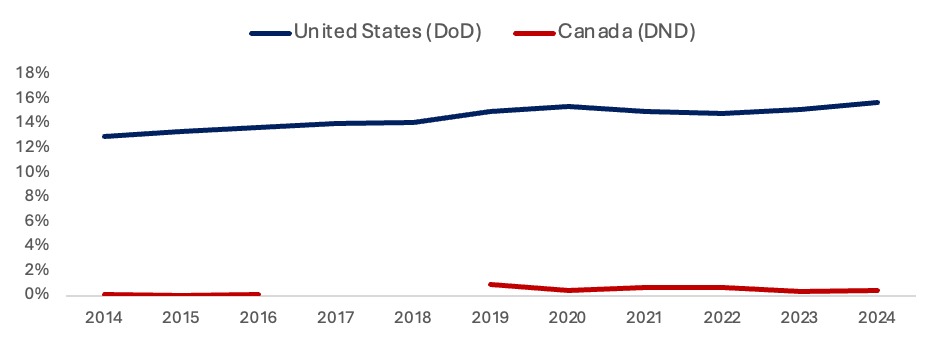
The United States has long treated academic research as integral to its defence capabilities, while the United Kingdom recently established a Defence Universities Alliance involving 35 institutions, and Australia has created a formal partnership framework encompassing every public university. While these approaches differ, they reflect a shared recognition that universities are essential to advancing scientific discovery, developing talent and building the technological foundations of future defence capabilities.
Canada has much of the scientific capacity needed to pursue a similar approach. Between 2020 and 2025, Canada’s federal granting councils supported more than 28,000 researchers in fields relevant to DIS priorities, including quantum, cybersecurity, advanced materials and AI. The challenge is connecting this existing expertise to clearly defined defence missions and creating pathways to translate research into operational capabilities.
Funding alone will not close this gap. Other NATO allies have established, or are actively building, innovation systems that mobilize research capacity and connect scientific discovery to operational requirements and industrial adoption. Canada has yet to build an equivalent architecture.
BOREALIS (Bureau of Research, Engineering and Advanced Leadership in Innovation and Science) was initially presented as a central mechanism to coordinate and accelerate defence research, with the agility, risk tolerance and innovative financing arrangements needed to move technologies from discovery to deployment. Yet its emerging structure – principally a joint program office and a network of small secure innovation hubs – falls short of that original ambition. Further work is required to realize the vision of an empowered, mission-driven defence innovation organization with substantial research funding and clear pathways into military procurement.
Canada’s challenge is not simply to coordinate existing programs more effectively. It is to build an innovation system capable of translating scientific discoveries into technological and industrial capabilities at scale.
The missing architecture matters as much as the missing money.
Turning ambition into lasting capability
The DIS commits to increasing government investment in defence R&D by 85 percent. That is an encouraging signal. Yet, according to Statistics Canada, DND’s R&D funding for higher education is projected to remain stagnant at $17 million annually through 2026-27, and a broad, sustained mechanism to fund mission-oriented university research has yet to take shape.
Greater investment in university research alone will not solve Canada’s defence innovation challenge. Translating scientific discoveries into deployable capabilities requires innovative firms, particularly Canadian-controlled companies capable of developing, commercializing, and scaling new technologies. It also requires stronger connections between researchers, industry, defence laboratories, and the military end-users who ultimately determine whether innovations are adopted.
The challenge, then, is one of building an entire innovation system, not just a few components.
The DIS represents an important opportunity to address these longstanding weaknesses, but increased spending and procurement commitments alone will not be enough. Its success will depend on whether Canada can build the connections between research, industry, and defence needed to translate new investment into lasting technological and industrial capabilities.
Ultimately, the measure of success will not simply be what Canada purchases, but whether it builds the scientific, technological, and industrial capacity to design, develop, produce, and sustain the capabilities on which its security and sovereignty depend.
That is what gives a country choices.
Notes:
[1] OECD defence R&D comparison: Figures represent defence-related government R&D budget allocations (GBARD), rather than actual expenditures. The OECD figure is an aggregate, not an unweighted average of member countries. Differences in national reporting practices and definitions may affect comparability; international comparisons should therefore be considered illustrative.
[2] Canada-U.S. business R&D comparison: Canadian and U.S. estimates use different definitions of defence-related business R&D. The Canadian figure measures R&D performed by firms identified as operating in the defence industry, while the U.S. figure measures business-performed R&D devoted to defence applications across industries.
[3] Patent ownership analysis: U15 Canada analyzed global patent families, including granted patents and pending applications, for which PATSTAT identified at least one inventor based in Canada. Patent families were assessed for relevance to the Defence Industrial Strategy’s Sovereign Capability Areas using an AI-assisted classification methodology and could be assigned to multiple capability areas, including those with dual-use applications. Personnel Protection and Ammunition were excluded due to limitations in classification accuracy. Applicants were classified as likely Canadian-controlled or foreign-controlled using record linkages and AI-assisted web-based research. These classifications are estimates and do not necessarily establish ultimate beneficial ownership or exclusive control.
[4] Canada-U.S. university R&D comparison: U.S. Department of Defense figures are drawn from the National Science Foundation’s Higher Education Research and Development Survey, Table 2, FY2014-2024. Canadian figures are drawn from Statistics Canada’s federal science and technology expenditure data. The U.S. series reflects expenditures reported by universities, while the Canadian series reflects federal departmental reporting, including expenditure intentions for future years. Comparisons should therefore be interpreted as indicative rather than fully harmonized.
[5] Canadian research capacity analysis: U15 Canada analysis of OpenAlex publication records and Tri-Agency grant databases to identify and map Canadian research activity across the sovereign capability domains identified in Canada’s Defence Industrial Strategy. Robert Asselin’s substack
See also: New federal initiatives on defence innovation will require stepped-up coordination and collaboration in today’s Innovation This Week
******************************************************************************************************************************
The financial system and other institutions need to recognize the new “modern entrepreneur” in Canada to provide adequate support
There’s a new kind of “modern entrepreneur” in Canada who doesn’t fit the traditional definition and isn’t adequately recognized or supported by the financial system including banks, according to a new report by Tangerine Bank and PwC Canada.
“Entrepreneurship has evolved, but many of the systems, products and assumptions built around it still reflect an older picture of who an entrepreneur is and what success looks like,” the report says.
“The entrepreneur has outgrown the label. It’s time for the institutions around them to catch up.”
The findings in the Modern Entrepreneur Report are based on an online survey of 552 Canadian entrepreneurs conducted by PwC on behalf of Tangerine, supplemented by qualitative interviews and economic analysis. The survey included a broad mix of industries and entrepreneurs at very different stages of their journey, from businesses less than a year old to those that have been operating for more than a decade.
Statistics Canada counted almost 5 million active business locations in Canada in June 2025: 3.59 million without employees and 1.38 million with employees.
Since 2020, the number without employees has grown by 24 percent compared with just four percent among employer businesses.
“Canada’s business landscape is not simply expanding. Its growth is being driven overwhelmingly by individuals building businesses without a traditional workforce,” the report notes.
“Technology has collapsed the distance between an idea and a global market, enabling modern entrepreneurs to tackle some of the world’s biggest challenges,” said Grace Lee Reynolds, CEO of MaRS Discovery District.
“If we want an ecosystem that serves them, it must move at the speed of innovation, not process,” she said in the report.
The report notes that for today’s modern entrepreneur, the reality is:
- A series of small steps, often beginning alongside employment or other work.
- Businesses can sit alongside other work, income and ventures, sometimes by choice.
- Small teams can pursue bigger opportunities, using technology, automation and flexible talent.
- Success can mean growth, but also freedom, control, craft and fulfillment.
- Work happens when and where it needs to, often woven through the rest of life.
- Independence is often made possible with help from other people, from family and peers to specialist expertise.
- Technology has become part of how the business operates, expanding capability while creating more choices to navigate.
- Resilience can mean knowing when to adapt, pivot or begin again.
- Confidence grows through doing, one customer, decision and small step at a time.
- Entrepreneurial possibility often exists long before success makes it obvious.
“Entrepreneurship in Canada is entering a new phase, and the role of ecosystem-builders must evolve as well,” said Doug Robertson, president and CEO of Venn Innovation Inc.
“Modern entrepreneurs need more than traditional business support. They need access to technology, talent, capital and networks that help them scale and compete globally,” he said.
Modern entrepreneurship increasingly starts with a person, the report says. A creator working from a laptop. A tradesperson moving between customers. A consultant building multiple sources of income. Someone gradually turning a side project into a livelihood.
The business may not have an office, employees or a conventional working day. Yet it creates value, carries responsibility and contributes to Canada’s economy.
Modern entrepreneurs move fluidly between the roles of strategist, finance lead, marketer, customer service representative and technology decision-maker, according to the report.
Most feel personally responsible for what happens next, and many feel they are navigating the journey alone. Yet the clearest challenge may be recognition.
While 65 percent of those surveyed feel the financial system treats their business as legitimate and 64 percent feel recognized as business owners by the people in their lives, only 50 percent feel their bank sees them as a business client.
“For many entrepreneurs, recognition comes more readily from the people around them than from the institutions designed to support them.”
Institutions need a more representative definition of entrepreneurship, one that recognizes ownership, value creation and ambition regardless of business size, employee count or stage of growth, the report says.
“Entrepreneurs do not simply need more products, tools or choices. They need to feel understood, recognized and supported with the confidence to act.”
“The modern entrepreneur is more than a business builder. They are community builders, problem-solvers and catalysts for change,” Jennifer Reynolds, CEO of NEXT Canada, said in the report. “When we create the conditions for them to succeed, we strengthen not only individual businesses, but also communities and the Canadian economy.”
The modern entrepreneur is defined less by the size, shape or stage of the business they run than by the way they build, the report says.
A broader understanding of who counts as an entrepreneur creates the conditions to intelligently support it, the report notes.
“When the person, the business and the reality around them are better understood, support can meet them where they actually are, and move with them as their needs change, rather than waiting for them to reach the point an older definition [of entrepreneur] assumes they should be at.”
“Canada needs a new generation of modern entrepreneurs. Improving access to the necessary financing and tools to start, scale and buy businesses will be critical to renewing Canada’s business dynamism and strengthening long-term productivity and competitiveness,” said Patrick Gill, vice-president, Business Data Lab, at the Canadian Chamber of Commerce. Tangerine Bank
*****************************************************************************************************************************
Data centres: Opposing them and developing them are not the only two choices
OPINION
By Jake Okechukwu Effoduh
Jake Okechukwu Effoduh is Assistant Professor, School of Law, Toronto Metropolitan University. This commentary first appeared here in The Conversation.
When a nurse in Thunder Bay opens a patient’s chart or a shopper in Halifax taps a bank card, the request travels somewhere physical – a building humming with servers, storage, network equipment, backup power and cooling systems.
Data centres are not mythical “AI factories” or innocuous warehouses, but industrial infrastructure with real appetites for electricity, water and land.
Current debate about data centres seems to offer a false binary: stop these facilities or accept them unconditionally.
There is a better option. We need to develop projects that are transparent, low-carbon, grid-responsible, respectful of Indigenous rights and that leave durable public value where they stand.
On September 3, the federal government and the Federation of Canadian Municipalities unveiled Canada’s Responsible Data Centre Development Principles, backed by 23 industry signatories. The principles say projects should:
- Create lasting local benefits.
- Avoid shifting project-driven electricity costs onto households and existing businesses.
- Minimize freshwater use and environmental impacts.
- Provide transparent, independently verifiable information on local impacts and commitments.
- Deliver lasting strategic value for Canada.
The principles are a common national framework, a baseline of expectations that complement provincial, territorial, municipal and Indigenous processes. They are not binding federal law, a permit or an approval.
These principles are a necessary start. Ottawa acknowledges that Canada relies significantly on infrastructure abroad for computing power, cloud and data storage. If we build domestic capacity, we can strengthen our resilience, keep critical services running and support innovation here.
However, location is not sovereignty. A Montréal server run by a firm subject to foreign law may still face foreign legal demands.
No two facilities are alike
A facility’s impacts depend on several things: its workload (AI or conventional); IT load (the power the computers themselves draw) and how fully it runs; cooling design; water source and local water stress; electricity mix; grid connection; backup generation and location.
Power usage effectiveness (PUE) is calculated by dividing a facility’s total energy by the energy its computers use; the theoretical ideal is one. Water usage effectiveness (WUE) counts litres of water consumed per kilowatt-hour of computing energy. Carbon usage effectiveness (CUE) does the same for emissions.
Natural Resources Canada’s best-practice guide notes that PUE ignores the useful work servers perform. It also reports that only about 22 percent of Canadian data centres report their PUE. And these ratios measure efficiency, not absolute local impact or public value. An efficient university campus, for example, can still strain a regional grid or a stressed watershed.
In Alberta, companies have requested about 19,565 megawatts (MW) of new data centre load. That is more than the province’s record hourly peak of roughly 12,800 MW. The International Energy Agency projects that global data centre electricity use will roughly double between 2025 and 2030.
Energy and water stewardship
Principles and expectations are not enforceable outcomes, however. We need to test these principles on a project-by-project basis, using data that communities, regulators and Indigenous rights holders can inspect and commitments they can enforce.
This begins with mandatory disclosure before approval. Proponents should report:
- Peak and average electricity demand, and expected load shape.
- New transmission, generation and substation needs.
- Water withdrawal and consumption by source.
- Cooling design and backup generation.
- Noise, emissions and land impacts.
We then need independent measurement, public reporting and enforceable consequences when a project deviates materially from its commitments.
Those building data centres should bear the connection, grid-upgrade and reliability costs their projects directly cause, not households or existing businesses. Clean-power rules should fit the local grid. A project should be judged against the capacity and emissions of its regional grid, not a one-size-fits-all national rule.
They should also disclose whether a company’s clean-energy claims rest on annual matching (balancing yearly totals) or hourly matching (clean supply at the time power is used). Research has found that hourly matching could substantially cut long-run system emissions in the western United States, although the cost is contested.
Water stewardship should start from basin conditions and drought planning. Cooling choices trade water against energy, so no single technology is always best. Waste-heat recovery should be assessed in contexts where a viable heat customer and infrastructure exist.
Communities must benefit
Community benefits should be enforceable and should outlast the construction of data centres. Benefits can include training, Indigenous and local procurement, research partnerships, municipal infrastructure and local access to computing power.
When a government decision could negatively affect Indigenous or treaty rights, the Crown must consult the affected Indigenous Peoples and, where needed, adjust the decision or reduce the harm. Consultation is not consent. A data centre also does not automatically trigger a federal impact assessment. Engagement should begin early and be grounded in rights.
Advocates of rapid expansion have a point. Blanket bans on data centres could forfeit economic and resilience gains, push impacts to other jurisdictions and deepen dependence on foreign infrastructure. But that argument supports conditions, not their absence. It does not excuse opaque projects, subsidized grid costs or disregard for host communities.
Canada has an opportunity to lead, if we can turn principles into proof. The question is not whether Canada should build more data centres, but what it should ask of them before they draw on public systems and local landscapes. The Conversation
*****************************************************************************************************************************
Sweden’s health care system consistently outperforms Canada’s, even though both countries spend similar amounts on their health care systems
Canada and Sweden both spend similar amounts on their respective universal health care systems, but Sweden’s system consistently outperforms Canada’s on key health care performance metrics, according to a study by the Fraser Institute.
“Canadians are increasingly aware that their health care systems are failing them, but they may not know that there are countries out there – like Sweden – that provide universal health care better,” said Yanick Labrie, Fraser Institute senior fellow and author of the study Beyond the Public-Private Divide: What Sweden Can Teach Canada About Health Care Reform.
The study shows that in 2025, Canada’s universal health care system cost 11.6 percent as a share of the economy (GDP). Sweden’s universal health care system was 11.1 per cent of GDP, so just slightly less.
But even though the systems cost similar amounts, Sweden outperforms Canada on several key measures related to wait times and access to doctors:
- Hip replacement wait times: The median wait for hip replacement surgery in Canada is 125 days, whereas it’s only 80 days in Sweden – more than a month shorter.
- Knee replacement wait times: The median wait for knee replacement surgery in Canada is 151 days, whereas it’s only 111 days in Sweden – again, more than a month shorter.
- Number of doctors: Sweden has nearly twice the number of doctors (per 1,000 people) at 4.4, compared to Canada’s 2.8
Unlike Canada, Sweden permits private health insurance within its universal system. Patients pay small fees when using a hospital and physician services, which helps to discourage unnecessary use, and allows the private sector to provide medical services within the public system including acute-care hospital services.
Nearly half (46.9 percent) of Swedish primary care centres are privately operated, while remaining fully publicly financed. Patients may change providers, funding follows patient enrolment, and providers compete on access and quality rather than price.
More than 85 percent of patients receive a medical assessment within three days when needed, and regions with a larger share of private providers generally achieve more timely access.
Private providers now perform more than 40 percent of publicly funded hip and knee replacements and over 70 percent of cataract procedures in Sweden.
Rather than displacing public activity, they expanded overall surgical capacity, the study notes.
Between 2001 and 2019, the share of cataract patients treated within 90 days increased from 36.9 percent to 88.2 percent, while median waiting times fell from 6.2 to 1.8 months.
The study examined St. Göran Hospital, Sweden’s largest privately managed acute care hospital within the universal public system. In 2024, its average inpatient treatment cost was approximately 28 percent below the Swedish average, while emergency department waiting times remained about 35 minutes shorter than expected for hospitals with similar patient volumes and case mix.
“These findings show that universal health care performance depends not only on public financing, but also on the institutional rules governing how care is organized, delivered and managed,” the study says.
“As Canadians are confronted with the reality that our health care system needs to be reformed, Sweden offers an interesting example of how a universal health care system can cost a similar amount, but provide a much better service to patients,” Labrie said.
The Alberta government, in a shift to a dual-practice health care model, now allows some surgical specialists to bill the public purse while also privately charging patients for their services. The legislation, which took effect September 1, covers such procedures as hip and knee replacements, cataract surgery and dermatology.
In June 2025, the Fraser Institute published a separate study by Labrie that explored how Switzerland successfully integrates private health care into a universal public system, and considers what Canada can learn from this model.
In Switzerland, universal coverage is delivered through a system of managed competition among 44 non-profit private insurers, while decentralized governance allows each of the 26 cantons to coordinate and oversee hospital services in ways that reflect local needs and priorities.
Nearly two-thirds of Swiss hospitals are for-profit institutions; they provide roughly half of all hospitalizations, births and hospital beds across the country.
All hospitals are treated equally – regardless of legal status – and funded through the same activity-based model, implemented nationwide in 2012.
The reform led to a significant increase in the number of cases treated without a corresponding rise in expenditures per case, suggesting improved efficiency, better use of resources, and expanded access to hospital care.
The average length of hospital stay steadily decreased over time and now stands at 4.87 days in for-profit hospitals versus 5.53 days in public ones, indicating faster patient turnover and more streamlined care pathways.
Hospital-acquired infection rates are significantly lower in private hospitals (2.7 percent) than in public hospitals (6.2 percent), a key indicator of care quality.
Case-mix severity is as high or higher in private hospitals, countering the notion that they only take on simpler or less risky cases.
Patient satisfaction is slightly higher in private hospitals (4.28/5) than in public ones (4.17/5), reflecting strong user experience across multiple dimensions.
“Canada could benefit from regulated competition between public and private providers and activity-based funding, without breaching the Canada Health Act,” the study said.
In an August 2025 commentary on the book, My Fight for Canadian Healthcare, by Dr. Brian Day, an orthopedic surgeon and founder of the Cambrie Centre in Vancouver, Labrie wrote: “Canadian health care is driven more by ideology than by evidence. The obsession with preserving a government monopoly has become an end in itself, eclipsing the system’s primary purpose: ensuring timely quality care for all.”
“In no other sphere of life would we tolerate this,” Labrie wrote. “Imagine being told you couldn’t pay for private tutoring if your child’s public school was failing him. Yet this is precisely what Canadian health care policy imposes.” Fraser Institute
*****************************************************************************************************************************
The Canada Health Act is not an obstacle to mixed medical practice
OPINION
By Michel Kelly-Gagnon
Michel Kelly-Gagnon is Founding President of the MEI (Montreal Economic Institute). This op-ed appeared here on MEI’s website.
Can doctors provide care to patients in the private sector without first having to opt out of the public plan?
Last year, the government of Alberta passed legislation to allow them to do just that, and began rolling out the initiative this June.
What’s new about Alberta’s mixed practice approach is that it allows doctors to work additional hours in a private clinic, without having to cancel their enrollment in the public health insurance plan. It is due to this prohibition that Quebecers often see headlines about doctors periodically moving back and forth between the public health care system and the private sector.
In an interview for the Toronto Star in August, federal health minister Marjorie Michel said she was “very concerned” following Alberta’s move, stating that the practice may violate the spirit of the Canada Health Act.
But the minister is mistaken, and it’s important to understand why.
First of all, the Canada Health Act does not explicitly prohibit any practices. Rather, it governs the conditions required for provincial health care systems to receive their full share of federal health funding.
Nowhere in the legislation is there mention of preventing a physician from working in both the public and private sectors. Rather, prohibitions against dual practice are imposed by provincial laws or administrative procedures.
This is clearly demonstrated by the fact that there are four provinces that have never forbidden mixed practice. Even before Alberta expressly authorized it, Manitoba, Nova Scotia, Prince Edward Island, and Newfoundland and Labrador implicitly allowed it, with no prohibition against it in their legislation. This does not prevent them from receiving the funding they are due.
In fact, if a province like Quebec decided to emulate Alberta and introduce mixed practice, it is not the federal law that would have to change, but provincial provisions. This was proved in 2003 analysis by MEI, based on a legal opinion from the firm Trudel & Johnson. Twenty-three years later, the federal laws governing this matter have not been changed.
Our study concluded that mixed practice respects the Canada Health Act insofar as the care provided in the private sector is excluded from public insurance, but remains free of charge for patients when it is provided in the government-run system. This protects its universality.
In other words, in order to respect the funding conditions stipulated in the Canada Health Act, a doctor could not simultaneously bill both the patient and the government for the same procedure. For example a patient could not go to a public hospital receiving government funding to undergo a surgery from a surgeon receiving government funding, and then pay $3,000 out of pocket in order to be treated faster than other patients. However, the patient could receive the very same surgery at a medical facility that doesn’t receive government funding and from a surgeon who, at the time of the surgery, is also not receiving any government funding for performing the specific surgery. It is dual funding that would pose a problem, not dual practice.
The question that remains is why a province should allow doctors this additional flexibility in their practice.
The answer is that it is a proven way of increasing their health care system’s treatment capacity, which means increasing the number of patients who can receive the care they need in a given period of time.
Even though mixed practice might be seen as new in Canada, it is far from being a novelty internationally. Indeed, among the six countries that ranked ahead of Canada overall in the Commonwealth Fund’s 2024 comparison, none prohibits mixed practice.
A study looking at the number of hours worked by doctors in Denmark – a country whose social-democratic values can hardly be questioned – concluded there was no statistically significant difference between the number of hours worked in public hospitals by doctors in mixed practice compared to doctors working strictly in the public sector. The same is true for their number of hours of overtime and their number of hours on call. The difference is that physicians in mixed practice add an average of 5.2 hours a week working in the private sector, on top of their hours already worked in the public system.
These five additional hours worked represent extra time spent operating, treating, diagnosing and answering patients’ questions, compared to working solely in the public sector.
The cumulative addition of extra hours worked by numerous doctors, following reforms in numerous provinces, would be a de facto equivalent of adding “new doctors” to the health care system as a whole, no matter what the naysayers will say.
Mixed practice in Alberta will help shorten waiting lists in both the public and the private sectors. Let’s hope for the sake of Canadian patients that premiers across the country take note of this measure that has been proven to work around the world. MEI
THE GRAPEVINE – News about people, institutions and communities
The University of Saskatchewan (announced that Dr. Patricia McDougall (PhD) was appointed as Provost and Vice-President, Academic for a five-year term, beginning November 1, 2026. McDougall holds an undergraduate degree in psychology from Queen's University, a Master of Applied Science degree from the University of Waterloo, and a doctoral degree in Human Learning, Development and Instruction from the University of British Columbia.
Her academic background as a developmental and educational psychologist has informed a career dedicated to advancing teaching excellence, student success and innovation in higher education. University of Saskatchewan
The Canadian Startup Capital Association (CSCA), a coalition for early-stage investors that launched this spring, named a new interim executive director. The CSCA announced in a LinkedIn post that Tara June (TJ) Misra had stepped into the executive director role. According to Misra’s bio, the Ottawa-based executive has a 15-year background in public-private partnerships for innovation ecosystems and has consulted for startups around the world. She is a co-founder of the SAIL Initiative, a non-profit organization that aims to help streamline the licensing and commercialization of publicly funded research. Misra succeeds angel investor Jesse Wiebe, who founded the CSCA in April this year. CSCA LinkedIn post
Former Microsoft executive Mikhail Parakhin is departing as chief technology officer of Ottawa-based retail technology giant Shopify after just over two years in the role. An anonymous X post was the first to indicate Parakhin’s departure. BetaKit has since confirmed with Shopify that Parakhin is leaving that position and transitioning to an advisor. Shopify did not disclose when or why Parakhin is departing, or share any other details regarding this move. Parakhin previously served as CTO of Moscow-based tech firm Yandex, and held senior executive roles at American tech giant Microsoft, including CEO of advertising and web services. BetaKit
François Carrier was named Western University’s first executive director of global engagement, effective November 9, 2026. Carrier will lead Western’s newly created Global Engagement group within the Office of the President, working closely with the provost, vice-president (research), deans and other senior leaders to advance the priorities in Western in the World, the university’s global engagement plan. Carrier brings more than 20 years of experience in higher education and expertise in international research collaborations. He currently serves as director of international research and experiential learning at the University of Ottawa, where he has developed and implemented global research collaborations, expanded institutional partnerships and created more international learning opportunities for students. Western University
Parti Québécois leader Paul St-Pierre Plamondon was sworn in as Quebec premier, naming Anne Nguyen – former head of the AI unit at the Conseil de l’innovation du Québec – as minister of artificial intelligence and digital issues. Economist Nicolas Marceau is finance minister, Chicoutimi MNA Marie‑Karlynn Laflamme, a former vice rector at the Université du Québec à Chicoutimi, is health minister and veteran MNA Joël Arseneau will take on the national education portfolio. Global News
Gillian Earle was appointed Vice-President, Communications at McMaster University, beginning October 26, 2026. Earle will lead the McMaster Communications office, which encompasses Brand and Marketing, Government Relations, and Strategic Communications. McMaster President Susan Tighe created the new vice-presidential role following an external review of the previous iteration of McMaster Communications, then called Communications, Marketing and Public Affairs. An accomplished communications leader and trusted advisor, Earle brings a distinguished record of achievement in strategic communications, reputation management, public affairs and marketing. Prior to joining McMaster, Earle held communications, marketing and public affairs leadership roles at Manulife Financial and Toronto Hydro. McMaster University
After just over three years at the helm, Hugh Chow has left as CEO of Markham, Ont.-based hard technology hub VentureLab. Chow officially left on October 16. Sep Assadian, VentureLab’s former vice-president of founder success, has since assumed the role of interim president and CEO. According to an email from Assadian that was shared internally and viewed by BetaKit, Chow is leaving the hardware and semiconductor-focused incubator for undisclosed “personal reasons.” Assadian, who has been with the hub for nearly a decade, said in a LinkedIn post that VentureLab’s board asked him to step into the position of interim CEO and president. BetaKit
Ryan St. Germaine joined Vancouver-based Raven Indigenous Capital Partners as a general partner, adding an experienced founder and former investment committee member as the Indigenous-led firm prepares for its next fundraise and continues investing through existing vehicles. St. Germaine formally took on the role after serving on the firm’s investment committee and working as an entrepreneur-in-residence. Raven invests in Indigenous-led technology companies across North America, backing startups from seed through Series A. St. Germaine is a Métis entrepreneur who has founded, led and exited technology companies. His previous ventures include BCjobs.ca and Jobcast, and he is also associated with Indigenous Tech Circle, an organization connecting Indigenous people and technology businesses. Nstartup
Carlyle Coutinho, CEO and board director of Enwave Energy Corporation, was named the 2026 Ontario Energy Association (OEA) Leader of the Year, becoming the first CEO of a dedicated district energy company to receive the honour. The recognition reflects Coutinho’s leadership in advancing innovative, large-scale energy solutions and in elevating the role district energy can play in meeting Ontario’s and Canada’s energy needs. The OEA Leader of the Year award recognizes individuals who demonstrate vision, innovation, collaboration and a strong commitment to customers. Under Coutinho's leadership, Enwave recently delivered several major projects that highlight the value of district energy in Ontario's energy system. Enwave
The self-proclaimed “King of Bay Street” and Dragon’s Den star Wes Hall, and philanthropist Patsy Anderson are supporting the Hospital for Sick Children’s (SickKids) AI program. SickKids announced on that Hall and Anderson joined forces to make a $3-million donation to the SickKids Artificial Intelligence (SKAI) program, which focuses on deploying “responsible AI” across clinical care, research, education and operations. The donation also establishes the SickKids Artificial Intelligence Innovator in Child Health award, with its inaugural recognition going to Dr. Devin Singh, the co-lead of SickKids’ SKAI Service. SickKids launched SKAI in March 2025 as a flagship initiative of the SickKids 2030 strategy. SKAI’s three major components include an in-house service to develop and support AI systems, a research arm with scientists using AI for medical discovery, and an AI literacy and knowledge-sharing component. BetaKit
Red Deer Polytechnic (RDP) received an $8-million gift from the estate of Rodney Ceccato that it will use to support its health care offerings. Half of the gift will be put towards the upcoming Healthtech Centre for Applied Learning and Innovation (HCALI). The other half will create scholarships and bursaries for nursing students through the Rodney Ceccato Memorial Nursing Endowment. In recognition of the donation, RDP will name the atrium within HCALI the Rodney Ceccato Memorial Atrium. The gift comes at a critical time for healthcare education and workforce development in the region. With the Red Deer Regional Hospital Centre expansion expected to open in 2030, an estimated 3,600 additional health care professionals will be required to support full operations. Red Deer Polytechnic
École de technologie supérieure and Ericsson Canada partnered to advance quantum computing research in Québec. With support from Mitacs’ Accelerate program, the project aims to develop better quantum computing methods that will help run and manage telecom networks more efficiently, while also training students and researchers in cutting-edge quantum technology that supports Canada's leadership in this field. The initiative will bring ÉTS Professor Jacob Biamonte and his team together with researchers from the Ericsson Quantum Program and support from Mitacs. Building on Biamonte's foundational contributions to variational quantum computing, the collaboration investigates methods to mitigate errors and improve optimization in quantum algorithms. Using quantum hardware and simulations, the team aims to advance the reliability and practical performance of quantum computation.
R$




Events For Leaders in
Science, Tech, Innovation, and Policy
Discuss and learn from those in the know at our virtual and in-person events.
See Upcoming Events
You have 0 free articles remaining.
Don't miss out - start your free trial today.
Start your FREE trial Already a member? Log in
By using this website, you agree to our use of cookies. We use cookies to provide you with a great experience and to help our website run effectively in accordance with our Privacy Policy and Terms of Service.